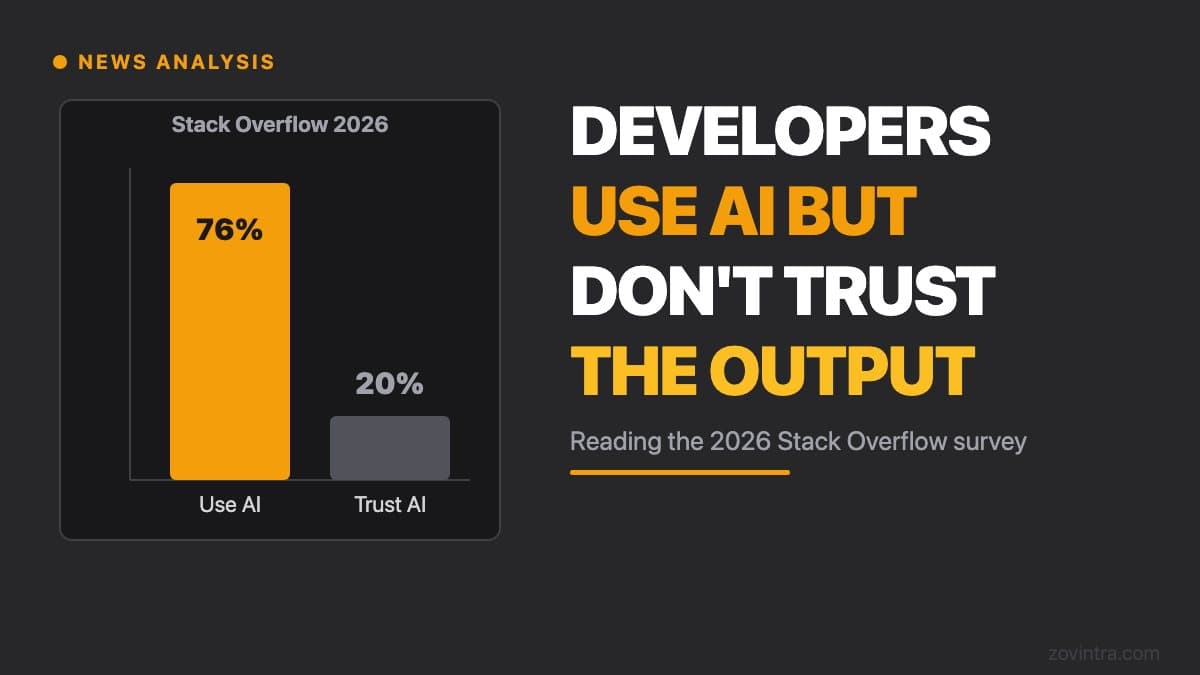
The Stack Overflow Annual Developer Survey is one of the largest regular surveys of practicing developers. The 2026 edition drew 30,903 responses from 169 countries and found that usage is heavy but trust is conditional. The adoption number is high. Unqualified trust is not.
Note on sources: figures attributed to Stack Overflow come from its 2026 survey results page. The exact 65.9%, 26.2% and employer-policy figures come only from IT Brief's report on the survey and we could not find them on the survey pages or Stack Overflow's results blog post, so treat those as secondary.
The adoption-trust gap in plain terms
Stack Overflow's results page reports that 80% of respondents used AI at least an hour per day, and that just 6.6% trust AI for many tasks including important work decisions. Its AI results page describes coding assistants and agents as the dominant AI use case at 66%. As reported by IT Brief, 65.9% of developers use coding assistants or agents, 26.2% use automated agent workflows, and only 24% say their employer has approved tools or an official AI policy.
Trust is a different question from usage, and the survey shows it is conditional: 48.0% trust AI output only when they can easily verify it, 16.3% trust it only for low-risk tasks, and 12.3% do not trust it for most work tasks. Developers use the tools while keeping a healthy skepticism about the output.
What developers do with code they do not fully trust
This is where the survey findings become practically important. When developers use AI tools while not fully trusting the output, they adopt one of three behaviours:
- Careful review: they read every line before merging, treating AI output like code from a junior developer they have not worked with before
- Selective trust: they trust AI for low-stakes, well-understood patterns (utility functions, boilerplate, test cases) but not for security-sensitive, performance-critical, or architecturally significant code
- Casual merge: they accept the output because it looks plausible, the tests pass, and the review bandwidth is low - this is the failure mode
The third behaviour produces the security and quality problems that have been independently documented in production AI-generated codebases. Automated scans versus human code audits covers what these reviews actually find. Reviewing AI pull requests provides a practical checklist for maintaining the first behaviour - careful review - without it becoming a bottleneck.
Why secondary outlets disagree on the numbers
When a survey asks developers about AI, the question phrasing matters enormously. 'Do you use AI coding tools' will get a different answer than 'do you use AI coding tools as a primary part of your workflow' and a different answer again from 'do you use AI coding tools daily.' Headline figures in media coverage often do not specify which question was asked.
Similarly, 'trust' can mean different things: trust that the code compiles, trust that it is logically correct, trust that it handles edge cases, or trust that it is secure. A developer might tick 'trust' on a general question while answering 'no' to the security-specific version. This is why secondary coverage of the Stack Overflow numbers often produces figures that seem inconsistent - they are typically drawn from different questions in the same survey.
The most reliable approach is to read the primary data directly from the survey results and note which specific questions underlie the figures being discussed. We try to do this consistently in our coverage of research - the evidence on AI coding speed applies the same approach to productivity claims.
What the trust gap means for teams using AI tools today
The fact that developers do not fully trust AI output is not a reason to stop using it. It is a reason to build review processes that match the level of trust the tool has earned in your specific context.
A team that deploys AI-generated code with the same casual review process used for senior developer code is operating above its actual trust level. A team that applies the same scrutiny to AI-generated utility functions as to AI-generated authentication logic is being inefficient in the other direction. The right answer is calibrated trust - different standards for different risk levels - which is what good engineering teams do with human code review too.
The policy gap in the numbers
The statistic that stands out from the 2026 survey is the spread between adoption and governance: per IT Brief, 65.9% of developers use AI coding tools but only 24% report employer-approved tools or a policy. That means the majority of AI-assisted development is happening outside any formal framework for review standards, acceptable use, or security guidance.
The risk is not that developers are using AI - it is that they are using it without agreed standards for how AI output should be reviewed before it ships. A developer using AI for a complex authentication flow without a review checklist may not apply the right scrutiny to a security edge case the AI handled incorrectly. This is an argument for explicit review standards, not an argument against using the tools.
What non-technical founders should take from this
If you are a founder managing a development team or evaluating work from a contractor, the adoption-trust gap has a direct implication: the fact that your team uses AI tools is not a quality guarantee or a risk indicator in either direction. The question that matters is what their review process looks like. Do they treat AI output as a starting point requiring verification, or as deliverable output?
Teams that have an answer to that question - a specific, consistent review standard for AI-generated code - are operating safely in the AI-assisted development model. Teams that do not have an answer are probably in the 'casual merge' category, regardless of how good the individual developers are. What we check when reviewing an AI-built app describes what that verification process looks like in practice.
What the trust gap looks like in code review practice
The gap between adoption and trust shows up most visibly in code review workflows. Teams that use AI coding assistants but do not trust the output fully end up in a state where review throughput needs to match code generation throughput. When it does not, a queue builds: AI-generated pull requests wait for human review, and the speed benefit disappears.
The teams that have navigated this successfully have not tried to review AI output the same way they review human output. They have adjusted what they review for. Human-written code from a senior developer gets a lighter review because the author has context and track record. AI-generated code on a security-sensitive path gets deeper scrutiny because the author has neither. This is not a higher or lower review bar across the board - it is a calibrated one, matching the review effort to the actual risk of the specific change. That calibration is what the adoption-trust gap is pointing at.
If you want to understand whether your current codebase has the kind of issues that surface when AI output is merged without structured review, request a technical review. We will look at what is actually in the codebase, not just the process that was supposed to produce it.
Common questions
How many developers trust AI coding tools according to Stack Overflow 2026?
Stack Overflow's 2026 results report that 80% of respondents used AI at least an hour per day, but just 6.6% trust AI for many tasks, including important work decisions. Usage is heavy while trust is conditional.
Why do different articles report different numbers from the same survey?
Question phrasing changes the answer, and trust can mean the code compiles, is correct, handles edge cases or is secure. Secondary coverage often draws figures from different questions in the same survey, so read the primary survey data.
How can I tell if my team reviews AI-generated code properly?
Ask what their review process looks like and whether it treats AI output as a starting point needing verification. Teams without a specific, consistent standard are probably merging casually. Zovintra offers a technical review of what is actually in the codebase.
Sources
- Stack Overflow Developer Survey 2026 - Stack Overflow, accessed 19 Oct 2026
- Stack Overflow Developer Survey 2026 - AI - Stack Overflow, accessed 19 Oct 2026
- Stack Overflow survey finds developers wary of AI tools - IT Brief, accessed 19 Oct 2026