The honest answer, as of October 2026, is that AI coding tools make some tasks faster, some workflows slower, and certain categories of work harder to measure either way. The studies that exist do not agree with each other or with the marketing claims. This article is a calibrated reading of the three most-cited sources - the DORA 2025 report, the METR productivity study, and the Stack Overflow Developer Survey - plus what those studies do not measure.
Why the Productivity Claims Diverge
Speed claims in AI tool marketing are almost always drawn from self-reported developer surveys or from narrow task benchmarks - writing a function from a spec, completing a code challenge, or producing a unit test. These are reasonable things to measure. They are not the same as measuring end-to-end team delivery, which includes requirements, code review, testing, debugging, deployment, and incident response.
The important distinction is between individual task speed and team throughput. A developer who writes code twice as fast does not deliver value twice as fast if the review process, the testing gap, or the post-deployment incident rate increases. Studies that measure only task completion time are measuring one input to a longer process.
What DORA 2025 Found
The 2025 DORA State of AI-assisted Software Development report, from Google's DORA research team, draws on survey responses from nearly 5,000 technology professionals. Its central conclusion is that AI's primary role is as an amplifier of what a team already does well or badly, and it introduces a capabilities model of seven practices meant to strengthen AI's effect on organisational performance.
Google's summary of the report says AI adoption among software professionals reached 90% and that over 80% of respondents said it boosted their productivity. Those are survey answers, not measured delivery times, so they tell you about perception rather than throughput.
The practical reading: output volume is rarely the constraint; verifying quality is.
The METR Study and Its Limits
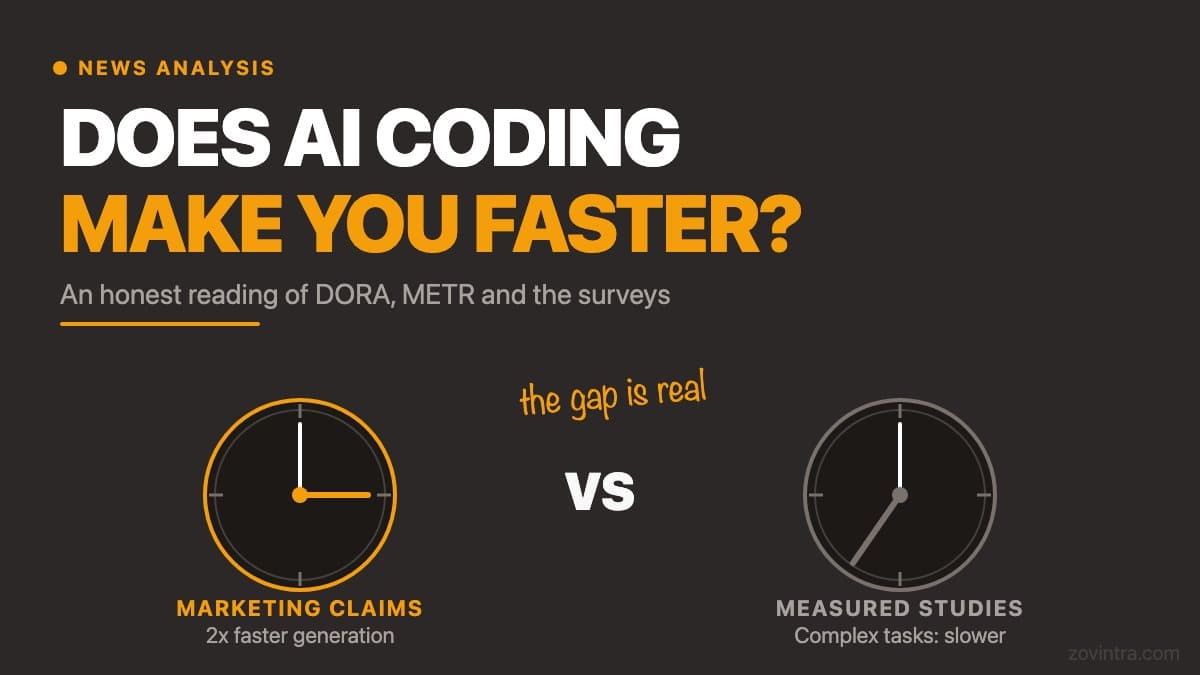
METR (Model Evaluation and Threat Research) published a study measuring the impact of AI tools on developer productivity using real tasks rather than synthetic benchmarks. In METR's 2025 trial, 16 experienced open-source developers working in their own familiar repositories took 19% longer to finish issues with AI tools, yet believed AI had sped them up by about 20%. METR now labels those results out of date, and its February 2026 update says developers are likely more sped up now but that its new data is only very weak evidence for how much.
This finding was counter-intuitive and widely discussed in 2025. It does not mean AI tools are not useful. Our reading is that they help most on boilerplate, first drafts of well-specified functions and syntax lookups, and help less where the developer is still learning the problem space, because supervising the tool competes with understanding the problem.
The same study found that developers overestimated how much time AI was saving them: they expected a 24% speedup and, after the measured slowdown, still believed they had gained about 20%. This calibration gap matters when interpreting survey results.
What the Stack Overflow Survey Shows
IT Brief's report on the Stack Overflow 2026 survey found that 65.9% of developers use coding assistants or agents, while only 24% said their employer had approved AI tools or an official AI policy. Usage is widespread, but governance lags behind it.
What the Studies Do Not Measure
The productivity studies measure speed of code production. They do not measure the downstream cost of lower-quality output. The Veracode 2026 GenAI Code Security Report, found an average security pass rate of 56 percent, essentially unchanged from the year before, meaning roughly 44 percent of tested tasks failed. Security issues found in production are generally costlier to fix than ones caught in review. If AI tools produce more code and that code has a higher defect rate, the net productivity impact depends on when those defects are caught - and most productivity studies end at merge, not at production.
The same point applies to technical debt. The MSR 2026 study of 302,600 AI-authored commits found 484,366 distinct issues, 89.3 percent of them code smells, and that 22.7 percent of the tracked issues were still present in the latest version of the repositories. Code smells are patterns that do not cause immediate failures but increase the cost of future changes. Code that is faster to write but slower to maintain produces a productivity loan, not a productivity gain. The repayment happens in future sprints.
How We Use AI Tools in Practice
We use AI coding tools as a generation assist, not as an autonomous output channel. Every AI-generated change goes through review against security, access control, and maintainability criteria before merge. The workflow is described in more detail in how Zovintra builds with AI and human review. The result is that AI tools give us speed on the generation step, and the review process gives us confidence in the output.
The gain we see in our own work is real but narrower than the marketing claims: faster first drafts of well-specified components, faster boilerplate, faster documentation. It is not a multiplier on team output. Teams that expect a multiplier and reduce review standards to achieve it are taking on a debt that shows up in production.
What This Means for Your Team
If you are evaluating AI coding tools for your team, the most useful question is not "will this make us faster?" It is "what is our current bottleneck?" If the bottleneck is generation speed, AI tools help. If the bottleneck is review, testing, or deployment, adding more generation speed increases the backlog at the real bottleneck.
The second useful question is "what will we check?" AI tools produce output that requires different review criteria than human-written code - more attention to access control assumptions, dependency validity, and test coverage of negative cases. Teams that invest in review process alongside tool adoption will see better outcomes than teams that adopt tools alone.
For a practical guide to evaluating AI tools before adopting them, our article on AI coding tools for non-technical founders covers what to ask and what to watch for. If you want a technical view on how AI-assisted development is changing the practice of software delivery, the context on what AI-assisted development changes goes deeper on the structural shifts.
If you want help evaluating whether your team's current AI tooling and review practices are calibrated correctly, a technical review from Zovintra can give you an independent perspective.
Common questions
Do AI coding tools actually make developers faster?
It depends on the task. In METR's 2025 trial, 16 experienced open-source developers took 19% longer with AI tools yet believed AI had sped them up by about 20%. METR now labels those results out of date, and its February 2026 update says developers are likely more sped up now.
Does AI-generated code have more security problems?
The Veracode 2026 GenAI Code Security Report found an average security pass rate of 56 percent, essentially unchanged from the year before, meaning roughly 44 percent of tested tasks failed. Most productivity studies end at merge, so they do not capture the downstream cost of defects.
Should I get an outside review of how my team uses AI coding tools?
Ask what your current bottleneck is and what you will check in AI-generated output, such as access control assumptions, dependency validity and negative-case tests. If you want an independent view on whether your tooling and review practices are calibrated correctly, Zovintra offers a technical review.
Sources
- DORA 2025 State of AI-assisted Software Development - Google Research, 2025
- Inside our 2025 DORA report - Google, 23 Sep 2025
- METR: early-2025 developer study - METR, 10 Jul 2025
- METR: experiment design update - METR, 24 Feb 2026
- Stack Overflow survey coverage - IT Brief, 7 Oct 2026
- Veracode 2026 GenAI Code Security Report - Veracode, 28 Jul 2026
- Debt Behind the AI Boom - arXiv, 2026