“AI will build you a very convincing prototype. Whether it's a product is a different question entirely.”
The distinction that costs founders six monthsThe Demo Is Not the Product
Every founder who has used a modern AI coding tool has experienced the same moment: you describe what you want, and within minutes there's a working app on your screen. It looks real. It behaves like real software. You can click buttons, fill in forms, and see data appear. This is genuinely remarkable and it has real value - but it is a prototype, not a product, and confusing the two is one of the most expensive mistakes an early-stage founder can make.
The difference is not visible from the outside. A prototype and a production product can look identical in a browser. The gap is in what happens when 500 users sign up, when your payment processor sends a webhook, when a user uploads a file that's 400MB instead of 4MB, when your database query runs on 100,000 rows instead of 50. AI tools optimise for getting something on screen quickly. Production software is engineered for the cases that don't show up in demos.
What AI Build Tools Genuinely Do Well
Being honest about AI's strengths matters as much as being honest about its limits. These tools have made real things possible that weren't before. For validation, they're exceptional: you can test an idea with real users in days rather than months. If your hypothesis is wrong, you find out before you've spent six figures on development.
UI generation is another genuine strength. Tools like v0 and Lovable produce clean, modern interfaces that would have taken a frontend developer days to build from scratch. For internal tools - dashboards, admin panels, reporting interfaces used by your own team - AI-built software is often entirely appropriate. The stakes are lower, the user base is known, and the failure mode is manageable.
- Idea validation prototypes - get user feedback before committing to a full build
- Investor demos - show the vision without a six-figure engineering investment
- Internal tools - dashboards and admin panels your own team uses
- Static or content-heavy marketing sites - no dynamic backend complexity
- Simple CRUD applications with a small, trusted user base
- Rapid UI mockups that a developer can then implement properly
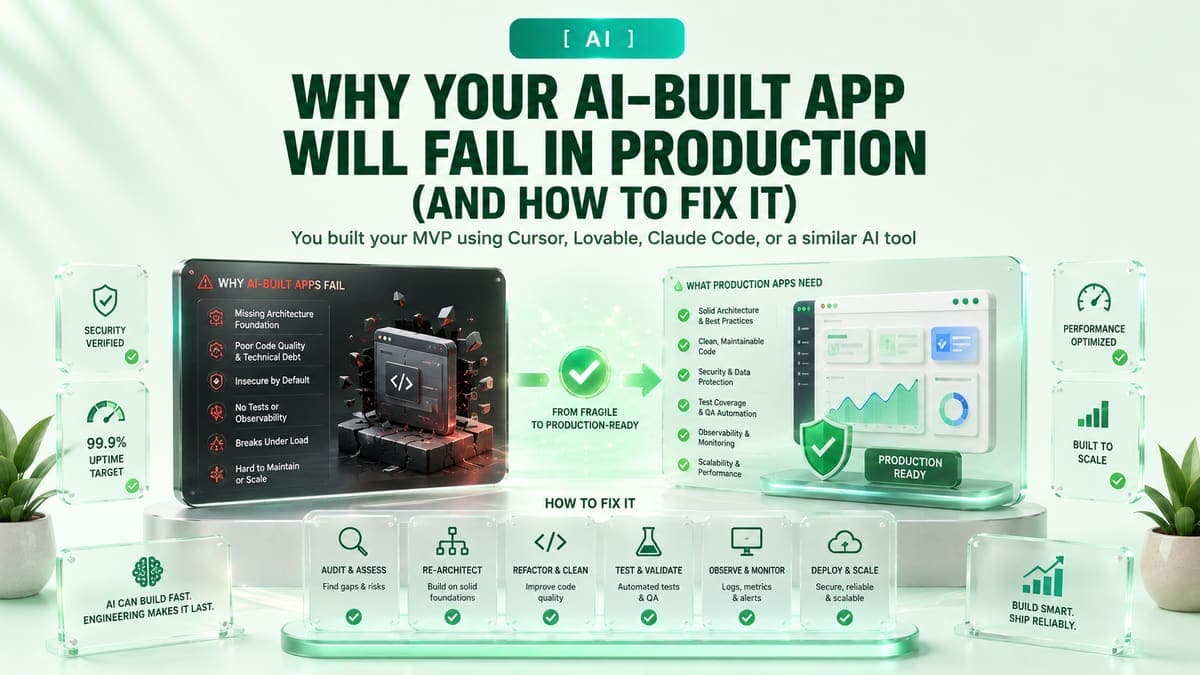
Where AI-Built Code Breaks Down
The breakdowns are predictable once you know what to look for. Authentication is the first major fault line. AI tools generate auth flows that look correct - sign up, log in, reset password - but frequently have subtle security flaws. Session tokens stored insecurely, password reset tokens that don't expire, missing rate limiting on login endpoints. These vulnerabilities are invisible to a non-technical founder and won't show up until you're breached.
Data integrity is the second. Relational data is hard. When a user deletes an account, what happens to their associated records? When two users edit the same resource simultaneously, which change wins? AI-generated code almost always ignores these edge cases because they don't show up in a happy-path demo. In production, they cause data corruption that's expensive to clean up and sometimes impossible to reverse.
The Scaling Problem Nobody Talks About
AI tools generate code that works at demo scale. They almost never generate code that works at production scale. The most common pattern we see at Zovintra is an application that performs acceptably with 100 records in the database that becomes unusable with 10,000. The underlying cause is almost always missing database indexes, N+1 query problems, or missing pagination - all things that an AI tool doesn't naturally produce because the demo never surfaced the issue.
Performance problems feel fixable in isolation but are often architectural. Adding an index helps a specific slow query but doesn't address a data model that was never designed for the access patterns of a real application. By the time a founder notices the performance problem, the codebase may need significant restructuring to fix it properly. This is the quiet cost of deferring the architecture conversation.
Week 1 to 2
AI tool build: validate the concept, get it in front of real users, gather feedback.
Week 3 to 4
Decision point: is the idea worth building properly? If yes, bring in a developer for an architecture review.
Month 2
Professional rebuild or rescue: proper data model, auth, security review, and test coverage.
Month 3
Staged launch: beta with real users, monitoring, error tracking, and a process for handling issues.
Month 4 onward
Iterate with confidence: a maintainable codebase that a team can extend without breaking existing features.
The Integrations That Require Real Engineering
Certain integrations have enough complexity and risk that they should not be handled by AI-generated code in a production application. Payments are the clearest example. Stripe's API is well-documented and AI tools can generate Stripe integration code - but correct Stripe integration requires server-side webhook validation, idempotency handling, subscription state management, and proper error handling for card declines. A flawed Stripe integration results in users being charged incorrectly, subscriptions not cancelling, or - worse - webhooks being forged.
Third-party APIs with rate limits, OAuth flows with token refresh logic, real-time features using WebSockets, background job queues, and multi-tenancy are all in the same category. The code AI generates for these scenarios often works in the happy path and fails silently in edge cases. Silent failures in payment or auth code are not acceptable in a product with real users.
Knowing When to Hand Off
The signal that it's time to hand off from an AI tool to a professional is usually one of four things: you're getting user complaints that feel like bugs you can't reproduce, a developer you consulted told you the code quality makes them uncomfortable, you need to integrate something that carries real financial or security risk, or you're about to spend money on marketing to drive traffic to something you're not confident will hold up.
None of this means AI tools wasted your time. A validated prototype built in Lovable in two weeks is a far better starting point than a blank page. The mistake is not using the tool - it's continuing past the point where the tool was the right instrument for the job.
Zovintra builds and rescues exactly these projects. If you've used an AI tool to get to a working prototype and you now need someone to take it to production - with proper architecture, security, integrations, and the ability to scale - our Launch & Rescue service is the bridge. We assess your existing build honestly and tell you what's worth keeping. Reach out at /contact for a free review.