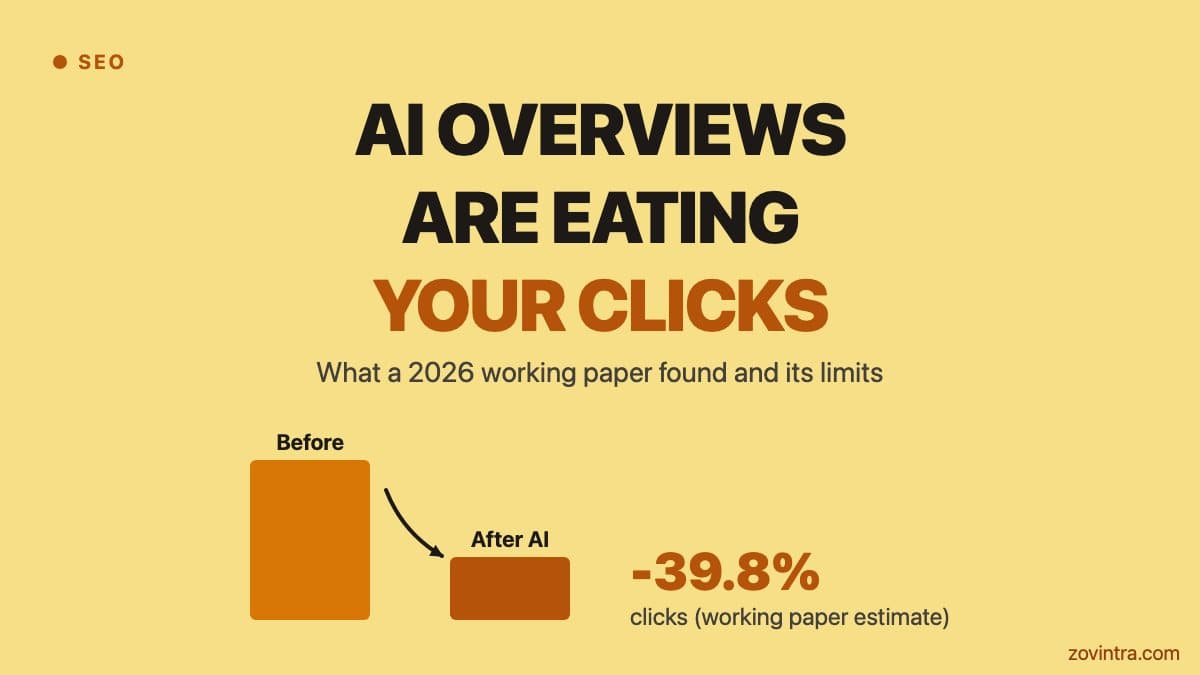
A working paper by Saharsh Agarwal (Indian School of Business) and Ananya Sen (Carnegie Mellon University) estimated that Google AI Overviews reduce organic outbound clicks by roughly 39.8 percent when an AI Overview is shown. That number is circulating widely in SEO discussions as of late 2026. Before adjusting strategy around it, it is worth understanding exactly what the paper measured, what it could not measure, and how preliminary its findings are.
What the Working Paper Actually Measured
The paper was posted to SSRN in April 2026 and revised in June 2026. According to PPC Land's summary, it is a randomized field experiment: 1,065 US participants on desktop Chrome, recruited through Prolific, used a browser extension that either showed AI Overviews as normal or hid them. AI Overviews appeared on roughly 41 percent of queries. On queries where an Overview would have appeared, hiding it raised outbound organic clicks per search from 0.37 to 0.62, and zero-click searches rose by 34.5 percent when Overviews were shown. The April version of the paper reported 38 percent; the revised version reports 39.8 percent.
Important context: this is a working paper, not a peer-reviewed journal publication. Working papers are preliminary research that has not yet completed peer review, which means the methodology, sample, and conclusions may change before formal publication. The 39.8 percent figure should be treated as an early estimate, not a confirmed industry baseline. I could not open the SSRN page itself, so the details above come from Search Engine Journal's report and PPC Land; read the paper before citing the number in strategy documents.
What the Paper Cannot Tell You
The working paper has several limitations worth naming clearly, some stated by its authors and some inherent to the design.
- It measures the presence of an AI Overview, not its quality or relevance. A high-quality, fully sourced AI Overview that satisfies the query is different from a partial one that leaves the user needing more, and one headline number blends them.
- Query types behave differently. Per Search Engine Journal, the losses were concentrated in informational queries, while navigational and transactional queries showed no measurable change, with smaller samples in those categories. A 39.8 percent average may not represent any single category accurately.
- It reports outbound organic clicks in the experiment; it does not tell you about traffic from other routes, such as citations inside the Overview itself.
- Google's AI Overview rollout is not static. The share of queries that trigger an AI Overview, the categories covered, and the format of citations have all changed since the feature launched, which means any snapshot measurement ages quickly.
- The sample is US-based desktop Chrome users recruited through an online panel, which limits how far the result generalises to mobile users, other countries, or your own audience.
The Zero-Click Trend Predates AI Overviews
It would be a mistake to treat AI Overviews as the beginning of the zero-click problem. Structured data, featured snippets, knowledge panels, and local packs have been reducing clicks on certain query types for years. Earlier industry studies of search behaviour (for example by SparkToro) already pointed to a large share of Google searches ending without a click. AI Overviews accelerate and extend a pattern that has been building for a long time. The practical response is the same as it has been: show up in AI Overviews rather than hoping to avoid them, and diversify the channels through which potential customers find you.
How to Think About Your Own Exposure
Not every site or query type is equally exposed. Informational queries on topics where a short AI-generated answer satisfies the reader are the most vulnerable. Queries with high commercial or transactional intent - where the user needs to compare, validate, or commit - are less well served by a generic AI Overview and more likely to result in a click. Queries that require local knowledge, specific pricing, recent events, or a trusted brand are also partially shielded.
The practical step is to segment your keyword set by intent and check which of your target queries currently trigger AI Overviews in Google Search. For queries where an AI Overview appears, look at whether your content is being cited inside the Overview or whether a competitor is being cited instead. The relationship between GEO and traditional SEO is becoming increasingly important to understand as AI-generated summaries become the first thing many users read.
The Response: Plan for Citation, Not Just Clicks
Being cited inside an AI Overview creates a different kind of visibility than a traditional organic click. The citation associates your brand or site with the authoritative answer to a query, even when the user does not click through. For brands with longer sales cycles or repeat-visit dynamics, being cited in AI Overviews is a form of trust-building that has value beyond the immediate session.
There is no published formula for being cited. As general practice, these are sensible factors: content that directly and clearly answers a specific question, well-structured pages with clear headings that match the question pattern, factual claims that are easy for a language model to verify against other sources, and content that is already trusted enough to rank in the top few organic positions. None of this is different from what good SEO has always required - the distribution channel is changing, but the underlying signal of useful, well-structured content remains the input.
What Publishers Should Watch For
The more important empirical question is not the aggregate click reduction but how it distributes across publishers. If AI Overviews draw disproportionately from a small set of highly-cited sources, the effect on smaller publishers could be significantly worse than the average figure suggests. Conversely, if citation is broadly distributed, new entrants with tightly focused, high-quality content may find citation opportunities that would have been harder to achieve through traditional ranking competition.
The working paper does not resolve this distribution question. Publishers should monitor their own Search Console click and impression data, and check manually which of their queries show AI Overviews and who is cited. Watching your own data over six months will tell you more about your actual exposure than any aggregate industry estimate.
A Balanced Reading of the Research
This working paper is a meaningful data point. A 39.8 percent reduction in outbound clicks for AI-Overview-triggered queries, if confirmed by peer review, would be a significant finding that affects how publishers and marketers think about organic search investment. However, acting on a single preliminary working paper as though it were a settled fact would be premature. The appropriate response is to take the directional signal seriously - AI Overviews appear to reduce click-through rates on the queries they appear for - while waiting for peer-reviewed confirmation of the magnitude and distribution before making large structural changes to content investment.
In the meantime, the technical SEO fundamentals that help pages rank are the same ones that improve citation probability in AI Overviews. Improving your structured data, page speed, and content clarity is not wasted work regardless of how the search results page evolves.
If you want to understand how your current content and site structure sits relative to AI Overview citation patterns, a technical SEO review can identify the gaps. Request a technical SEO review from Zovintra and we will map your exposure and the concrete steps available to you.
Common questions
How many clicks do Google AI Overviews take from websites?
A working paper by Agarwal and Sen estimated that AI Overviews reduce organic outbound clicks by roughly 39.8 percent when shown. It is a preliminary working paper, not peer-reviewed, so treat the figure as an early estimate rather than a confirmed industry baseline.
Should I change my SEO strategy because of AI Overviews?
Take the directional signal seriously, but avoid large structural changes based on one preliminary paper. Check your own Search Console click and impression data, see which of your queries show AI Overviews and who is cited, and keep investing in technical SEO fundamentals and clear content.
Who can review how exposed my site is to AI Overviews?
Segment your keywords by intent and check which target queries trigger AI Overviews and whether you or a competitor is cited. A technical SEO review can identify the gaps, and Zovintra offers one that maps your exposure and the concrete steps available.
Sources
- Google AI Overviews Study Finds Lost Clicks Weren't Lower Quality - Search Engine Journal, accessed 19 Oct 2026
- AI Overviews cut publisher clicks 39.8% in first randomized study - PPC Land, accessed 19 Oct 2026