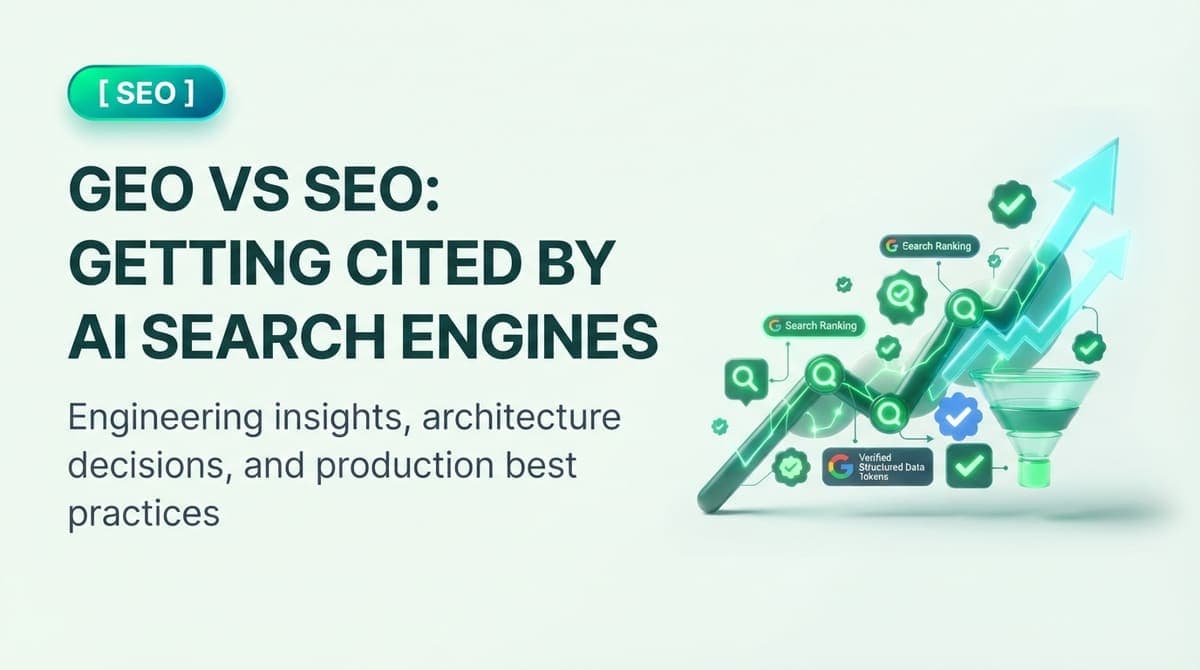
“SEO was about ranking. GEO is about being quoted. The skills overlap, but the scoring system has changed.”
Why your existing content strategy may be failing silentlyTwo Different Games
Search Engine Optimisation and Generative Engine Optimisation both want the same end result: your content visible to people who need it. But the mechanics are different enough that a strategy built for one will underperform on the other. Understanding where they overlap and where they diverge is not an academic exercise - it's the difference between your content getting cited in AI answers or being invisible to the growing share of users who now get answers from Google AI Overviews, ChatGPT, and Perplexity without clicking a link.
Classic SEO optimises for a ranking algorithm. You build domain authority, target keywords with intent, earn backlinks, and ensure technical health so Googlebot can crawl your pages. The output is a position on a search results page and a potential click. GEO optimises for a language model that synthesises content from multiple sources into a single answer. The output is being quoted - or not - in that synthesis. The click is secondary; the citation is the win.
Where SEO and GEO Agree
The foundations of GEO are not exotic. Fast-loading, mobile-responsive, server-side-rendered pages with strong technical health perform well in both systems. Authoritative content - well-researched, factually accurate, specific rather than vague - ranks in traditional search and gets cited in AI answers for the same reason: it's trustworthy. E-E-A-T (Experience, Expertise, Authoritativeness, Trustworthiness) was a Google search quality signal before GEO existed; it's now arguably more important.
Backlinks still matter. AI models cross-reference entities - your company, your authors, your claimed expertise - across sources they've indexed. A strong backlink profile signals authority to both Googlebot and to the language models that crawl the web for training and retrieval. Building a credible web presence with legitimate third-party mentions helps your GEO just as it helps your SEO.
Where GEO Requires Different Thinking
The biggest divergence is at the content structure level. Traditional SEO rewarded long, comprehensive articles that covered a topic thoroughly - pillar pages, content clusters, 3,000-word guides. GEO rewards passage-level clarity. A language model extracting an answer doesn't read your whole article; it finds the paragraph that most directly answers the query it's processing. If that paragraph requires the reader to have read the three paragraphs before it, the model won't extract it confidently.
This changes how you should write section introductions. In traditional SEO, it's acceptable to set context before delivering the point. In GEO, each section's first sentence should function as a standalone statement that answers the section heading as a question. "Row-level security in Supabase restricts which database rows each user can read, preventing one user from accessing another user's data" is a citable passage. "In this section we will explore security considerations" is not.
Schema Markup: Where GEO Outweighs Classic SEO
Structured data was always a nice-to-have in traditional SEO - it could earn rich snippets and improve click-through rates, but most pages ranked fine without it. For GEO, it's closer to mandatory. Language models use schema markup to verify entity relationships: who wrote this, when, what organisation published it, what is it about, and what specific questions does it answer. Without schema, a model has to infer these relationships from prose, which introduces uncertainty.
The schemas with the most direct GEO impact are FAQPage and HowTo for content pages, Article and BlogPosting with full author and publisher data, and Organisation with sameAs references pointing to your verified profiles on LinkedIn, Google Business, and Crunchbase. If your site has these in place and your competitor's doesn't, you have a structural advantage in AI citation that persists regardless of keyword rankings.
Brand Mentions and Entity Authority
Traditional SEO measures links. GEO measures entity associations. If your brand name appears in technology publications discussing a topic you want to be cited for, language models learn to associate your brand with that topic. This happens whether or not the publication links to you. An unlinked brand mention in a credible outlet contributes to your entity authority in a way that would have been invisible in a pure link-counting SEO model.
This gives PR and thought leadership a direct, measurable SEO equivalent for the first time. Contributing a guest article to a relevant industry publication, being quoted as a source in a journalist's piece, or being mentioned in a well-indexed podcast transcript - all of these now contribute to the entity graph that AI models use to decide who to cite. It's not just content on your own site that shapes your GEO visibility.
- Guest articles in publications your audience already trusts and that AI systems index
- Podcast interviews with show notes that include your name, company, and topic keywords
- Industry directory listings (Clutch, G2, Capterra) with consistent brand information
- Forum contributions on Stack Overflow, Reddit, or niche communities - these are indexed
- Press coverage with your company named in context of your core services
- LinkedIn articles by named authors associated with your organisation
The Technical GEO Checklist
Most sites that want to improve AI citation have a short list of concrete technical changes to make. Server-side rendering is the first: if your content isn't in the HTML that a crawler receives before JavaScript runs, most AI crawlers won't see it. This is a common gap for React or Vue SPAs that don't use SSR. A static site or a Next.js app with server-side rendering is the baseline.
After SSR, the next highest-value changes are: adding FAQPage schema to any Q&A content, rewriting section intros to lead with the answer rather than context, publishing an llms.txt file that lists your canonical authoritative pages, and adding an Organisation schema block with sameAs references to all your verified external profiles. These changes can be implemented in a focused two to three day sprint and have a measurable impact on citation rates within four to six weeks.
Measuring GEO Performance
Traditional SEO metrics - rankings, organic traffic, click-through rate - only partially capture GEO performance. You can be cited heavily in AI Overviews on queries where you rank third or fourth in organic results, meaning you're gaining brand visibility without gaining clicks. This is a new category of value that most analytics setups don't track by default.
The most practical measurement approach right now is a combination of: manual spot-checking your target queries in Google, Perplexity, and ChatGPT once a month; tracking branded search volume in Google Search Console (citations drive branded queries); and using a tool like Semrush's AI Overview tracker or BrightEdge to get systematic coverage data. Establish a baseline before you make changes so you can attribute impact correctly.
GEO is not a replacement for SEO - it's an extension of it that rewards the same disciplines (authority, accuracy, technical health) while adding new requirements around passage-level clarity, schema completeness, and off-site entity presence. If your team is stretched across both or you're not sure where your site stands on either front, Zovintra's SEO practice covers full GEO audits and implementation. We handle the technical and content work end-to-end so you're visible in both traditional and AI search. Book a free audit at /contact.