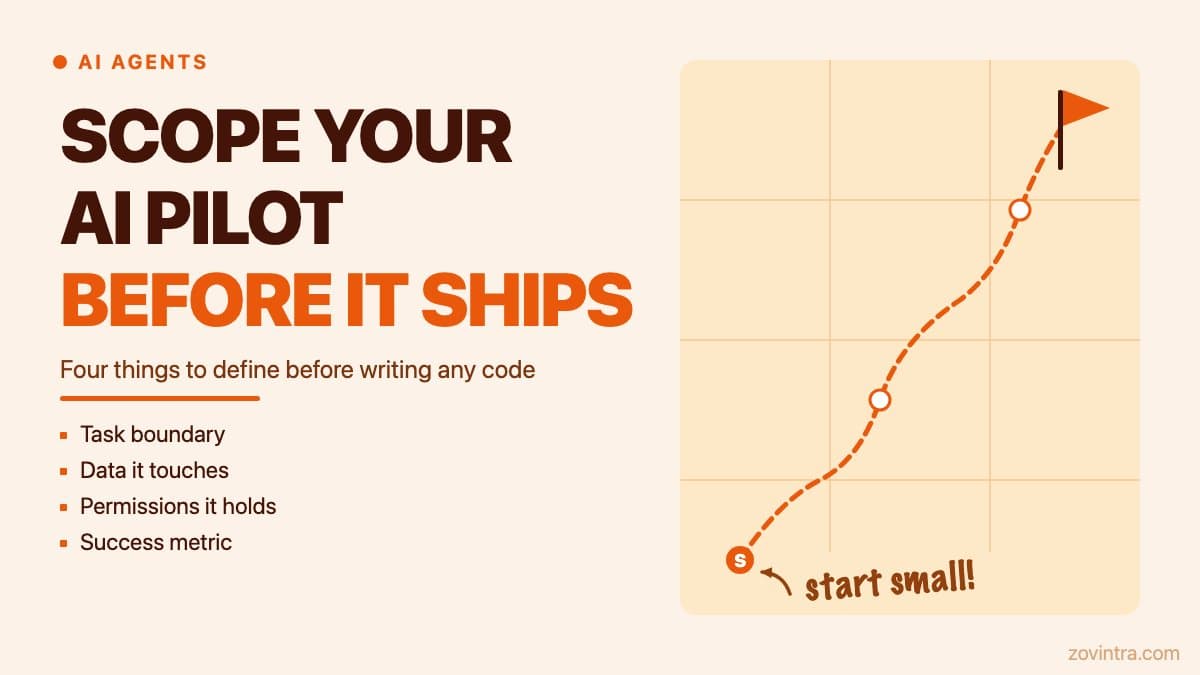
A first AI agent pilot for a small business should answer one question before it touches any code: is this task narrow enough that a failed run causes no real damage? If you cannot answer yes confidently, the scope is too wide. The four things to define before you start are the task boundary, the data the agent will touch, the permissions it will hold, and the metric you will use to call it a success or a failure.
Why Most Small Business AI Agent Projects Stall
The businesses that end up rescuing a failed AI project usually ran into the same pattern: the pilot started as "automate our customer support" and quietly expanded into email routing, CRM updates, escalation logic, and eventually payment processing. Nobody said the scope changed - it drifted. When something broke, nobody knew which part to debug.
The other common failure is skipping the success metric entirely. The business runs the agent for three weeks, gets mixed results, and cannot tell whether to expand it, fix it, or bin it. Without a measurable bar set in advance - response time, error rate, cost per task - you are flying blind.
AI agents are also expensive to misuse. A task that takes a human two minutes and costs nothing can cost dollars per run when delegated to an LLM, especially if the agent retries on errors or calls multiple tools. Realistic running cost estimates belong in the scoping document before a single line of code is written.
The Four-Part Scoping Frame
1. Task boundary
Write the task in a single sentence using the format: "The agent reads X, decides Y, and writes Z." If you need more than one sentence, you have more than one task. A good first pilot task: "The agent reads incoming support emails tagged 'order status', looks up the order in the database, and replies with the current status." A bad first pilot task: "The agent handles customer support."
The single-sentence test also forces you to identify the inputs and outputs. An agent that reads structured data (a database row, a spreadsheet cell, an API response with a known schema) is far more predictable than one that reads free-form text and must infer structure. Start with structured inputs.
2. Data the agent will touch
List every table, file, API endpoint, or external service the agent will read or write. Then ask: what is the worst thing that happens if the agent writes incorrect data here? For a read-only lookup, the answer is a wrong reply to one customer. For a write to a payment table, the answer is a billing error at scale. Pilot tasks should be read-heavy and write-minimal, with any writes going to a staging record or a log rather than a live production table.
This step also surfaces data residency questions. Customer emails, order records, and contact details may be subject to privacy rules. Before an agent reads them, confirm that the LLM provider's data handling terms are compatible with your obligations. This is a legal and compliance question, not a technical one - get it answered before the pilot starts.
3. Permissions it will hold
Every permission you give an agent is a potential blast radius. The checklist for what access to grant an AI agent is worth reading before you set up any credentials. The short version: grant only the permissions the agent needs for the specific task, use a dedicated service account with no extra roles, and never hand a production admin token to a pilot running in a test environment.
A pilot should not hold persistent permissions at all if you can avoid it. Rate-limited, short-lived tokens that expire after each run are harder to set up but dramatically reduce the cost of a misconfigured agent. The PocketOS incident in April 2026 is the cautionary example: according to the OECD AI incident entry, a coding agent running Claude Opus 4.6 through Cursor deleted the company's production database and its backups in nine seconds, causing an outage of about 30 hours. Blame for that incident is disputed, but the lesson on access scope applies either way.
4. Success metric
Pick one measurable outcome and set a threshold before the pilot runs. Good examples: "At least 90% of replies are accurate with no manual correction for two weeks"; "Cost per task stays below $0.05"; "The agent handles 50 tasks per day with fewer than 3 escalations." Bad example: "The team feels it is saving time."
The metric tells you when to stop evaluating and make a decision. Without it, pilots run indefinitely, accumulate costs, and never produce a clear signal. If your chosen metric is hard to measure with the tools you have, that is a sign you need logging and observability in place before the pilot starts - not after.
What a Pilot Is Not
A pilot is not a proof of concept built by a vendor who wants to sell you the full implementation. It is a controlled experiment with a short time window (two to four weeks is reasonable) and a clear exit. At the end, you should be able to say: the agent met the metric, costs were acceptable, no data issues arose, and we want to expand - or one of those conditions failed and we need to rethink.
A pilot is also not a permanent workaround. If the pilot succeeds, the next question is whether it can survive a code audit, a security review, and proper error handling before it becomes part of your production workflow. Pilots that skip that gate tend to drift into production quietly and create exactly the kind of fragile, undocumented dependency that causes expensive rescues later.
Tasks That Tend to Work Well in a First Pilot
- Classifying or tagging inbound data (emails, form submissions, support tickets) into a fixed set of categories
- Drafting templated responses for a human to review and send, rather than sending autonomously
- Summarising a structured document (a meeting transcript with known sections, a fixed-format report) into bullet points
- Looking up a record and returning a formatted answer to a known query type
- Routing an item to the right human queue based on a keyword or category rule
Tasks That Are Too Risky for a First Pilot
- Anything that writes to a live payment system, billing record, or financial ledger
- Sending customer-facing communications autonomously without human review
- Making access control decisions (who can see what, who gets approved)
- Tasks that involve personal data where you have not confirmed the LLM provider's data processing terms
- Workflows where one error compounds into multiple downstream errors before a human can intervene
How to Evaluate the Results Honestly
Use a simple spreadsheet: log each task the agent handled, mark it correct or incorrect, note the cost, and record any errors. At the end of the pilot window, calculate the accuracy rate and the total cost. Compare both against your pre-set thresholds. If the accuracy is below threshold, review the errors - are they clustered around a specific input pattern, or are they random? Clustered errors often have a fix; random errors usually signal that the task is too open-ended for an agent to handle reliably.
A basic eval framework does not require an ML team. Running AI evals without specialist resource covers practical approaches that any technical founder can implement with a few hours of work.
When to Bring in Outside Help
If you are unsure whether a task is a good candidate for an agent, if the permissions question is complicated by existing infrastructure, or if you want a second opinion on the scoping document before committing budget - that is the right time to ask someone with relevant experience. Getting the scope wrong is the most expensive mistake in an AI project, and it is also the easiest to make at the beginning when everything seems straightforward.
If you have a task in mind and want a candid view on whether it is a good pilot candidate, book a scoped AI feature review. We will tell you directly if the scope needs narrowing before it is worth building.
Common questions
How do I scope a first AI agent pilot for a small business?
Define four things before any code: the task boundary, the data the agent will touch, the permissions it will hold, and the success metric. Write the task in one sentence: the agent reads X, decides Y, and writes Z. If it needs more than one sentence, it is more than one task.
What tasks are safe for a first AI agent pilot?
Tasks that tend to work well include classifying inbound emails or tickets into fixed categories, drafting templated replies for a human to review, summarising fixed-format documents, and looking up a record to answer a known query. Avoid anything that writes to payment systems or sends customer messages without review.
When should I bring in outside help for an AI agent pilot?
Ask for help if you are unsure whether a task suits an agent, if the permissions question is complicated by existing infrastructure, or if you want a second opinion on the scope before committing budget. Zovintra offers a scoped AI feature review and will say directly if the scope needs narrowing.
Sources
- AI coding agent deletes PocketOS production database and backups - OECD.AI Incident Monitor, entry dated 27 Apr 2026