“Your tech stack is a long-term commitment. Most founders spend 30 minutes choosing it and the next 3 years living with that decision.”
The choice that shapes every hire, every feature, and every outageWhat Is a Tech Stack?
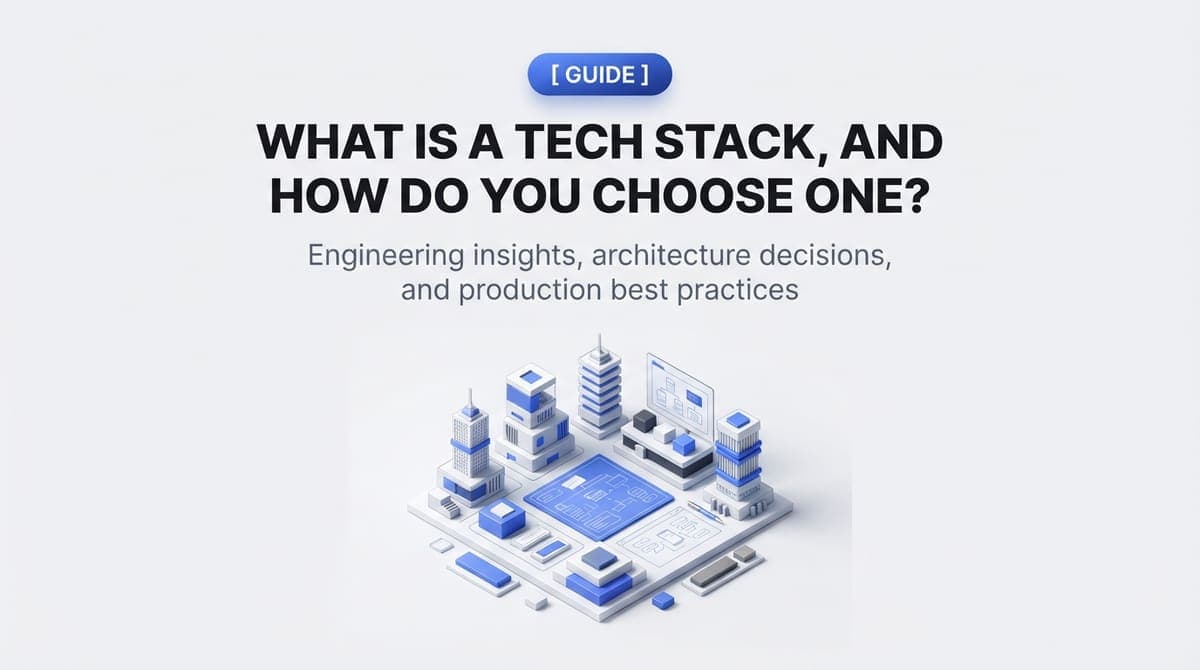
A tech stack is the combination of technologies used to build and run a software application. The term covers everything from the programming language and framework your developers write in, to the database where your data lives, to the cloud infrastructure that serves your app to users. When someone says "we're a React and Node shop" or "we built this on Next.js and Supabase," they're describing their tech stack.
Every application has a stack whether or not anyone made a deliberate decision about it. The difference between a stack chosen intentionally and one that accumulated by default is significant - not because there's one right answer, but because the stack shapes every technical decision that follows. Who you can hire, how fast you can build, what you can integrate with, and how much your infrastructure costs are all downstream of the stack you're running on.
This guide explains what a tech stack consists of, how the major components relate to each other, and what actually matters when you're choosing one for a new project.
The Layers of a Typical Tech Stack
A full tech stack has several distinct layers. The frontend is what users interact with in their browser or on their phone - the visual interface, the forms, the navigation. The backend is the server-side logic that processes requests, enforces business rules, and handles data. The database is where data is stored and retrieved. Infrastructure is the servers, hosting platforms, and networking that keep everything running.
For a web application built today, a common stack looks like this: Next.js on the frontend and backend (since it handles both), PostgreSQL as the database (often managed via Supabase), Vercel for hosting, and a handful of third-party services for specific functions - Stripe for payments, Resend for email, Cloudinary for image storage. Each piece solves a specific problem, and they connect to each other via APIs.
Mobile apps add another layer. A React Native app using Expo can share business logic with a web frontend, while native iOS or Android development requires separate codebases with platform-specific languages (Swift for iOS, Kotlin for Android). The backend and database are typically shared regardless of whether the frontend is web or mobile.
Frontend: What Users See
The frontend layer is what a user interacts with directly. For web applications, this is almost universally built with JavaScript - specifically with a framework that manages the complexity of building interactive interfaces. React is the dominant choice, used by roughly 40 percent of web developers. Next.js, which builds on top of React and adds server-side rendering and routing, has become the default for production applications because it handles SEO, performance, and deployment optimisation out of the box.
Vue and Angular are the significant alternatives to React. Vue has a gentler learning curve and is a strong choice for teams without deep React experience. Angular is common in enterprise environments and large organisations where its opinionated structure suits teams with formal processes. Svelte is a newer option that generates highly performant code but has a smaller ecosystem and fewer available developers.
The frontend choice matters most for hiring. If you're building in a market where most developers know React, building in a niche framework makes it harder to find and onboard talent. Stick with the popular choice unless there's a specific technical reason not to.
Backend and Database: Where Logic Lives
The backend is where your application's rules run: access control, data processing, integrations, and anything that shouldn't happen in the browser. Backend technologies include Node.js (JavaScript on the server), Python (common for data-heavy and AI applications), Go (high-performance systems), and Ruby on Rails (still a strong choice for fast product iteration). Each has a different profile of strengths and available talent.
The database decision is one of the most consequential parts of the stack. PostgreSQL is the default for most applications - it's relational, battle-tested, and handles complex queries well. MySQL is the other major relational database. MongoDB is a document database that's faster to get started with but creates data integrity problems at scale that teams frequently regret. For most new applications, PostgreSQL is the right starting point.
Infrastructure: Where It All Runs
Infrastructure is the layer most non-technical founders think about least and most operations teams think about most. For most early-stage applications, managed platforms like Vercel, Render, or Railway handle deployment complexity and let your team focus on the product. For larger scale, AWS, Google Cloud Platform, and Azure give you more control and lower unit costs at high volume but require DevOps expertise to manage.
The infrastructure choice matters less early on than people think. Vercel or Render is fine for most applications up to a significant scale - tens of thousands of daily active users. The migration path to AWS when you need it is well-documented. Don't let infrastructure decisions slow down early product development.
How to Choose a Tech Stack
The right stack for your project is determined by four factors: your team's existing expertise, the nature of the problem you're solving, your hiring plan, and the ecosystem of tools and integrations you need. A data-heavy application with machine learning components should be built on Python. A content-heavy web platform with heavy SEO requirements fits Next.js naturally. A real-time collaboration tool has different database requirements than a standard CRUD application.
The worst tech stack decisions come from chasing novelty. A team that chooses a cutting-edge framework because it's interesting to work with ends up with a smaller pool of developers to hire from, less documentation to reference when things break, and more maintenance burden as the ecosystem matures around them. Boring tech that your team knows well outperforms exciting tech that nobody is expert in.
The Stack Doesn't Matter as Much as Execution
There are multiple stacks that can build any given product successfully. React vs. Vue is a minor decision compared to whether your team executes well on whichever one they choose. PostgreSQL vs. MySQL is a minor decision compared to whether your data model is designed correctly. The stack establishes constraints and defaults, but it doesn't determine whether your product succeeds.
Where teams get stuck is making stack decisions by committee, using the decision as a proxy for deeper disagreements about team structure or product direction, or delaying a project start while chasing the "perfect" technical setup. The productive approach is choosing a sensible default stack - one your team knows, with broad community support - and getting to work.
When we scope new projects at Zovintra, our default is Next.js, TypeScript, Supabase, and Vercel - not because it's the only right answer, but because it's a well-understood stack with a large talent pool, mature tooling, and a deployment story that scales from day one to millions of users. If your project has specific requirements that call for a different approach, we'll tell you why and what we'd change.