“Every assumption you skip in discovery becomes a surprise in development. Discovery is cheap. Surprises are not.”
The cost of skipping the briefWhen you talk to a development agency about building your product, they may recommend starting with a discovery phase before any development begins. If you have not encountered this before, it can feel like a way to charge more before the real work starts. In most cases it is the opposite — it is the part of the process that makes the development phase significantly cheaper and more predictable.
This guide explains what a discovery phase actually involves, what it produces, when you genuinely need one, and when you can skip it.
What a Discovery Phase Is
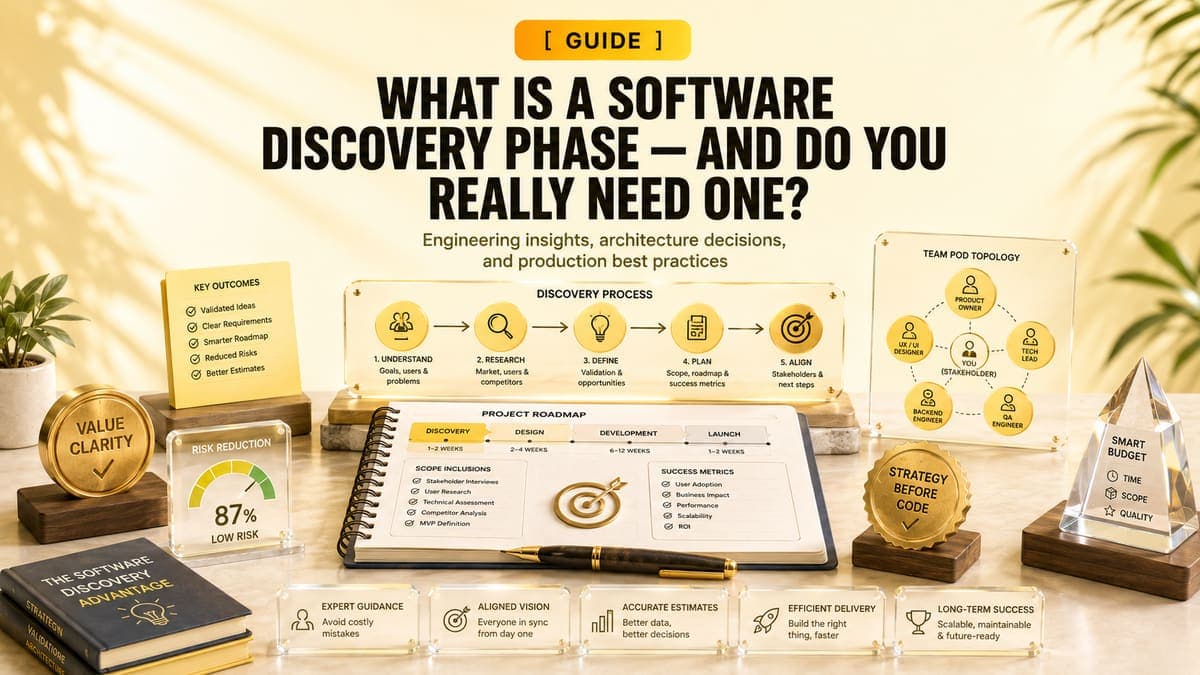
A discovery phase is a structured period — typically two to four weeks — where the development team works with you to fully understand the problem you are solving, the users you are solving it for, and what the product needs to do to solve it. The output is a set of documents that serve as the foundation for the development phase.
It is not a design phase, though some light wireframing often happens. It is not a project planning phase, though a development timeline is often produced. It is fundamentally a problem definition phase — the work of translating your vision into a specification detailed enough that engineers can build it without guessing.
What a Good Discovery Phase Produces
- User research summary: who are the users, what are their goals, what are their pain points, and where do existing solutions fail them
- Problem statement and success criteria: what does this product need to achieve, measured how, in what timeframe
- Feature specification: a detailed description of every feature in scope, with acceptance criteria for each
- Information architecture: all screens and the navigation paths between them
- Low-fidelity wireframes: sketches of key screens showing layout and user flow, not final design
- Technical architecture recommendation: which technology stack, which third-party services, and why
- Development estimate: a realistic cost and timeline range based on the above specification, not a vague brief
- Risk register: the things most likely to cause delays or problems, and how they will be managed
When You Need a Discovery Phase
You need a discovery phase when your requirements are not fully defined — which is most of the time for greenfield products. If you cannot answer in specific terms what every major feature does, who uses it, and what success looks like, you are not ready to start development. A discovery phase is the work of getting to that answer.
You also need one when you are making a significant investment. For projects over $30,000, the cost of a discovery phase is a small fraction of what an ambiguous scope can add to the total development cost through scope changes, rework, and delays. A $5,000 discovery phase that produces a clear specification is often the best investment you make in a $100,000 project.
When You Can Skip a Discovery Phase
You can skip the discovery phase when your requirements are genuinely well-defined. This typically happens in two cases: when you are building a clearly specified addition to an existing product (a single integration, a well-understood feature), or when you are working with a team that already knows your product deeply after months of collaboration.
You can also move faster with a lighter discovery process — sometimes called a design sprint or a scoping workshop — that compresses the work into a few days rather than a few weeks. This is appropriate for simpler products or for situations where speed to market genuinely outweighs the risk of specification ambiguity.
The discovery phase is not overhead. It is the foundation. Teams that skip it are not moving faster — they are moving at the same speed but with less certainty about where they are going. The surprises that would have been caught in discovery become expensive mid-development pivots or post-launch rebuilds.