“Picking a mobile framework is not a technical decision. It is a business decision that your developers will live with for the next three years.”
A hard truth from app rescues we've doneWhy This Decision Still Matters in 2026
React Native and Flutter have both matured significantly. Either can produce a polished, high-performance app. But "either works" is not the same as "either works for you." Your team's skills, your timeline, your backend architecture, and your long-term hiring plan all tip the balance one way or the other.
We've built and rescued apps on both frameworks. The founders who made the wrong choice didn't pick a bad technology - they picked the wrong technology for their specific constraints. This post is a practical breakdown of where each one wins and where each one quietly costs you.
State of React Native in 2026
React Native's New Architecture - Fabric renderer and the JSI bridge replacement - is now stable and enabled by default in new projects. Startup times are down, scroll performance is up, and the old "JS bridge is slow" complaint is mostly retired. If your team writes JavaScript or TypeScript for your web frontend, the learning curve is the shortest it has ever been.
The Expo ecosystem has become the default way to start a React Native project. Expo's managed workflow handles native builds, over-the-air updates, and app store submissions without needing to touch Xcode or Android Studio until you genuinely need to. For teams without a dedicated mobile specialist, this matters more than benchmark scores.
The trade-off is that React Native still delegates rendering to native components. This means your UI looks and feels native by default - which is good for trust - but it also means platform inconsistencies surface more often. A component that looks right on iOS can render slightly differently on Android, and debugging those gaps takes time.
State of Flutter in 2026
Flutter's proposition is the opposite: one rendering engine (Impeller, now the default) draws every pixel on both platforms. You get pixel-perfect consistency across iOS, Android, web, and desktop from a single codebase. If your product has a highly custom UI - complex animations, branded design systems, unusual interaction patterns - Flutter's control is unmatched.
Dart has also matured. Sound null safety, records and patterns (added in Dart 3), and a strong package ecosystem mean Dart is no longer the "unfamiliar language" objection it used to be. Most developers get productive in Dart within a few weeks.
The real risk with Flutter is hiring. The global React Native developer pool is still roughly three times larger than Flutter's. If your founding engineer leaves or your team scales, replacing Flutter expertise is harder and more expensive. This is not a Flutter flaw - it is a market reality you should price into your decision.
Flutter
- Pixel-perfect custom UI - single renderer across all platforms
- Better performance ceiling for animation-heavy or complex UIs
- Dart is consistent and fast; null safety baked in from the start
- Strong choice for consumer apps with strong brand identity
Performance: Where the Gap Actually Exists
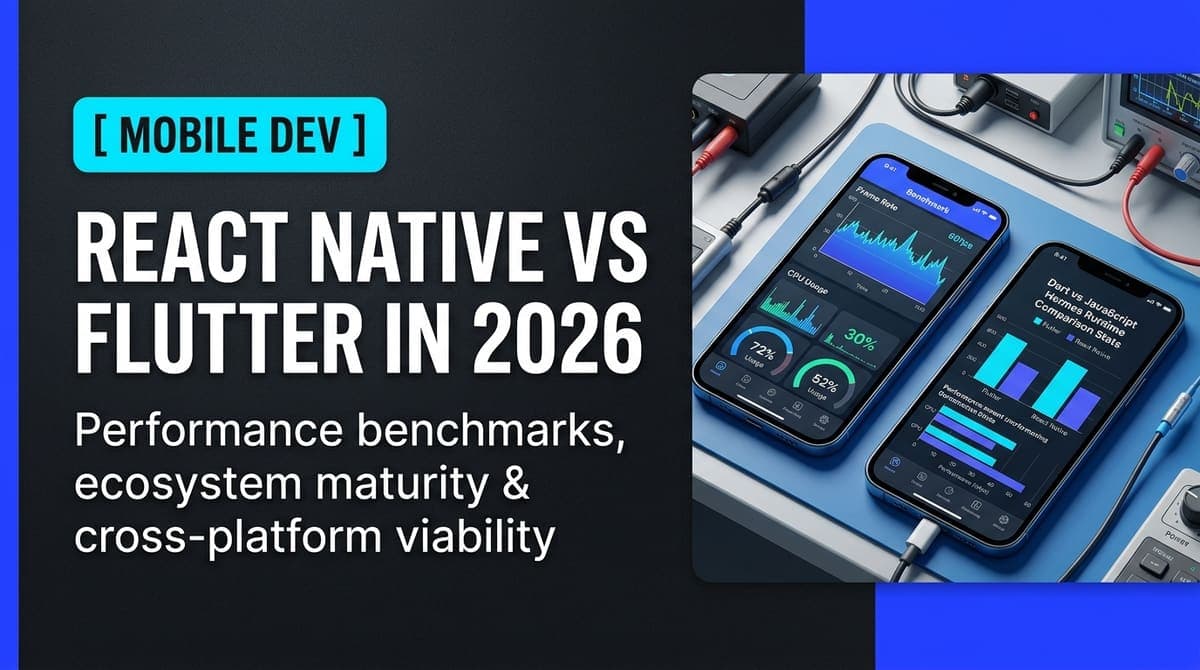
For a typical app - a few screens, API calls, a list or two, some forms - both frameworks perform identically from a user's perspective. The performance gap only opens up in specific scenarios: frame-rate-critical animations, very large lists with complex cells, or heavy use of platform sensors and camera APIs.
Flutter wins on animation benchmarks because Impeller draws at 60 to 120 fps without JS thread involvement. React Native wins on "native feel" for standard UI patterns because it literally uses the platform's own widgets. For most B2B or SaaS mobile apps, this distinction is irrelevant. For a consumer product where delight is a differentiator, it is worth weighing.
The Third-Party Plugin Risk
This is where many cross-platform projects quietly fail. You need Stripe payments, push notifications, background location, or deep camera access. You find a plugin. Six months later, the plugin is unmaintained, broke on the latest OS update, or never supported a feature you now need.
React Native benefits from Facebook and Microsoft's investment in first-party modules, and a huge community maintaining popular plugins. Flutter's pub.dev has grown substantially, but the long tail of niche plugins is thinner. Before committing to Flutter, verify that every third-party integration you need has a well-maintained package - check the last commit date, not just the download count.
- Check the plugin's GitHub last-commit date before adding a dependency
- Prefer plugins with official SDK backing (Stripe, Firebase, RevenueCat all have first-party Flutter/RN support)
- Test third-party plugins on both iOS and Android before building your feature on top of them
- Budget time for plugin maintenance in your roadmap - plugins break on major OS releases
- For custom native code, ensure your team has at least one developer comfortable with Swift/Kotlin bridging
When Teams Get Stuck Mid-Build
We regularly receive projects that started in one framework and stalled. The most common pattern: a solo developer chose Flutter because a YouTube tutorial made it look easy, built 60% of the app, then left the company. The remaining team was all JavaScript developers with no Dart experience. Rewriting was expensive; finishing it was slow.
The second pattern: a React Native project started without Expo, went deep into custom native modules, and now requires a full Xcode environment to build. The founder can no longer ship updates independently. These are not framework problems - they are setup and team-fit decisions made early that compounded over time.
The Honest Recommendation
If your team writes React or TypeScript, use React Native with Expo. If you are building a consumer-facing product with a strong visual identity and your team is willing to learn Dart, Flutter is a legitimate and often superior choice. If you are a solo founder with no mobile background, React Native's larger community and more abundant tutorials will save you hours of debugging.
If you're at the stage of choosing a framework - or stuck in the middle of a build that isn't moving - this is exactly the kind of scoping conversation we have before writing a single line of code. Getting the foundation right saves six months of rework. If you'd rather not learn this lesson on your own budget, we're happy to talk through your specific situation.