This is one of the most common questions we get from clients starting a mobile project. The honest answer is that neither approach is universally better. The right choice depends on your timeline, budget, team, and what your users actually need.
“There is no universally right answer. The best choice is the one that fits your timeline, your budget, and how your users actually behave.”
Native or cross-platformUnderstanding What You're Actually Choosing Between
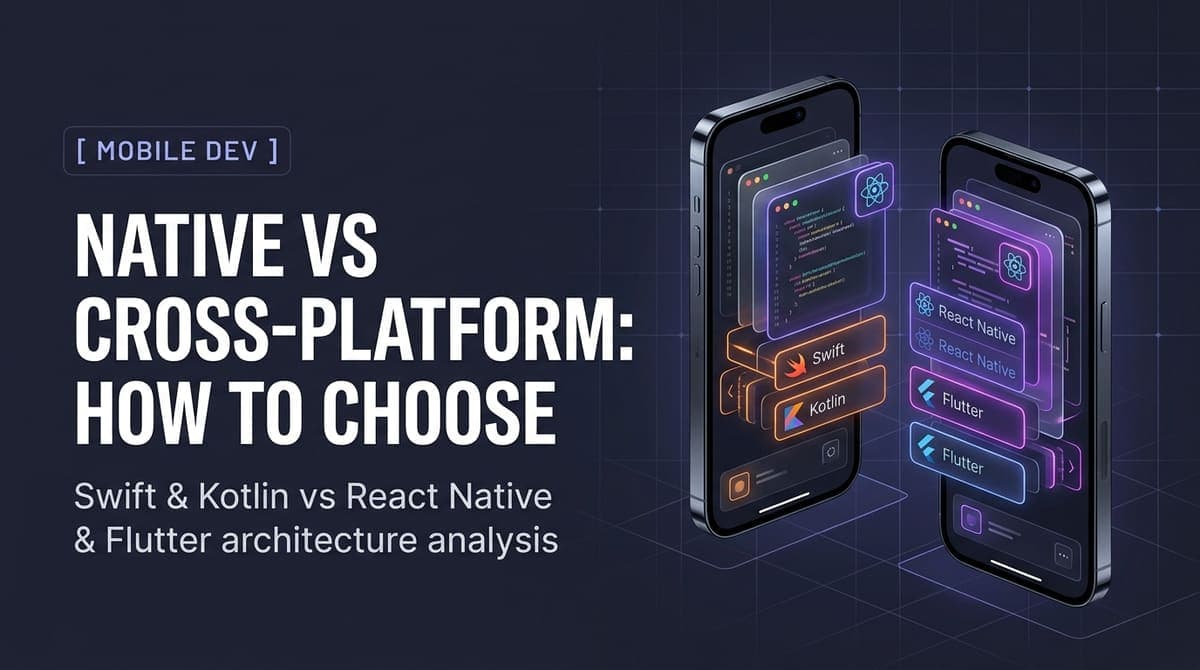
Native development means building separate apps for iOS (using Swift or Objective-C) and Android (using Kotlin or Java). Each app is built specifically for its platform, uses the platform's native UI components, and has direct access to all device APIs. Cross-platform means writing one codebase that runs on both platforms. The leading frameworks are React Native (backed by Meta) and Flutter (backed by Google).
The distinction matters because it affects everything downstream: your team structure, your hiring decisions, your testing process, and your ability to access new platform features when Apple or Google releases them. Choosing the wrong approach for your context creates drag that compounds over months.
Cost Comparison Breakdown
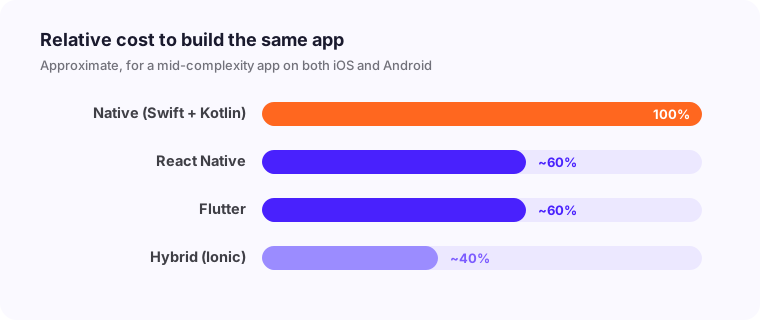
For a mid-complexity app with standard features, native development for both iOS and Android typically costs 1.6x to 2x more than a cross-platform equivalent. You're essentially building the app twice, with two separate teams or one team working sequentially on each platform.
Cross-platform reduces that cost because the majority of business logic, UI components, and API integrations are written once. The overhead comes in platform-specific adjustments - navigation patterns, permissions flows, and UI details that differ between iOS and Android. Expect roughly 20% of the codebase to be platform-specific even in a well-built cross-platform app.
- Native iOS + Android: full cost, two separate codebases, two sets of deployments
- React Native: roughly 60% of native cost, 80% shared code, one deployment pipeline
- Flutter: similar cost to React Native, strong UI consistency across platforms
- Hybrid (Ionic, Capacitor): lowest cost, but performance and UX trade-offs are real
Team Size and Hiring Implications
Native development requires platform-specific expertise. iOS developers know Swift and the Apple ecosystem. Android developers know Kotlin and the Android ecosystem. They are not interchangeable. A team of two building a native app often needs one of each, which doubles your hiring surface area.
Cross-platform development, particularly React Native, draws from the much larger JavaScript and React developer ecosystem. The talent pool is significantly bigger and the average cost per developer is often lower. If you already have a web team using React, the ramp-up to React Native is shorter than learning Swift from scratch.
Testing Complexity and App Store Approvals
Testing a cross-platform app means testing the same user flows on both platforms, even though the code is shared. You're not testing twice the code, but you are testing twice the devices. iOS and Android handle notifications, background tasks, and permissions differently. These edge cases require platform-specific test cases.
App store approval processes differ. Apple's review process is stricter and more unpredictable. Rejections for policy violations, missing privacy declarations, or technical issues can delay launches by days or weeks. Android's review is faster but Google Play's automated scanning can flag issues quickly. Neither platform treats cross-platform apps differently for approval purposes - the binary that ships is still a native app.
Real Examples of When Each Approach Worked
We built a field service management app in React Native for a facilities management company. The app handled job scheduling, customer signatures, photo capture, and GPS tracking. React Native handled all of it without any noticeable performance difference from native. The client got iOS and Android in the same timeline and budget they had originally allocated for iOS alone.
On the other side, we built a health tracking app in Swift that used Apple's HealthKit extensively and needed precise background heart rate monitoring. The depth of HealthKit integration and the real-time sensor processing made native the only sensible choice. A React Native wrapper would have introduced latency and complexity for no benefit.
How to Make the Decision
Run through these questions in order. The first answer that points clearly in one direction is usually the right call.
- Does your app need deep device hardware access (custom camera processing, AR, health sensors)? If yes, native.
- Do you need both iOS and Android within the same budget as a single platform? If yes, cross-platform.
- Is your team already fluent in React? React Native will ship faster.
- Does your app involve complex animations or real-time graphics rendering? Native is safer.
- Is time-to-market your top priority and the app primarily data-driven? Cross-platform wins.
- Are you building iOS-only for a premium audience with no Android plans? Swift is worth it.
For most business apps, cross-platform frameworks like React Native deliver 90% of the native experience at 60% of the cost. But for apps that push device boundaries - health tracking, real-time navigation, AR features - native development is worth the investment. The decision should come from your product requirements, not framework loyalty.