“A PWA is not a cheaper version of a native app. It's a different product, for a different audience, solving a different distribution problem.”
The distinction most startup comparisons skipWhat a PWA Actually Is
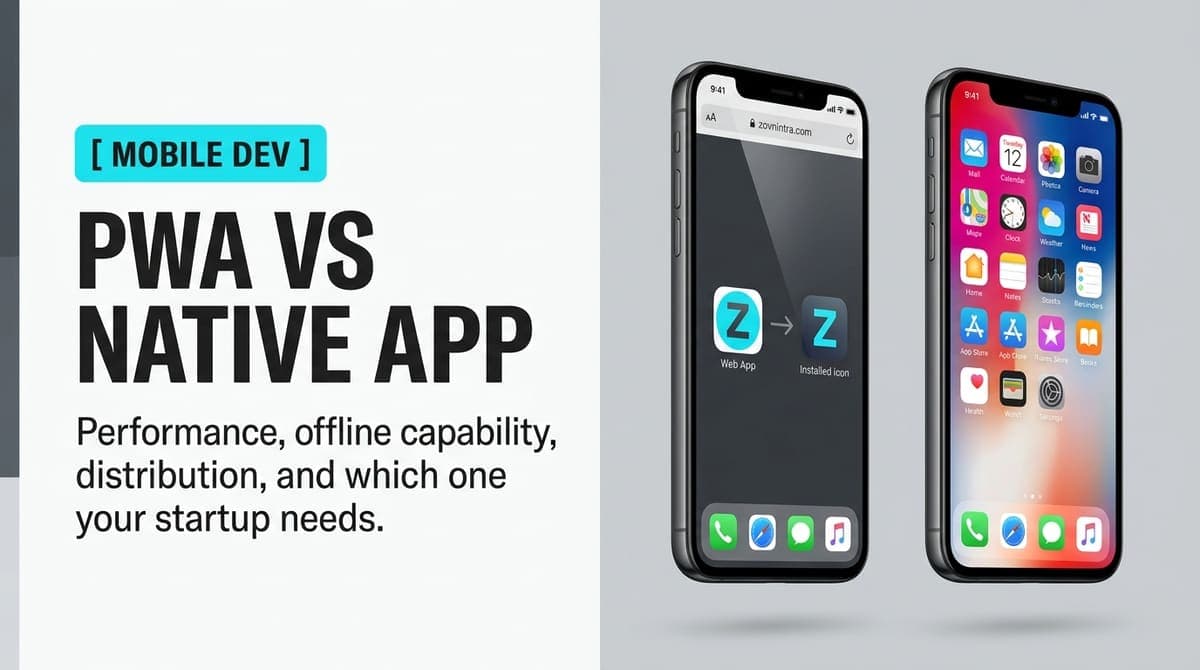
A Progressive Web App is a website that behaves like an app. It can be added to a home screen, work offline via service workers, send push notifications (on supported platforms), and access device hardware like the camera and GPS. It loads in a browser, gets indexed by Google, and requires no App Store submission to ship an update.
The confusion in most comparisons is that people pit a fully native app against a mid-quality PWA and declare a winner. The honest framing is: a well-built PWA and a well-built native app serve different use cases. Choosing between them is a product and distribution decision, not a quality decision.
Where PWAs Win
If your users come from search or social links, a PWA gives you something a native app cannot: instant access with no install friction. A user clicks a link, your product opens immediately in their browser. Zero download, zero app store approval wait, zero "do you want to allow notifications" prompt on first visit. For content-heavy products, e-commerce tools, utilities, and B2B dashboards used occasionally, this frictionless entry is a genuine conversion advantage.
PWAs also win on update velocity. You ship a change to your server and every user gets it immediately - no App Store review, no waiting for users to update. For a startup iterating fast, this is significant. React or Next.js teams can build a high-quality PWA with existing skills, which means no hiring a mobile specialist and no framework switch.
SEO is another underrated PWA advantage. Your product is crawlable, linkable, and shareable. Deep links work natively. Blog posts about your product drive traffic directly into the app experience. A native app has none of that - you're invisible to Google except for your App Store listing.
Where Native Apps Win
Native apps have a performance ceiling that PWAs cannot reach for certain use cases. Fluid 60 fps animations, complex gesture recognizers, background processing, augmented reality, Bluetooth and NFC access, and deep system integrations (HealthKit, Apple Pay, Google Pay) require native APIs that browsers cannot access or throttle significantly.
The App Store is also a distribution channel, not just a submission gate. Millions of users discover apps through App Store searches, editorial features, and Top Charts. If your product competes in a category where users actively search the App Store - fitness, finance, games, productivity tools - you are invisible without a listing.
User trust and perceived quality still differ by platform. Research consistently shows that users rate "the same product" higher as a native app than as a web app. For consumer products where retention and daily engagement matter, the native experience - haptic feedback, system font rendering, smooth transitions - builds habits that a browser experience does not.
The Hybrid Middle Ground
Capacitor (from the Ionic team) lets you wrap a web app in a native shell and ship it to both app stores while still writing HTML, CSS, and JavaScript. This gives you App Store presence, access to native plugins, and web-speed development. The trade-off is that deeply native interactions still require native code, and debugging cross the native-web boundary adds complexity.
Many startups ship a PWA first, validate their product, and then build a native app once they have revenue and user data to justify the investment. This is a sound strategy - but it requires that your PWA is actually good, not a fallback that users tolerate.
The Decision Framework
- If your users come from Google search or marketing links and you iterate weekly, start with a PWA
- If you need App Store distribution, background processing, hardware access, or daily-engagement features, build native
- If your team is all web developers and budget is constrained, a well-built PWA beats a poorly executed native app every time
- If you're in a competitive consumer category (fitness, finance, social), you need a native app - App Store presence is not optional
- If you've already built a React web app and need mobile coverage quickly, Capacitor or a PWA wrapper is a faster path than a full native rewrite
Getting the Decision Right Before You Build
The most expensive mobile decisions are the ones made by default - someone builds a native app because "that's what apps are", or chooses a PWA because it sounded cheaper, without mapping the decision to their actual user acquisition and engagement model. An hour of product scoping before writing code can save three months of rework.
If you're deciding between these paths right now, the right answer depends entirely on your distribution model, your team's skills, and your feature requirements. We scope this out as part of every engagement we take on - and if you want to talk through your specific situation before committing to a build direction, that's what our free discovery calls are for.