The minimum viable secure MVP is not a full security audit. It is the smallest set of controls that keeps your users' data safe, keeps you legally defensible, and does not become a structural problem the moment real users appear. Most of what belongs on that list costs less to build correctly the first time than to retrofit after launch - because the things that are expensive to fix later are always the ones baked into your data model and your authentication architecture.
Why Security and Features Are Not the Same Budget
The classic tension in MVP planning is features versus security. The framing is almost always wrong. Security controls are not a separate feature you add on top of a working product - authentication, data ownership rules, and input validation are structural. They determine what the database schema looks like, how the API routes are designed, and whether user data is isolated or shared by default. Adding them after the architecture is set is a rework, not an add-on.
A common pattern in AI-built MVPs is that the generated code handles the happy path well - a user logs in, creates a record, views it back - but the isolation between users is either not enforced at the database level or enforced only in the application layer. Application-layer checks are easy to miss on one route. Database-level row-level security applies at the query level regardless of how the application calls it, as long as the policies themselves are correct and the app does not use a key that bypasses them. That architectural decision costs little to make at the start and a full rework to fix later.
The Security Floor: What the OWASP ASVS L1 Defines
The OWASP Application Security Verification Standard (ASVS) defines three levels of security controls. According to the ASVS 5.0 text, Level 1 contains the minimum requirements to consider when securing an application and is a critical starting point, with around 20% of the requirements. It is not a government regulation. It is an open standard for what "defensible" looks like when an incident happens and someone asks whether you took reasonable precautions.
ASVS is organised into chapters that include authentication, session management, authorization, validation and encoding, cryptography, and error handling. The list below is our MVP-oriented summary of six of those areas, not a quotation of the Level 1 requirement list, so read the standard itself before you claim compliance.
- Authentication: passwords hashed with a modern algorithm (bcrypt, Argon2, not MD5 or SHA-1); no default credentials; account lockout or rate limiting on login
- Session management: tokens expire, cannot be reused after logout, are not exposed in URLs
- Access control: every authenticated user can access only their own data; admin functions are not accessible to regular users
- Input validation: all inputs validated server-side; no raw user input reaching a database query, HTML output, or file system path
- Cryptography: sensitive data at rest encrypted; TLS enforced for all connections; no hardcoded keys in code
- Error handling: errors do not expose stack traces, database error messages, or internal paths to users
This is not an exhaustive list, but it covers the issues we check first when we review apps before launch. If you are using Supabase, Firebase, or a similar managed backend, several of these are handled by the platform - but only if you configure them correctly and do not work around them. A managed auth provider does not protect you if you ship the wrong key in the frontend: Supabase's docs say the secret key (the successor to the legacy service_role key) bypasses Row Level Security and must never leave your control.
What an MVP Actually Needs to Implement
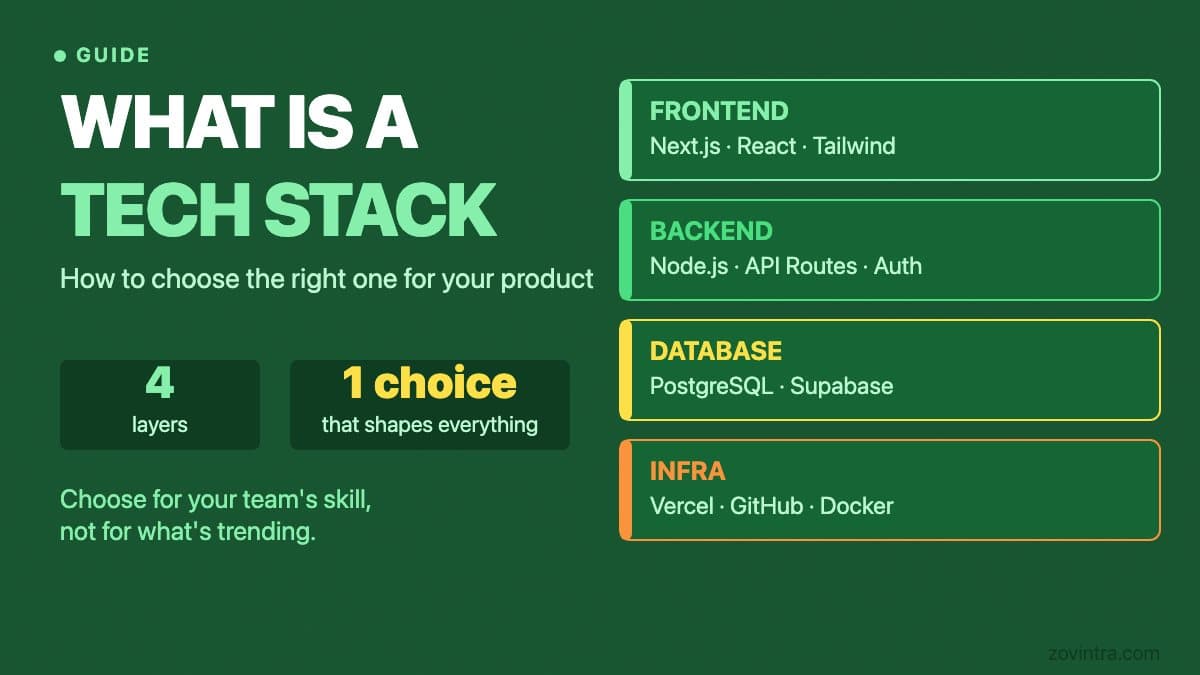
Translating ASVS L1 into an MVP scope means separating what the platform handles from what your team must build. For a typical Next.js + Supabase or Firebase stack, the breakdown looks like this.
- Authentication: use a managed provider (Supabase Auth, Firebase Auth, Clerk). Do not build password hashing yourself. The provider handles token issuance, expiry, and logout. Your job is to not expose the service key and to verify the token on every protected server-side call.
- Row-level security: write RLS policies at the database level so that even a bug in your application code cannot return another user's data. For a simple schema this is a small, bounded task, and for a data-storing app it is one of the highest-value controls.
- Input validation: use a schema library (Zod, Yup, Joi) on every API route. Validate before processing. Reject and log invalid payloads.
- Rate limiting: add rate limiting to your auth endpoints and any publicly accessible API. Hosting platforms offer options: for example, Vercel's WAF rate limiting is available on all plans, and Supabase Auth enforces rate limits on its own authentication endpoints. Rate limiting on your own login and public API routes is still your job.
- Secrets management: environment variables in the hosting platform, never in source code. Rotate any key that was ever committed, even briefly.
- Error responses: your API should return generic error messages to clients. Server logs can be detailed; client responses should not reveal schema structure or query text.
What You Can Defer
A minimum viable secure MVP does not require a penetration test, a SOC 2 audit, or a full threat model document. It does not require end-to-end encryption of every database field. It does not require multi-factor authentication on day one (though it should be planned). It does not require a dedicated security team or quarterly security reviews.
What you are deferring is the upper tiers of the ASVS - the controls that matter when you have thousands of users, handle regulated data (health records, financial transactions, children's data), or face a motivated adversary. Deferring these is reasonable. Deferring the L1 floor is what turns a launch into an incident.
How to Budget for It
The security controls described above are not a separate workstream on top of your build. They are decisions about how you build. The cost difference between writing a Supabase RLS policy correctly and not writing one is close to zero in development and very large in remediation. The same is true for input validation - adding Zod to an API route takes minutes; removing an injection vulnerability from a production system that has been running for months is an incident.
Where founders do spend extra is on review. If your team is not experienced with database-level security policies, having someone check the RLS rules before launch is a one-time cost that prevents a predictable class of problems. If you built with an AI tool, the cost to build your MVP included the speed benefit; the security review is the quality gate that catches what the tool did not know to include.
The Risk of Launching Without the Floor
The concrete risk of skipping the L1 controls is not abstract. A missing RLS policy means any authenticated user can query any other user's data with a direct API call. A secret key (the old service_role key) shipped in your frontend means anyone who opens the browser dev tools can bypass your access controls entirely. Rate limiting absent from your own login route means a credential-stuffing script can try many passwords without triggering any alarm.
None of these require a sophisticated attacker. They require basic curiosity or an automated scanner. The UpGuard study published on 14 October 2026 identified 16,326 databases exposing readable tables across a candidate set of about 300,000 domains with signs of Supabase use - and the study noted that tables created programmatically through the API, which is how coding agents interact with Supabase, do not enable RLS by default. The floor is not hard to reach. The problem is that many MVPs built quickly with AI tools are never checked against it.
Getting the Review Done Before Launch
If you are approaching launch and you are not certain the L1 controls are in place, the fastest first step is to run a scan. Our free code review tool checks for secrets in source, Supabase and Firebase configuration mistakes, dependency vulnerabilities, and common injection patterns. It will not tell you whether your RLS policies are logically correct - that requires a human to read your schema and your policies together - but it will tell you whether the structural mistakes are present.
For the logical review - the auth flow, the data ownership rules, the business logic edge cases - you need a reviewer who understands what your app is supposed to do. Use the project planner to describe your stack and your launch timeline, and we will scope what a pre-launch review covers and what it costs. Security does not have to be a separate budget line. It should be part of the definition of done.
Common questions
What security does an MVP actually need before launch?
An MVP needs the OWASP ASVS Level 1 floor: managed authentication, row-level security so users reach only their own data, server-side input validation, rate limiting on auth and public APIs, and no secret keys in the frontend. Penetration tests and SOC 2 can wait.
Can I skip multi-factor authentication and a penetration test for my MVP?
Per the post, an MVP does not need a penetration test, a SOC 2 audit or a full threat model, and multi-factor authentication can wait on day one, though it should be planned. What you should not defer is the Level 1 floor, which is what turns a launch into an incident.
When should I get someone to review my MVP's security?
Before launch, especially if your team is not experienced with database-level security policies. A one-time check of your row-level security rules prevents a predictable class of problems, and reviewing auth flow and data ownership needs someone who understands your app. Zovintra scopes this kind of pre-launch review.
Sources
- What is the ASVS? (ASVS 5.0.0) - OWASP Foundation, accessed 19 Oct 2026
- OWASP Application Security Verification Standard (ASVS) - OWASP Foundation, accessed 19 Oct 2026
- Everything, Everywhere: Systemic Data Exposure in Supabase Apps - UpGuard Research, published 14 October 2026
- Understanding API keys - Supabase Docs, accessed 19 Oct 2026
- WAF Rate Limiting - Vercel Docs, accessed 19 Oct 2026
- Rate limits - Supabase Docs, accessed 19 Oct 2026