“Shipping a five-page website when you need one focused page is not being thorough - it's delaying the moment you find out if your idea works.”
The launch decision most founders overcomplicateThe Question Behind the Question
When a founder asks whether they need a landing page or a full website, they're usually asking a more important question underneath: how much should I invest in web presence before I know whether this product will sell? The answer depends on where you are in the business, not on what looks more professional.
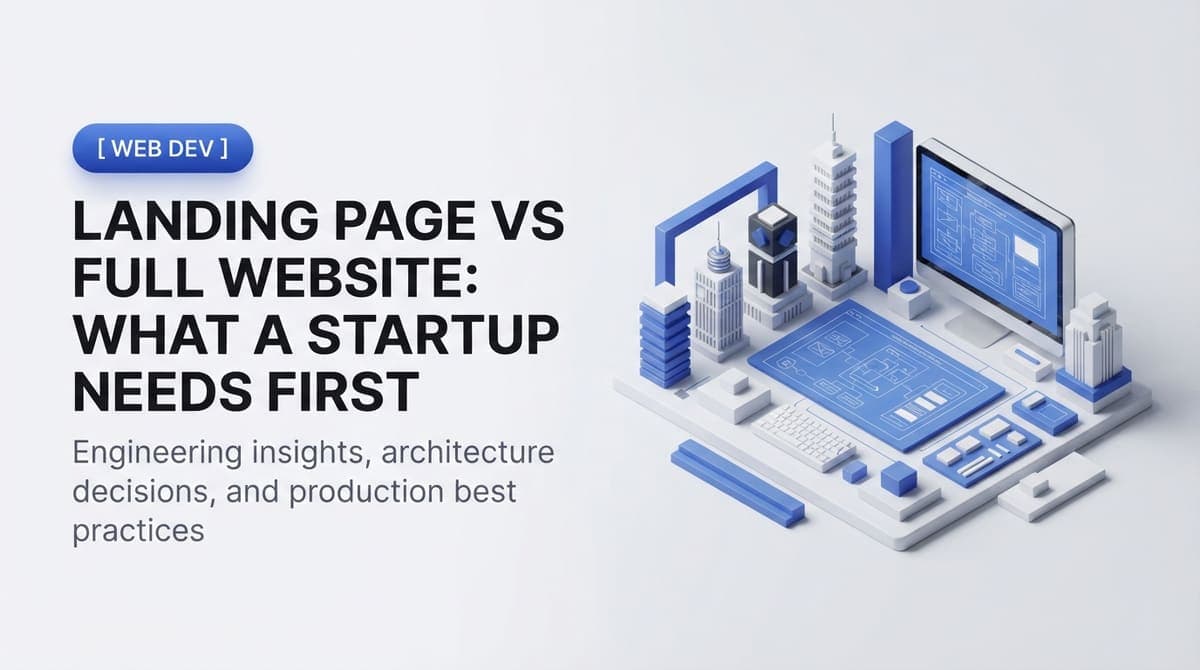
A landing page is a single-purpose page designed to get one type of visitor to take one specific action - sign up, book a call, join a waitlist, or buy. A full website is a multi-page structure that communicates your brand, explains your service, builds credibility over time, and serves multiple audiences. Both are legitimate. The question is which one serves your current goal.
The most expensive mistake is building the full website first when what you actually need is validation. A five-page site with an About page, a Services page, a Portfolio page, a Blog, and a Contact form takes weeks and thousands of dollars to build well. A focused landing page can go live in days and tell you more about whether your offer resonates.
When a Landing Page Is the Right Call
If you are pre-launch or in early customer development, a landing page is almost always the right starting point. Your goal at this stage is not to inform every possible visitor - it is to find out whether a specific audience will respond to a specific offer. A landing page designed for one audience and one action is a much cleaner test than a full site.
Landing pages also perform better in paid acquisition campaigns. If you are running Google Ads or Meta Ads, sending traffic to a homepage that covers everything you do produces lower conversion rates than sending it to a page built specifically to convert that ad's audience. This is not an opinion - every digital marketing study that has tested this shows the same result.
- You are validating a new product or offer before committing to a full build
- You are running paid traffic and need a high-converting destination
- You have a single clear audience and a single conversion goal
- You are building a waitlist before a product launch
- You need to launch in days, not weeks
When You Actually Need a Full Website
A full website becomes the right choice when you have multiple distinct audiences, a complex service that takes more than one page to explain, or when your sales cycle is long enough that buyers need to build trust with you over multiple touchpoints before they commit. A fintech startup selling to enterprise clients needs a full site. A B2C consumer app launching to early adopters does not.
If your product has a meaningful free-to-paid conversion flow, a blog that drives SEO traffic, or a documentation requirement, those are also signals that a full site structure is warranted. The test is whether visitors with different needs require genuinely different content - if yes, you need more than one page.
Services businesses typically need full sites earlier than product companies because the sales process involves trust-building. When a potential client is evaluating whether to pay you for consulting or development work, they will look for case studies, team information, and signals of credibility that a single landing page cannot carry.
Landing Page First
- Can launch in 3 to 7 days
- Built around one audience and one conversion goal
- Low cost - test the offer before the full investment
- Every word is written to get one specific action
- Easy to update copy and test variants quickly
The Hybrid Path Most Startups Miss
There is a third option that works well for startups with more than one page's worth of content but not yet enough to justify a full build: a focused multi-section single-page site. This is one URL that scrolls through your hero, your problem-solution story, your offer, social proof, and a CTA. It reads like a website but loads like a landing page and costs a fraction of a full multi-page build.
This format is well-matched to SaaS products, agencies, and service businesses in early growth. It gives you the credibility signals a landing page lacks while keeping the focus and speed advantages. When you've validated the offer and understand your audiences better, the single-page site becomes the brief for the full site - you already know what messaging works.
What "Good" Looks Like at Each Stage
At the idea validation stage, good means a landing page that loads in under 2 seconds, clearly communicates what you do and who it's for above the fold, and has a single CTA that captures intent - even if that's just an email address. It does not need to be beautiful. It needs to be clear and fast.
- Idea validation: one-page site with email capture, no more than 500 words of copy
- Early sales: landing page with case study or testimonial, book-a-call CTA
- Post-validation: multi-section single-page site with social proof and a clear offer
- Growth stage: full site with blog, case studies, and SEO-optimised service pages
- Scale: full site plus dedicated landing pages per campaign and audience segment
The mistake is skipping stages - building a full site with a blog before you have validated customers, or staying on a landing page for two years when your service complexity now demands more. Stage-appropriate web presence is not a compromise. It is the efficient path.
The Build Cost Is Not the Whole Cost
Founders often compare build costs in isolation - a landing page costs less to build than a full site, so the decision feels obvious. But the cost to build is only one number. The cost of a full site that doesn't convert is the build cost plus the time-to-pivot cost plus the lost revenue from an unclear value proposition running for months.
The more useful comparison is: what is the minimum web presence that lets me test the thing I most need to test right now? At pre-launch, that is almost always a focused landing page. At growth stage, that is a site structured around the audiences and conversion paths you've already proven work.
Deciding between a landing page and a full website is ultimately a question about what decision you need to make next in your business - and what information you need to make it. If you're unsure which path fits your current stage, or if you've already built something that isn't converting the way it should, that's the conversation we have with founders every week at Zovintra. We've helped teams go from a struggling Lovable or Bolt prototype to a focused, fast landing page that actually generates leads - and we've helped growth-stage teams structure their first real multi-page site around what their landing page data told them. The right starting point is a clear brief, not a bigger build.