“The question isn't how much your app costs to build. It's how much it costs to build wrong.”
From our intake calls with founders who've already spent onceWhy Cost Estimates Vary So Wildly
Ask ten agencies how much a mobile app costs and you'll get quotes from $8,000 to $800,000. Both numbers can be right. The variation is not about who is overcharging - it's about the enormous difference in scope, complexity, and quality level between "app" projects. A basic MVP with three screens and a Firebase backend is a fundamentally different product from a multi-tenant platform with offline sync, push notifications, and a custom CMS.
The other variable is who builds it. Offshore teams billing at $20 to $40 per hour and senior product studios billing at $150 to $250 per hour are not selling the same thing. The cheaper option often produces code that works on demo day but requires a near-rewrite once real users stress it. We see this constantly in projects that come to us for rescue.
The Real Cost Drivers
Platforms are the first lever. An iOS-only app typically costs 30 to 40 percent less than a cross-platform build. A React Native or Flutter app that targets both platforms from a single codebase adds roughly 20 to 30 percent over a single-platform build - not double - which is why cross-platform frameworks dominate startup budgets.
Authentication and user accounts add more cost than most founders expect. "Just add login" typically means implementing email/password auth, social login (Google, Apple - both required for App Store compliance), password reset flows, account deletion (required by Apple since 2022), and session management. That's one to two weeks of work before your app does anything useful.
Third-party integrations - payments, maps, video, analytics, push notifications - each add days to weeks depending on complexity. Stripe integration with subscriptions, trials, and webhooks is two to three weeks of work done properly. A map feature that just pins locations is two days; a map with real-time tracking, geofencing, and routing is three to four weeks.
Budget Tiers: What You Actually Get
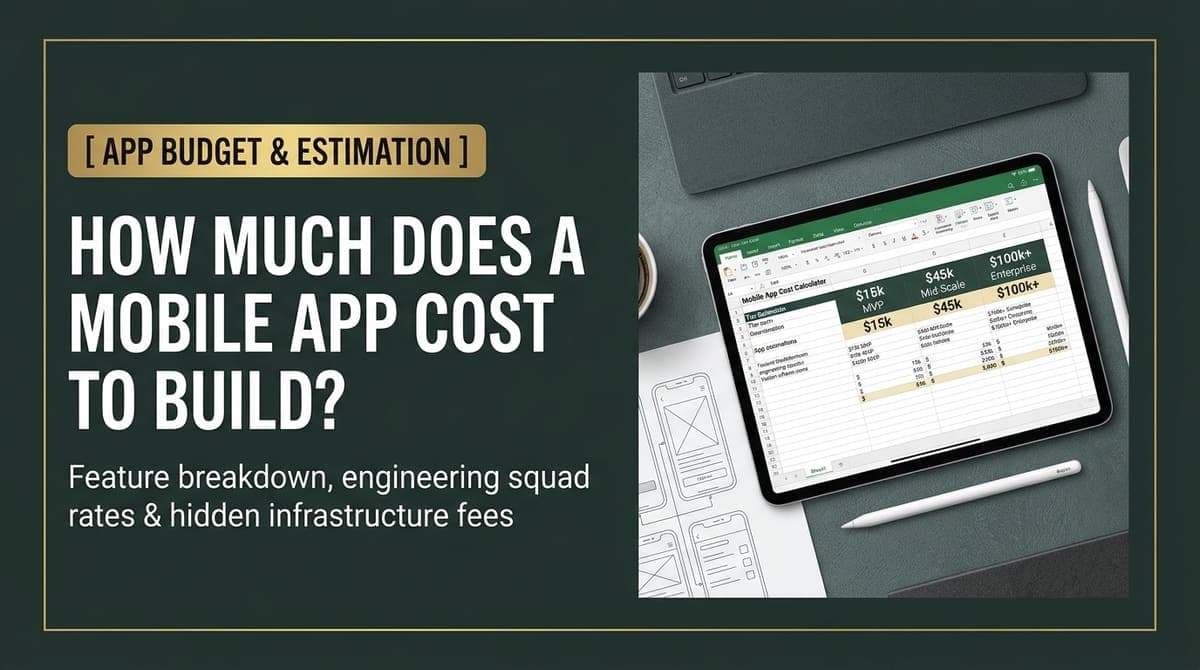
Under $15,000 gets you a very lean MVP - think one platform, basic auth, three to four screens, no backend complexity. This is viable if your goal is validation with a narrow user group. It is not viable if you expect to scale or hand the codebase to another developer without a rewrite.
$25,000 to $60,000 is the real working-product range for most B2B and SaaS mobile apps. You get cross-platform (iOS + Android), clean architecture, a proper backend or API integration, push notifications, basic analytics, and a codebase a developer can maintain. This is where most funded early-stage companies land.
Above $100,000 covers complex consumer apps, marketplace platforms, apps with real-time features (chat, live video, collaborative editing), offline-first requirements, or highly regulated industries (fintech, health). These aren't "expensive" - they're scoped accurately.
The Hidden Costs Founders Miss
- App Store fees: Apple charges $99/year; Google charges a one-time $25 fee - but review times can add 1 to 3 weeks to your launch timeline
- Backend infrastructure: AWS, GCP, or Supabase costs are small at launch but can reach $500 to $5,000/month at scale depending on architecture choices made early
- Push notification services: free tiers work for small user bases, but production-grade delivery at scale (OneSignal, Firebase) has real costs
- Bug fixes post-launch: every major iOS/Android OS release breaks something - budget 10 to 15 percent of build cost annually for maintenance
- Third-party API costs: maps, SMS verification, AI features all have per-call pricing that surprises founders at growth stage
Freelancer vs Agency vs In-House
A freelancer is fastest to start and cheapest per hour, but you carry the project management, QA, and architecture risk yourself. If they disappear at 70 percent complete - which happens more than anyone admits - you are left with a half-built app and code only they understood.
An agency adds coordination overhead and a margin, but you get accountability, a structured process, and usually a team that has solved your specific problems before. In-house is the most expensive option at the start (salary, benefits, onboarding) but the cheapest option if you are building a long-term product that requires continuous iteration.
Getting a Quote That Means Something
A quote is only as good as the specification behind it. If you hand a developer a paragraph description and ask for a price, any number they give you is a guess. A meaningful estimate requires a defined feature list, user flows, a decision on platforms, and clarity on third-party integrations. Expect any serious agency to ask three to five clarifying questions before quoting.
If you've already spent money on a build that stalled or delivered less than expected, a codebase review before spending again is worth every cent. We offer a structured technical review that tells you what you have, what it would take to finish it, and whether continuing on the current foundation is worth it. That conversation is free. Most founders leave it with a plan they didn't have before.