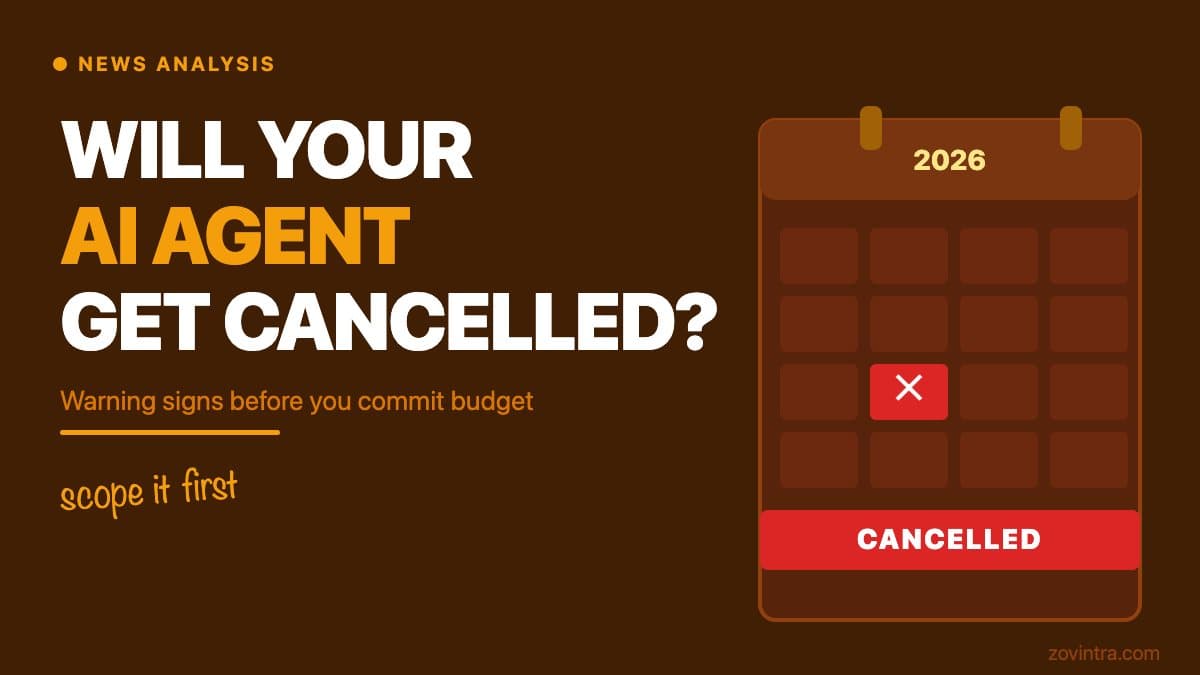
In June 2025, Gartner predicted that more than 40% of agentic AI projects would be canceled by the end of 2027, as reported by w.media from Gartner's 25 June 2025 press release. That is a forecast, not a measured outcome. Gartner attributes the expected cancellations to rising costs, unclear business value and inadequate risk controls. This article is about why projects fail in those ways and what a small business can do to be in the group that does not cancel.
Note: we treat the Gartner figure as a June 2025 prediction, not a confirmed outcome. The five failure modes below are our own practical grouping of the cost, value and risk problems Gartner names, not Gartner's list.
What 'agent washing' looks like and why it matters
Agent washing is the practice of labelling any AI feature as an 'AI agent' regardless of what it actually does. Gartner uses the term for vendors repackaging AI assistants, RPA tools and chatbots as agentic (as reported by w.media), and estimates that only about 130 of the thousands of agentic AI vendors are genuine. A chatbot that looks up a FAQ is not an agent. A script that runs nightly and sends a report is not an agent. An agent, in the technical sense, takes goals, breaks them into steps, calls external tools, handles the responses, and decides what to do next without a human approving each step.
Projects fail when the definition is loose at the start. A team builds a 'customer support AI agent' that is really a retrieval-augmented chatbot, realises it cannot handle escalation or case updates, and then tries to bolt on real agency after the fact. The architecture needed for a chatbot and for a genuine autonomous agent are different, and retrofitting one onto the other is expensive. Projects cancelled at this stage are often cancelled not because AI did not work but because the wrong thing was built.
The five failure modes that cancel projects
1. Undefined success criteria
An AI agent project that starts with 'let us see how well it works' has no exit condition. It drifts through iteration cycles without a clear point at which it is either good enough to deploy or not good enough to continue. Define the acceptance criteria before you build: what specific tasks will the agent complete, at what success rate, measured how, over what data set. If you cannot define this before building, the project will not survive contact with a realistic evaluation.
2. Integration scope underestimated
Most AI agent value comes from the agent acting on real systems - updating a CRM, sending an email on behalf of a user, querying a proprietary database. Getting the agent to do something in a demo environment with static data is straightforward. Getting it to do the same thing against your actual production systems, with authentication, rate limits, data validation, and error handling, is a different project. Teams that treat integration as a detail rather than the majority of the work often underestimate timelines.
3. Hallucination handling not designed in
LLMs produce plausible-sounding outputs that are sometimes factually wrong. An agent that writes code, drafts contracts, or summarises customer records will occasionally produce incorrect output. If the system has no mechanism for catching, flagging, or correcting those outputs before they act on them, errors compound. A project that discovers this problem in production - when real customer records have been updated based on a hallucinated field - is in a much harder position than one that designed for it from the start.
4. Scope expansion without budget revision
AI agent projects attract scope additions as stakeholders see the demo. 'Can it also do X?' is the most dangerous question in these projects because X is almost always a new integration, a new evaluation benchmark, or a new failure mode to handle. Each addition is small individually and significant collectively. Projects without a formal change control process absorb these additions until they are over budget and under-delivered.
5. No plan for what happens when the agent makes a mistake
An autonomous agent that can take actions without human review will, at some point, take a wrong action. The question is not whether this will happen but what happens when it does. If there is no audit log, no rollback mechanism, and no human review trigger for edge cases, a single bad decision can cause a problem that takes days to diagnose and repair. This is why we recommend scoping agent permissions carefully before any agent is connected to live systems.
What a well-scoped SMB agent project looks like
The small projects that hold up tend to share a few characteristics, in our view. They automate a specific, well-defined task with clear inputs and outputs - not 'help our team be more productive' but 'extract the client name, invoice number, and total from incoming email attachments and create a draft invoice in the billing system.' They run in a human-in-the-loop mode first, with a person reviewing every output before it is actioned, and only move to full automation after the error rate is acceptable. They have a defined pilot period with a go or no-go decision at the end.
The what to ask before adding AI to your SaaS article covers the scoping questions that apply whether you are building an agent or a simpler AI feature. For a narrower look at how to run a pilot without overcommitting, the AI agent pilot scoping for small business article goes into the specific decisions about data access, tooling, and success criteria.
Should you start an agent project in 2026?
The honest answer is: it depends on whether you have a specific, valuable, and well-defined task for the agent. AI agents are not a solution you apply to a vague problem in the hope that value emerges. They are an automation tool that is particularly powerful for tasks involving natural language input, multi-step reasoning, or integration across several systems. If your task meets those criteria, and you have the engineering capacity to build the integration layer correctly, a well-scoped agent project has a clear ROI.
If your motivation is mainly that AI agents are being talked about and you want to be in the category of companies using them, that is a weaker starting point, and it is the situation Gartner describes when it calls much current work hype-driven experimentation.
Questions to answer before committing budget
- What specific task will the agent complete? Can you write it in one sentence?
- How will you measure success, and what is the minimum acceptable performance rate?
- Which production systems does the agent need to access, and what is the integration effort for each?
- What happens when the agent makes an error - who sees it, how is it corrected?
- What is the pilot window, and what is the decision criteria at the end of it?
- Who owns the ongoing maintenance once it is live?
- What is the shutdown plan if the project is cancelled - how do you clean up access and data?
If you want to talk through whether your specific use case is a good fit for an agent - or a simpler AI feature that delivers the same outcome with less complexity - we offer advisory conversations with no commitment to build. Book a scoped AI feature review and we will tell you honestly what we think.
Common questions
Will 40% of AI agent projects really be cancelled?
In June 2025 Gartner predicted that more than 40% of agentic AI projects would be canceled by the end of 2027, as reported by w.media. That is a forecast, not a measured outcome. Gartner attributes the expected cancellations to rising costs, unclear business value and inadequate risk controls.
What is agent washing in AI?
Agent washing is labelling any AI feature as an AI agent regardless of what it does. Gartner uses the term for vendors repackaging AI assistants, RPA tools and chatbots as agentic, and estimates that only about 130 of the thousands of agentic AI vendors are genuine, as reported by w.media.
Should I talk to someone before starting an AI agent project?
It helps if you are unsure whether your use case needs an agent or a simpler AI feature that delivers the same outcome with less complexity. Zovintra offers advisory conversations with no commitment to build, and will tell you honestly what it thinks.
Sources
- Over 40 percent of Agentic AI projects could face the axe by end of 2027: Gartner - w.media, 27 Jun 2025 (reporting Gartner press release of 25 Jun 2025)