

Publishing blog posts for the sake of publishing is a waste of time and money. If your content doesn't connect to a business goal, it's noise. The companies that win with content aren't publishing more - they're publishing with more intent.
“Publishing is not a strategy. Content only works when each piece is aimed at a real person, with a real question, at a real moment.”
What content strategy means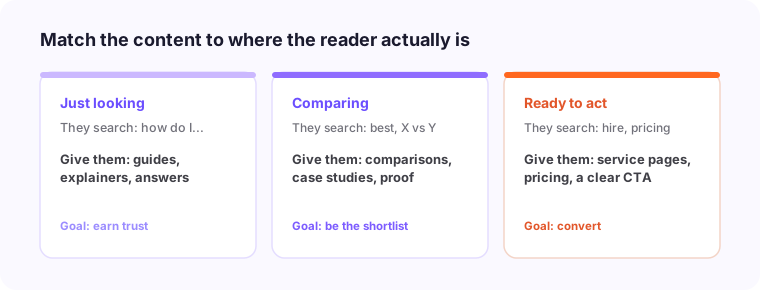
Starting With Keyword Research That Reflects Real Intent
Before writing anything, understand what your potential customer is searching for and why. Not just the keyword - the intent behind it. Someone searching 'mobile app development cost' is early in their research. Someone searching 'React Native vs Flutter for my project' is ready to make a decision and talk to someone. Those two pieces of content serve different stages of the buyer journey and should have different calls to action.
Use Google Search Console to find what queries are already bringing traffic to your site. These are the topics your audience cares about and that Google already associates with your domain. Build more depth around them before chasing new topics. Most content strategies we audit spend too much effort on new keywords and too little deepening their authority on the terms they're already winning.
- Google Search Console: free, shows exactly what queries drive current traffic
- Ahrefs or Semrush: for competitive keyword research and identifying gaps
- AnswerThePublic: for finding the questions people ask around a topic
- Google's People Also Ask box: direct insight into what related questions your content should answer
- Google Autocomplete: shows how people naturally phrase searches, useful for subheading ideas
Quality Over Quantity: What That Actually Means
'Quality over quantity' is advice that's easy to say and hard to operationalize. Here's what it actually means in practice. A quality piece of content fully answers the search intent. Someone searching for 'how to set up a CI/CD pipeline' should finish reading your article able to actually set one up. If they still need to Google three more things, you haven't fully addressed the intent.
Quality content includes original perspective. Not just a rewrite of what's already ranking - a point of view based on real experience. What did you discover that isn't obvious? What does the standard advice get wrong? What have you seen work in practice that theory doesn't predict? This is what earns links, social shares, and return visits.
Building a Content Calendar That Actually Gets Followed
Most content calendars fail because they're too ambitious and treat all topics as equal priority. A realistic content calendar has three tiers. Tier 1 is pillar content: comprehensive, high-value articles targeting your most important keywords, published monthly. Tier 2 is supporting content: shorter articles linking to pillar pieces and targeting long-tail queries, published bi-weekly. Tier 3 is news and commentary: timely takes on industry developments, published as needed.
The calendar specifies the topic, the primary keyword, the target audience persona, the intended call to action, and the person responsible for writing and editing. A brief with those five elements produces consistently better content than a blank page with a title.
The Writer Briefing Process
- Topic and primary keyword: one keyword the article is optimized for
- Target reader: their role, what they already know, and what problem they're trying to solve
- Desired outcome: what action should they take after reading
- Key points to cover: 5-7 specific points the article must address
- Competing articles to beat: 2-3 top-ranking URLs to study and outperform
- Word count target: minimum, not a ceiling
- Internal links to include: existing articles on your site the new piece should link to
Repurposing Framework for Maximum Reach
One well-researched article can produce 8 to 10 pieces of content across different formats. The full article is the foundation. A 5-slide LinkedIn carousel covers the key takeaways. A short LinkedIn post poses the central question with a link to the full piece. A 60-second video script covers the top 3 points. An email newsletter section summarizes the main insight. A Twitter thread breaks down the framework into 8 steps.
The work is done once. The distribution multiplies. Most teams skip repurposing because they're focused on producing the next new thing. The highest-leverage content teams we've worked with publish less frequently but extract far more from each piece through systematic repurposing.
Measuring Content ROI
Track three metrics for every piece of content: organic traffic (how many people found it through search), engagement (average time on page, scroll depth), and conversion (what percentage of readers took the desired next action). These three metrics tell you whether the content is attracting the right audience, whether it's compelling once they arrive, and whether it's connecting to business outcomes.
Content is a long game. Articles we've published 12 months ago consistently outperform articles published last month in terms of traffic. That compounding effect is why consistent publishing over 12 to 18 months produces outsized returns compared to bursts of activity followed by silence. The companies that win with content are the ones still publishing when the results feel slow.