“Every codebase tells a story. A code audit just makes sure you understand the plot before it becomes a crisis.”
On why technical due diligence should not wait for a problemWhat a Code Audit Actually Reviews
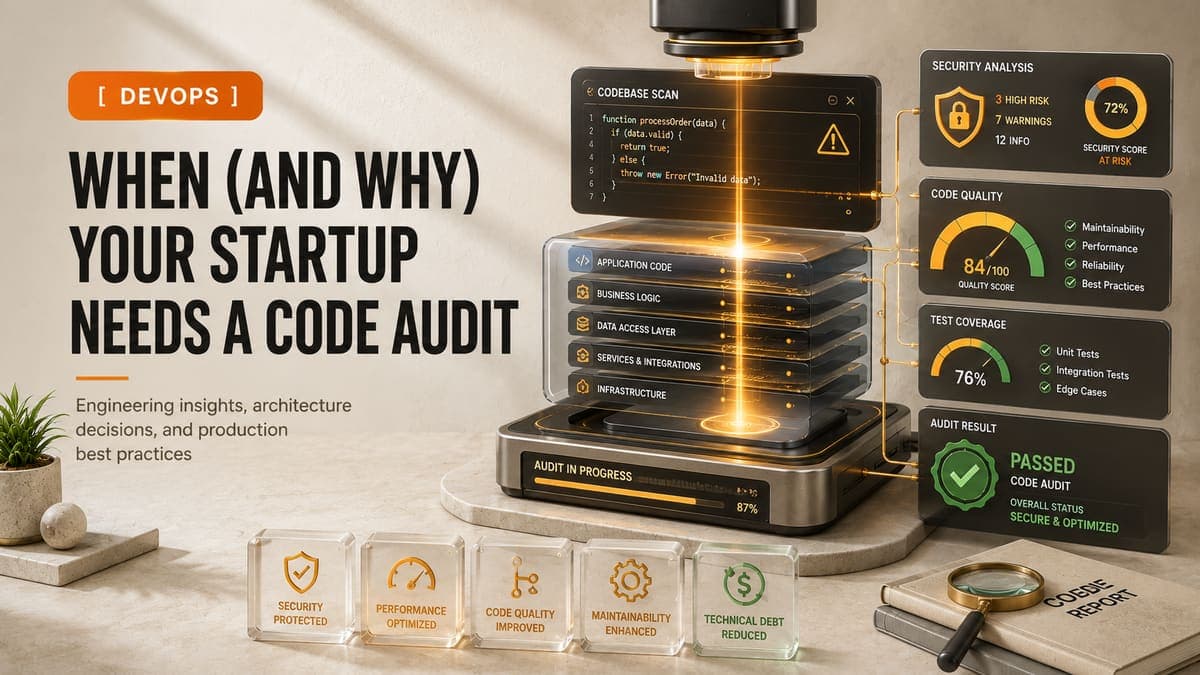
A code audit is a systematic review of your codebase, infrastructure, and engineering practices by someone who did not write the code. The goal is not to find every bug - it is to surface structural risks, security vulnerabilities, performance bottlenecks, and maintainability problems before they become production incidents or blockers to growth.
A serious audit covers more than the code itself. It looks at how your application is deployed, how secrets are managed, how dependencies are kept current, whether your test coverage actually reflects your risk surface, and whether a new engineer could reasonably onboard without a three-week guided tour from the person who built it.
The output is not a list of bugs. It is a prioritised set of findings - critical risks that need immediate attention, medium-term refactors that will pay back in velocity, and longer-term architectural recommendations tied to where your product is heading.
The Five Situations That Call for an Audit
The most common trigger is investor due diligence. A Series A term sheet almost always includes technical due diligence, and if your codebase has not been reviewed externally, you are walking into that process blind. Findings at that stage - particularly around security, scalability, or test coverage - can delay a close or become conditions of the investment.
The second situation is an acquisition or acqui-hire. The acquiring company's engineering team will pull your codebase apart. It is far better to know what they will find before the process starts than to negotiate around surprises mid-deal.
The third is a velocity problem. If your team is shipping less per sprint than they were six months ago despite roughly the same headcount, the problem is almost always in the code - accumulated technical debt, missing abstractions, fragile tests, or a data model that was right for v1 but is wrong for v3. An audit surfaces where the drag is coming from.
- Investor or acquirer technical due diligence is approaching
- Engineering velocity has dropped without a clear reason
- A security incident or near-miss has just occurred
- You're about to scale to 10x current load and aren't confident in the architecture
- The original engineering team has left and new engineers inherited the codebase
- You built your MVP with AI tools like Lovable, Bolt, or Cursor and are moving to production
The AI-Generated Codebase Problem
There is a rapidly growing category of startup codebases that were built primarily with AI coding tools - Lovable, Bolt, v0, Cursor, Replit, or similar. These tools can get a functional MVP running in days, which is genuinely useful. The problem is that generated code optimises for working right now, not for being maintained and extended over time.
The patterns we see repeatedly in AI-generated codebases: business logic embedded directly in UI components with no separation of concerns, no meaningful error handling, database queries without indexes on the columns that will be hit hardest, secrets committed to the repo during early development and never rotated, and a complete absence of tests.
None of these are dealbreakers on their own. All of them together, in a codebase about to go to production with real users, is a genuine risk. A code audit scoped specifically to AI-generated codebases is something we run regularly for founders coming out of the no-code and AI-tool stage - and the findings tend to cluster in predictable, fixable ways.
What a Good Audit Process Looks Like
How to Read the Findings
The most important thing to understand about a code audit report is that finding many issues is not a sign of a bad team. It is a sign of an honest audit. Every codebase accumulates technical debt. The question is whether the debt is being tracked and managed deliberately, or whether it is invisible and compounding.
Critical findings - typically security vulnerabilities like exposed credentials, broken authentication, or unvalidated user input reaching a database - need to be addressed before the report is a week old. They are not negotiable. Medium and low findings are prioritisation decisions: some will be worth fixing immediately because they affect developer velocity, others will stay in the backlog indefinitely because the cost of fixing them exceeds the benefit.
The architectural recommendations section is where you want your CTO or most senior engineer paying close attention. These are not bugs - they are structural choices that will constrain or enable what you can build over the next 12 to 24 months. A data model decision made at month one can be expensive to undo at month eighteen, and audits surface those decisions before they calcify.
The Cost of Waiting
What to Do After the Audit
The audit report is the beginning, not the end. Once you have a prioritised findings list, you need to convert it into a remediation plan with owners, timelines, and acceptance criteria for each item. Critical findings should be in the current sprint. High-priority items should have a target sprint. Architectural recommendations should be scoped as projects with rough estimates.
One common mistake is treating the audit as a one-time event. Codebases evolve, teams change, dependencies age, and new vulnerabilities are discovered. A lightweight quarterly review - covering dependencies, secrets rotation, and a sampling of new code - catches drift before it becomes a serious problem. A full audit every 12 to 18 months, or at major inflection points like a fundraise or a significant team change, keeps the risk profile manageable.
The startups that handle audits well treat them the way a CFO treats a financial audit - a necessary, recurring part of running a serious company, not a one-off triggered by a crisis. If your codebase has never been reviewed externally, or if it was built primarily with AI tools and is heading toward a funding round, that is the conversation we have first before we talk about what comes next.