“The most expensive words in software development are 'I assumed you meant...' - said by both sides, after a month of work.”
The cost of an unclear briefWhy Most Projects Go Wrong Before They Start
The moment a developer writes the first line of code without a clear brief is the moment the project starts accumulating hidden cost. Every assumption they make that doesn't match your vision is a conversation, a revision, a delay, or a rebuild that didn't need to happen.
Most founders, especially first-time app buyers, underestimate how much of the project happens before any code is written. The planning phase is not overhead - it's the work that makes the execution phase possible without constant interruption and rework.
This post covers exactly what to prepare before your developer starts building. None of it requires technical knowledge. All of it saves money and reduces the frustration that comes from a build that drifts away from what you imagined.
A Written Description of the Problem You're Solving
Before you describe features, describe the problem. Who are your users and what are they currently doing to solve this problem without your app? What's painful or inefficient about that? What does success look like for a user 30 days after they start using your product?
This context shapes every technical decision a developer makes. The same feature - say, a user notification system - looks completely different depending on whether your users are checking the app several times a day or relying on it weekly for a single critical workflow.
Two paragraphs is enough. You're not writing a business plan. You're giving the developer a lens for every decision they make when you're not available to answer a question.
A Feature List With Priority Levels
List every feature you can think of, then assign each one to one of three buckets: must have for launch, nice to have for version 1, and future phases. This is harder than it sounds because everything feels essential when you're imagining the finished product.
A useful test for the must-have bucket: if this feature were missing at launch, would you delay launch? If yes, it's must-have. If no, it's not. Most founders who go through this exercise honestly end up with a must-have list that is 30 to 40 percent shorter than their original feature count - and a launch that happens on schedule.
Sharing this prioritized list rather than a flat feature dump also helps your developer estimate accurately. A project with 10 must-haves and 20 nice-to-haves is scoped and priced very differently from one that presents 30 features as equally urgent.
Wireframes or Reference Screenshots
You don't need to hire a designer before a developer. You need to communicate what you have in mind visually - and that can be hand-drawn sketches, a free Figma file, or screenshots of other apps annotated with "something like this, but..." notes.
The value of wireframes is not aesthetic - it's precision. When you sketch a screen, you discover decisions you didn't know you'd made. Where does the navigation live? What happens when a user has no data yet? What does the error state look like? Every screen that you sketch before development is a screen that doesn't need to be reworked after development.
If you've started with a no-code tool like Lovable, Bolt, or v0 and have a working prototype, share that. Even if it's broken or incomplete, it communicates intent better than any written description. Good developers use it as a reference point, not a constraint.
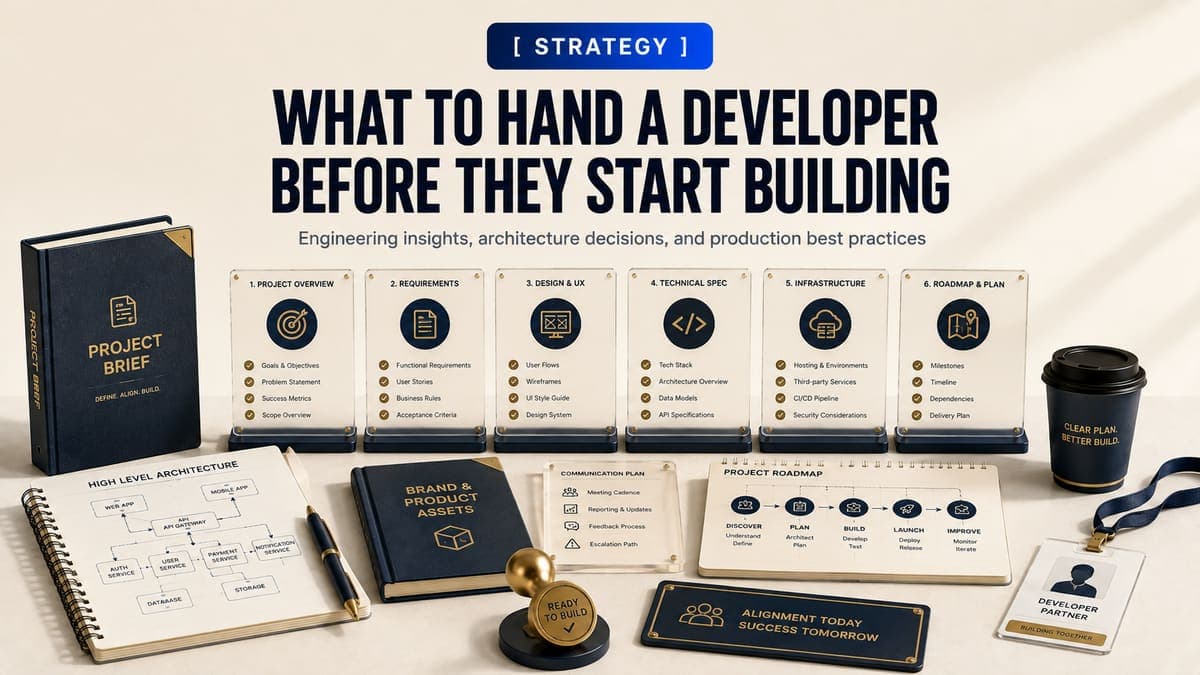
Problem brief
2 paragraphs: who are your users, what problem they have, what success looks like for them
Prioritized feature list
Every feature in one of three buckets: must-have for launch, v1 nice-to-have, future phases
Wireframes or references
Sketches, annotated screenshots, or a prototype - anything that shows intent on key screens
Technical accounts and access
Your domain registrar, hosting accounts, and any third-party API credentials set up in your name before kickoff
Definition of done
Written acceptance criteria for the first milestone - how will you both know the first phase is complete?
The Accounts and Credentials You Need to Set Up
This is the step first-time buyers most often skip, and it's the one that causes the most painful disputes. Before development begins, you should own and control the accounts where your product will live: your domain registrar, your hosting provider (AWS, GCP, Vercel, or similar), your database, and any third-party services the product depends on.
Invite the developer as a collaborator - not as the account owner. This sounds like a small distinction until a payment dispute or a change in developer relationship means you need access to your own product and you discover you've been locked out of the infrastructure it runs on.
The same logic applies to the code repository. Set up a GitHub or GitLab organization under your account and add the developer as a contributor. The code is your asset. It should live in your space from day one.
What "Done" Looks Like for the First Milestone
Before work starts, agree in writing on what the first milestone delivers and how you'll both know it's complete. Vague milestones like "Phase 1: core features" create disputes because they mean something different to you than to the developer.
A good milestone definition names the specific screens that will be built, the user actions that will work, the devices it will be tested on, and any performance criteria that matter - for example, "the dashboard loads in under 3 seconds on a standard mobile connection." This is your acceptance criteria, and it removes subjectivity from the review.
Writing this down before the build starts is also a useful sanity check on whether you and the developer have the same understanding of the scope. Any gap that appears when you try to write it down is a gap that would have appeared anyway - just later, and more expensively.
A Note on Trusting the Process
Handing a developer a well-prepared brief is not a one-time exercise - it's the foundation of a working relationship. The founders who get the most out of their development budget are the ones who treat the planning phase seriously, show up to reviews with clear feedback, and make decisions promptly when trade-offs arise.
Where teams get stuck is usually not in the building - it's in the back-and-forth that happens when expectations weren't set clearly at the start. A developer waiting on a decision about a feature is a developer you're paying to wait.
If you're about to kick off a project and you'd like help structuring your brief, reviewing a proposal, or picking up a build you've already started, Zovintra works with founders at exactly this stage. We run a structured discovery process that produces the brief, the feature priority list, and the milestone definitions before a single line of production code is written.