The biggest MVP mistake isn't building too little - it's building too much. Teams pack in features because they're afraid the product won't be competitive. Then they spend 6 months building something that could have been validated in 6 weeks. The irony is that the extra features almost never make the product more competitive. They make it slower to launch and harder to learn from.
“The hardest part of an MVP is not deciding what to build. It is having the discipline to leave almost everything else out.”
The discipline of minimalDefine the Core Loop Before Anything Else
Every product has one core action that delivers value. For a ride-hailing app, it's booking a ride. For a health app, it's logging a metric and seeing a trend. For an e-commerce tool, it's listing a product and receiving an order. Your MVP should make that one thing work perfectly. Everything else - profiles, analytics dashboards, integrations, admin tools - is a distraction until the core loop is validated.
Write the core loop as a single sentence: 'The user does X and gets Y as a result.' If you can't write that sentence, you haven't defined your product clearly enough to build it. Product clarity at the definition stage prevents scope creep at the build stage.
The Scoping Workshop Process
We run a 3-hour scoping workshop with every new product client before writing a single requirement. The workshop covers four questions in order. What problem are we solving and for whom? What does success look like in 6 months (specific, measurable outcomes)? What is the one action our user must be able to take for the product to deliver value? What can we do manually or with off-the-shelf tools while we build?
That last question consistently produces the most surprising answers. Founders often discover they can serve their first 20 customers manually using spreadsheets and email while they build the automated version. Those 20 customers teach them more about what the product needs to do than any amount of upfront specification.
Prioritization Using MoSCoW
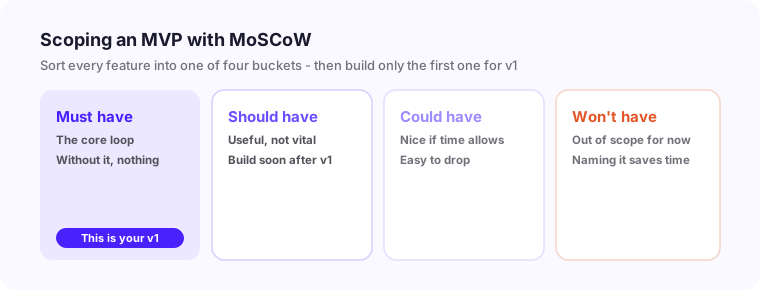
MoSCoW (Must-have, Should-have, Could-have, Won't-have) is the most useful prioritization framework for MVP planning. It forces explicit decisions about what's truly essential versus what's nice to have. The discipline is in the Must-have category - it should be ruthlessly small. If the product doesn't work without a feature, it's Must-have. If a user could complete the core job without it, it's not.
- Must-have: the product literally doesn't work without this
- Should-have: important but the product can launch without it and add in sprint 2
- Could-have: desirable if time allows, no real impact if absent at launch
- Won't-have: explicitly out of scope for this version - document it so it doesn't re-enter scope
Features to Cut From Every MVP
In every MVP planning session we run, the same categories of features appear in the must-have list that don't belong there. The most common is admin dashboards. You don't need a custom-built admin panel to manage your first 50 users - use your database GUI, a spreadsheet, or a third-party tool. Build it when the manual process breaks.
Social features are almost always premature. Comments, sharing, user profiles, follow functionality - these require a critical mass of users to have value. An MVP with no users doesn't need social features. Add them when you have users who are asking for them.
- Admin dashboards: use a database GUI or Retool until manual management breaks
- Social features: comments, sharing, profiles - build when users ask for them
- Multiple user roles: start with one role type and expand based on real requests
- Third-party integrations: validate demand manually before automating
- Custom analytics: use Mixpanel or PostHog free tiers before building your own
- Email templates and notification preferences: one template and one notification type is enough to start
Timeline Estimation and Common Anti-Patterns
MVP timelines are consistently underestimated because teams estimate the happy path - the features working perfectly with no edge cases, no integration issues, and no requirement changes. A more accurate estimate adds 40% buffer to the technical estimate (for integration overhead, testing, bug fixing, and deployment configuration) and treats requirements as variable (something will change once development starts).
The most common MVP anti-patterns we see: perfectionism disguised as quality standards (launching a 'finished' product 6 months later when you could have launched something rough 2 months earlier), feature bundling (refusing to launch until a second-priority feature is ready), and audience broadening (adding features to appeal to a second audience before validating with the first).
Post-Launch Measurement and Iteration Planning
Define your success metrics before you launch, not after. If you define them after, you'll unconsciously select metrics that make your results look better than they are. The key metrics for a typical MVP: activation rate (percentage of signups who complete the core action), retention rate (percentage of users who return within 7 days), and task completion rate (percentage of users who successfully complete the core flow without support intervention).
Set a 4-week post-launch review date. Collect all the data, run 5 to 8 user interviews with real users, and make explicit decisions: continue building in the current direction, pivot based on what you've learned, or stop. The review meeting should produce a clear answer to one question: did we validate our core assumption?
The best products we've built started small and grew based on evidence, not assumptions. An MVP that launches in 6 weeks and teaches you something is worth ten MVPs that launch in 6 months and teach you nothing because you've already spent the learning budget.