“Every week you wait after a developer goes silent is another week of compounding uncertainty. Act fast, stay methodical, and document everything.”
The first 48 hours matter mostYour developer stopped responding. Calls go to voicemail. The last message in your project channel was two weeks ago. You do not know if the app runs, where the code is, or whether you have the credentials to access anything. This situation happens more often than most people expect, and how you handle the first week makes the difference between recovering the project and starting from scratch.
This guide covers exactly what to do, in order, when a developer or freelancer goes silent mid-project.
Step 1: Confirm It Is Actually a Ghost
Before assuming the worst, send one final message across every communication channel — Slack, email, WhatsApp, LinkedIn — clearly stating that you need a response within 48 hours to continue the relationship. Make it non-threatening. People disappear for health emergencies, family crises, or mental health reasons. Give them a clear, reasonable window to re-engage.
If 48 hours pass with no response after a clear message, you are dealing with a ghost. At this point your response becomes about recovery, not reconciliation.
Step 2: Secure Every Access Point You Have
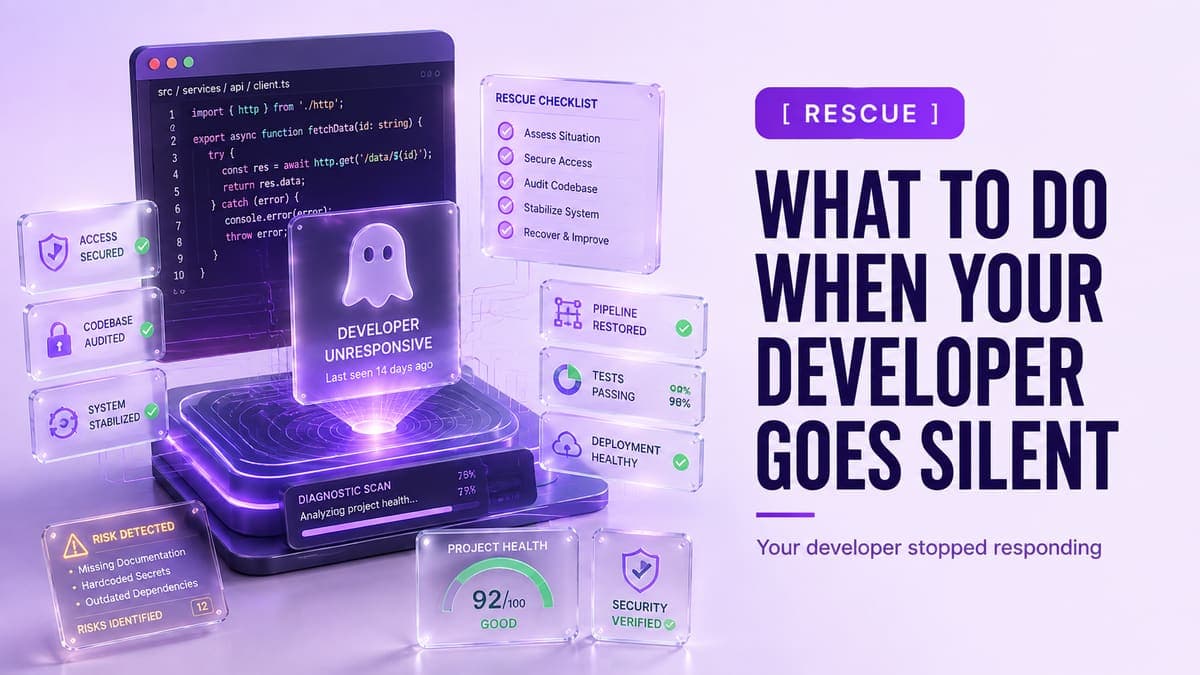
Immediately change passwords on every account where you have access and the developer was added as a collaborator. This includes your domain registrar, your hosting provider, your cloud accounts (AWS, Google Cloud, Vercel), your app store accounts, and any third-party services the app relies on.
Remove the developer as a collaborator or administrator from every platform. Do this before you attempt to contact them further. You are not being aggressive — you are protecting your business. If they later resurface and have a legitimate explanation, you can restore access. If they resurface and they are angry, you have protected yourself from a retaliatory action.
Step 3: Inventory What You Have Access To
- Code repository: do you have GitHub, GitLab, or Bitbucket access? Can you clone the repository?
- Database: do you have connection credentials? Is there a recent backup?
- Hosting and servers: do you have access to the deployment environment?
- App store accounts: are you the owner on App Store Connect and Google Play Console?
- Domain and DNS: do you control your domain registrar?
- Third-party APIs: do you have the API keys or are they stored only in the developer's environment?
- Design files: are Figma or Adobe XD files accessible in your account or theirs?
Step 4: Get an Independent Technical Assessment
Before you can decide what to do next, you need to know what you actually have. An independent developer or agency can review the codebase and answer the questions that matter: does the app run, is the code quality reasonable, how much work is genuinely done versus how much is scaffolding, and what would it take to complete the project?
This assessment typically takes 2 to 5 days and costs $500 to $2,000 depending on the codebase size. It is the cheapest possible investment given the alternative of paying another team to build on a foundation you do not understand. Do not skip it even if you are in a hurry.
Step 5: Understand Your Legal Position
Review your original contract or agreement. If you paid a fixed price and the work is not delivered, you likely have a claim for breach of contract. If you were paying hourly and have already paid for delivered work, the calculation is different. Either way, document everything: the original agreement, all payments made, all communications, all milestones that were or were not delivered.
For amounts under $5,000 to $10,000, small claims court is a realistic option in most jurisdictions. For larger amounts, a solicitor's letter is often enough to produce a response. Note that winning a legal claim against someone with no assets is largely academic — the documentation is still worth having because it establishes the record.
Step 6: Decide Whether to Continue the Project
After the technical assessment, you have a real decision to make. The assessment will tell you whether the codebase is worth continuing from, whether it needs significant remediation before it can be built on, or whether it would be faster to start fresh. The honest answer is sometimes the last option, and accepting that early saves months of compounding cost on a foundation that does not work.
Days 1–2: Attempt final contact and begin access audit
Send the final communication across all channels. Simultaneously document what access you currently have and do not have.
Days 2–3: Secure and change all access
Change passwords, remove developer access, transfer domain and hosting ownership where possible.
Days 3–7: Commission technical assessment
Engage an independent developer to review the codebase and provide a written report on what exists and what it would take to complete.
Days 7–10: Make the continuation decision
Based on the assessment, decide whether to continue from the existing codebase or start fresh, and begin engaging a new development team.
If you are in this situation right now, the most important thing is to start acting today. Every week of inaction means one more week of risk exposure, one more week of project delay, and one more week of the situation becoming harder to recover from. The assessment is the first step — everything else follows from understanding what you have.