“Everything that made your MVP fast to build will slow you down at scale. The question is which trade-offs to address first and in what order.”
The second build problemThe transition from MVP to scaled product is where many technically successful startups run into unexpected problems. The MVP worked. Users came. Revenue arrived. And then something that felt like a straightforward next step — adding a new feature, onboarding a large client, running a marketing campaign — exposed a problem that was always there but was hidden by small scale.
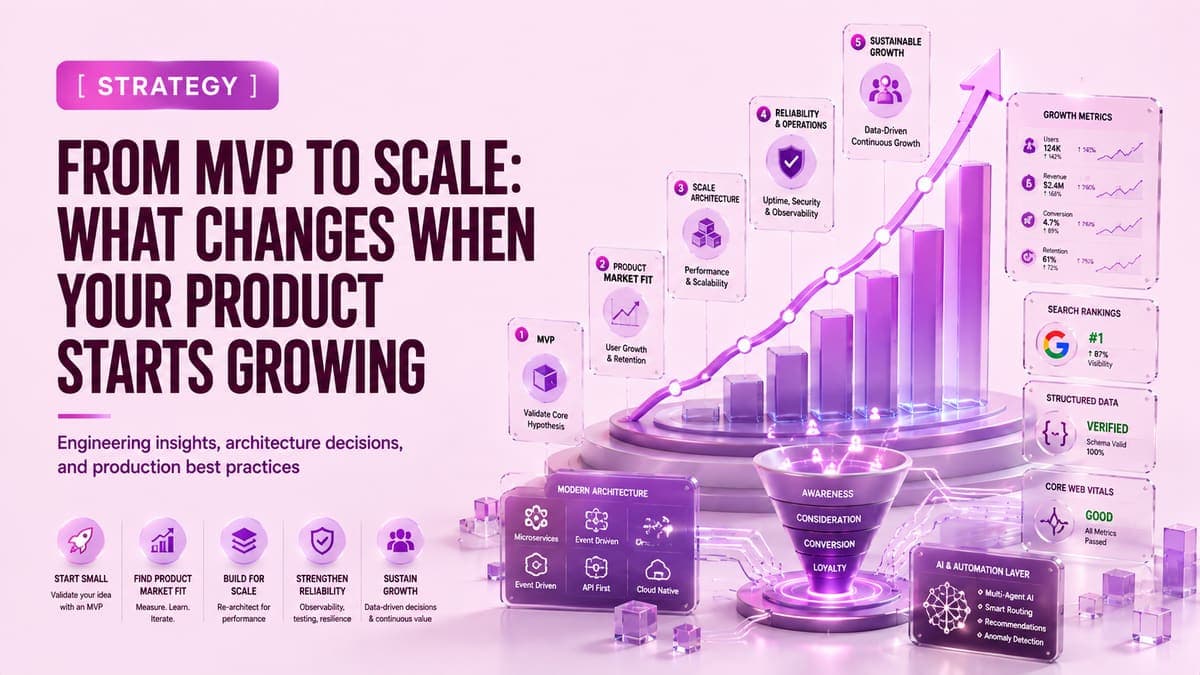
This guide covers the specific things that change when a product moves from MVP to scale, how to recognise the problems before they become crises, and how to sequence the work of addressing them.
What an MVP Is Optimised For
An MVP is optimised for speed to learning. It is built to test one core assumption with the minimum investment. By definition, it trades long-term architectural quality for short-term speed. The decisions that made sense at MVP stage — simpler data models, less robust error handling, manual processes instead of automation, a single server rather than a distributed architecture — create constraints as the product grows.
This is not a failure of the MVP approach. It is the expected outcome of an approach that correctly prioritises speed over permanence. The failure would be treating those MVP-stage trade-offs as permanent rather than as deliberate short-term decisions to be revisited as you learn and grow.
The 6 Things That Break First
- Database performance: queries that take 10ms on 1,000 rows take 5 seconds on 1,000,000 rows without proper indexing
- Authentication and authorisation: session management that works for 100 users fails in specific ways at 10,000
- Email and notification delivery: what was handled by a basic SMTP call needs a proper queue and retry system at scale
- Background jobs: tasks that ran synchronously for single users need proper background processing for concurrent users
- Manual operations: anything a person was doing manually for a handful of customers becomes a bottleneck at hundreds
- Third-party API rate limits: integrations that worked under low volume hit rate limits and cost thresholds at scale
The Performance Problem Is Invisible Until It Is Not
The insidious thing about performance problems is that they are invisible until they are dramatic. Your app works perfectly at 500 users and then is unusable at 501, not because of a single change but because a database query that was taking 200ms on 50,000 rows is now taking 8 seconds on 200,000 rows. The fix is adding an index — 15 minutes of work — but identifying which query is the problem requires monitoring infrastructure that may not have been set up.
The way to prevent this is to set up query performance monitoring before you need it. Tools like Supabase's query analytics, Datadog, or New Relic show you which queries are slow before they become user-facing problems. Doing this during the MVP stage costs almost nothing. Doing it after an outage is more expensive in every way.
When to Invest in Platform Improvement vs. New Features
The tension between platform improvement (fixing the foundation) and new feature development (adding capability) is one of the defining challenges of scaling a product. New features drive growth. Platform improvement enables future growth. Both are necessary and neither can be ignored indefinitely.
A practical rule: when any of the following is true, platform work should be scheduled before the next major feature: a production incident occurred in the last three months and the root cause is unresolved, load testing reveals performance thresholds below your next growth target, manual operations are consuming more than one day per week of engineering time, or a security review has identified unresolved medium or high severity issues.
The Engineering Team Transition
The skills needed to build an MVP fast are not identical to the skills needed to scale a product safely. MVP-stage development prioritises speed of delivery and flexibility. Scale-stage development prioritises reliability, observability, and the ability to make changes without introducing regressions. Teams that are excellent at one sometimes struggle with the other.
This is not a reason to change the team — it is a reason to invest in process. Code review culture, automated testing, deployment pipelines, and on-call protocols are not overhead. They are the infrastructure that makes it possible to keep shipping fast without breaking what already works. Introducing these practices during the transition from MVP to scale, rather than after the first significant production incident, is significantly cheaper in the long run.