
“The choice between staff augmentation and a dedicated team is a question of control versus continuity. Get the balance right for your context and both can work well.”
The trade-off in plain termsIf you are scaling your engineering capacity and considering external help, two models come up most frequently: staff augmentation (adding individual engineers to your existing team) and dedicated teams (engaging an external team that operates as a unit). Both work. The right choice depends on your existing team structure, your management capacity, and the nature of the work.
What Staff Augmentation Is
Staff augmentation means adding individual engineers — or designers, QA specialists, or product managers — from an external provider to work directly within your team. They attend your standups, work in your project management system, and report to your internal leads. The external provider handles HR, payroll, and HR compliance. You direct the work.
The advantage is flexibility: you add the specific skills you need, scale up and down as your workload changes, and maintain full control over how the work is done. The requirement is that you have the management capacity to direct that work. Staff augmentation engineers are not self-managing — they need a product roadmap, sprint planning, code review, and direction from internal leads.
What a Dedicated Team Is
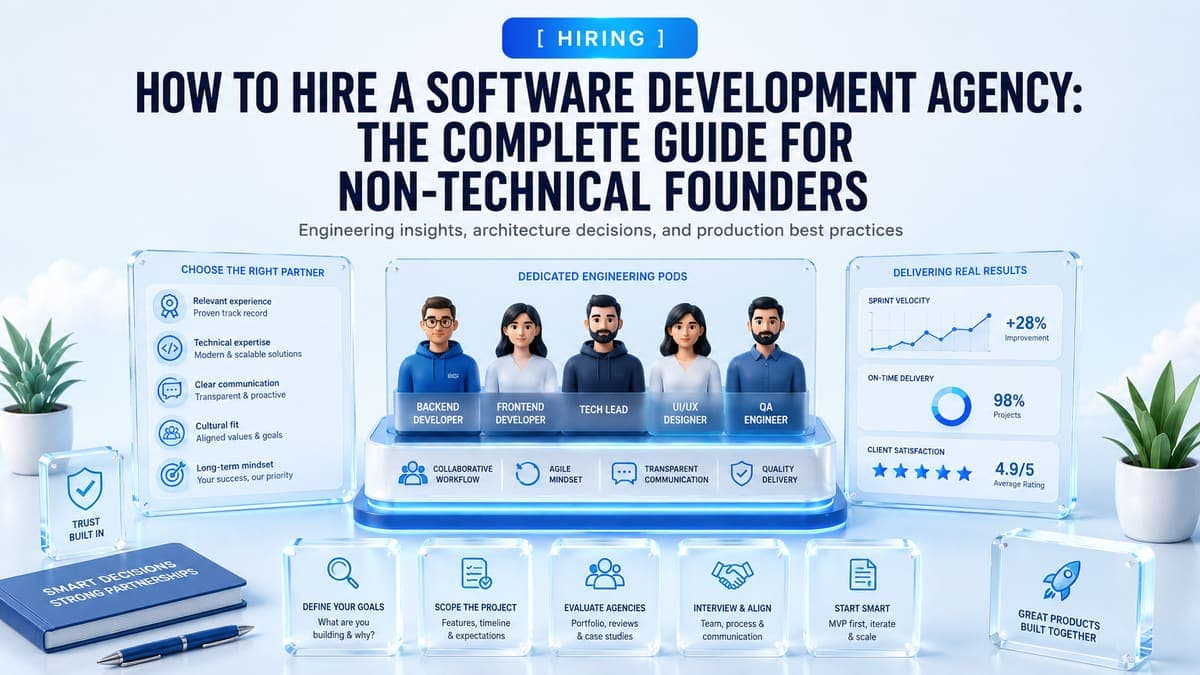
A dedicated team is a group of engineers — and often a project manager, a tech lead, and sometimes a designer — who work on your project as a coherent unit. They have their own internal coordination, their own sprint processes, and a project manager who is your point of contact rather than individual engineers. You define what needs to be built. They handle how it gets built.
The advantage is lower management overhead on your side. You do not need to run sprints, resolve inter-team conflicts, or manage individual engineering performance. The trade-off is that you have less direct control over individual decisions and a higher dependency on the external team's internal culture and process quality.
Dedicated Team
- External team operates as a unit with internal coordination
- External PM manages day-to-day — you manage outcomes
- Higher cost, lower management overhead for you
- Best for: building a capability you do not yet have internally
- Requires a clear product roadmap and outcome expectations
The Management Capacity Test
The single most important factor in choosing between these models is your existing management capacity. Staff augmentation works when you have internal tech leads with the time and skills to direct additional engineers, run code reviews, and manage sprint priorities. If your existing leads are already at capacity, adding unmanaged engineers makes the situation worse, not better.
If you do not have the internal management capacity, a dedicated team model — with its own internal project management — is typically the more productive choice, even though the per-hour cost may be higher. The productivity difference between a managed dedicated team and an unmanaged augmented individual is significant enough to outweigh the cost differential in most cases.
Hybrid Models
Many engagements blend both approaches. A dedicated team builds a new capability or a significant new product, then hands it over to an augmented individual who maintains and iterates on it alongside the internal team. Or an internal team is supplemented with specific expertise — a mobile specialist, a security engineer, a data engineer — that fills a skill gap without requiring a full dedicated team.
The best model is the one that matches the work to the management infrastructure you actually have, not the one that sounds most efficient in a presentation. If you are uncertain which applies to your situation, describe your team structure and workload to the agency you are considering — a good agency will tell you which model they think fits rather than defaulting to the most profitable one.