“By the time a founder emails an agency, they have already made 70% of the decision. Your job is to make sure the right information reaches them during those invisible months.”
The hidden buying journeyHiring a software development agency is one of the most consequential decisions a non-technical founder will make. Get it right and you have a team that builds exactly what your users need, on time, with code you actually own. Get it wrong and you are 12 months in, $80,000 spent, with a half-built app and a developer who has gone silent.
This guide covers everything you need to know before signing anything: how to evaluate agencies, what questions to ask, what red flags to watch for, and how to structure the engagement so you're protected. It is written for founders who cannot read code, not for developers comparing frameworks.
What You Are Actually Buying
When you hire a software development agency, you are not buying code. You are buying a process, a team, and a set of decisions made on your behalf over several months. The code is the output. The quality of your outcome depends on how good the agency's decision-making is — on architecture choices, on technology selection, on how they handle ambiguity when your brief is incomplete.
Most agencies can produce working software. The question is whether that software will still work when you have 5,000 users instead of 50, whether it is secure enough to handle payment data, and whether you can maintain and extend it without being permanently dependent on the same agency.
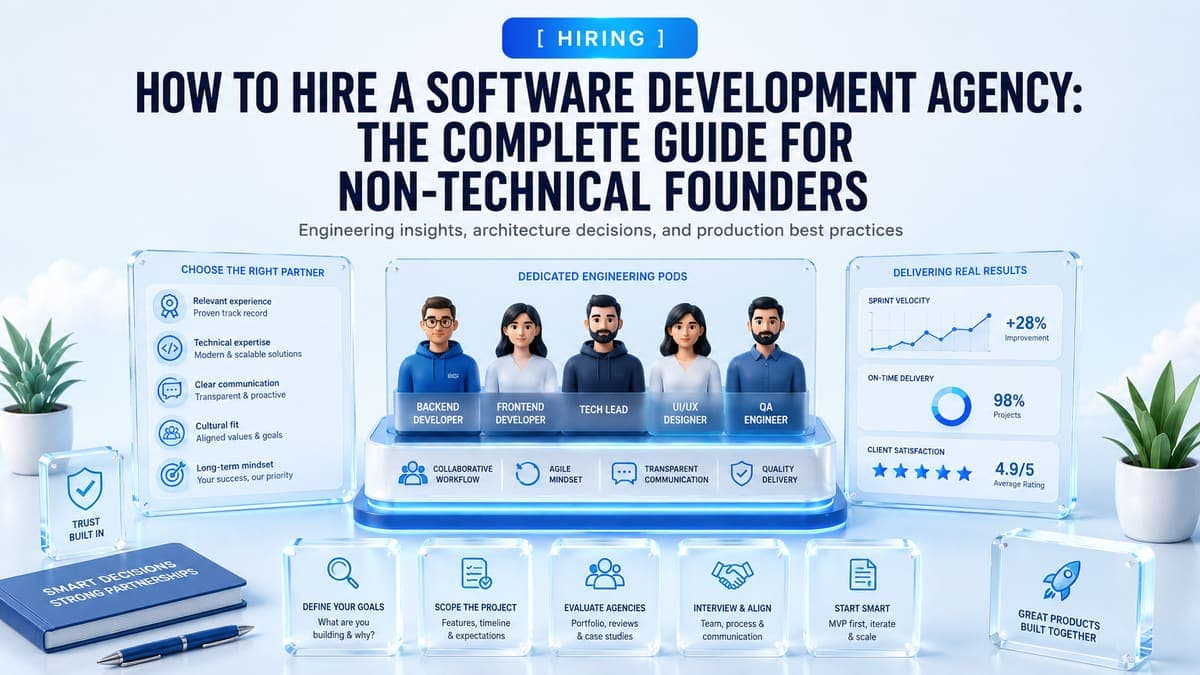
The 5 Stages of Finding and Hiring an Agency
- Stage 1: Define your project before approaching anyone — what problem, what users, what MVP scope, what budget range
- Stage 2: Build a longlist of 6 to 10 agencies through referrals, Clutch, and search
- Stage 3: Filter to a shortlist of 3 to 4 through website review, case study quality, and initial emails
- Stage 4: Run discovery calls and request proposals from your shortlist
- Stage 5: Evaluate proposals, check references, and make the final decision
What to Look For on an Agency's Website
Before you contact anyone, their website tells you a significant amount. An agency that cannot communicate clearly about its own services will not communicate clearly about your project. Look for specificity: does the portfolio show real products with real outcomes, or just screenshots? Are there case studies with actual numbers — not just 'we improved conversion rates' but 'we increased checkout completion from 31% to 67% in 8 weeks'?
Look at who writes the blog. If articles are attributed to a generic 'team' and cover every possible topic at surface depth, it usually means the content is written to attract search traffic, not to demonstrate expertise. The best agency blogs have named authors — engineers, designers, or founders — writing with specificity about problems they have actually solved.
The 10 Questions That Separate Good Agencies from Great Ones
- Who specifically will be working on my project day-to-day, and can I meet them before signing?
- Can you walk me through a recent project that went wrong, and what you did about it?
- How do you handle scope changes mid-project, and can I see a sample change request?
- What does your onboarding look like in the first two weeks?
- What will I own at the end — repository access, infrastructure credentials, documentation?
- How do you structure your development process and how often will I see working software?
- What happens if someone on the team leaves mid-project?
- Can I speak with two or three past clients who had a project of similar size?
- What does your handoff process look like when the project ends?
- What technology stack would you recommend for my project, and why?
Green Flags and Red Flags
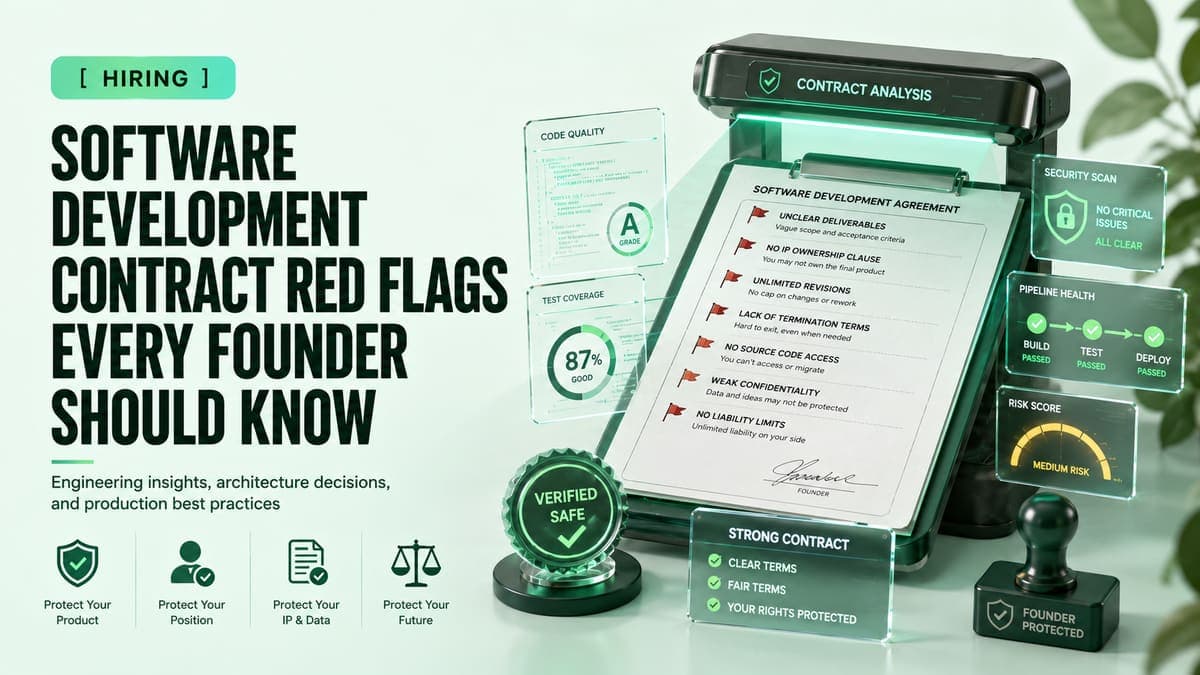
Red Flags
- Senior devs pitch, junior devs build — at senior rates
- They agree to every feature without discussing trade-offs
- They cannot show live production apps, only mockups
- They resist giving you repository access from day one
- They offer vague status updates without shared project visibility
- They quote an hourly rate but cannot give a total estimate
Contract Basics Every Founder Should Understand
The contract protects both sides, but the first priority is making sure you own what gets built. Look for explicit IP assignment language — every line of code, every design file, every database schema becomes your property upon payment. This should not be an assumption; it should be written. Some agencies default to retaining IP ownership or licensing the code back to you. If the contract is silent on this, ask before signing.
Payment structure matters. The safest structure ties payments to delivery milestones, not calendar dates. A split of 25% on signing, 50% across defined milestones, and 25% on final acceptance protects you from paying for work that hasn't been delivered while giving the agency enough to resource the project properly. Never pay 50% or more upfront before seeing significant work.
How to Evaluate a Proposal
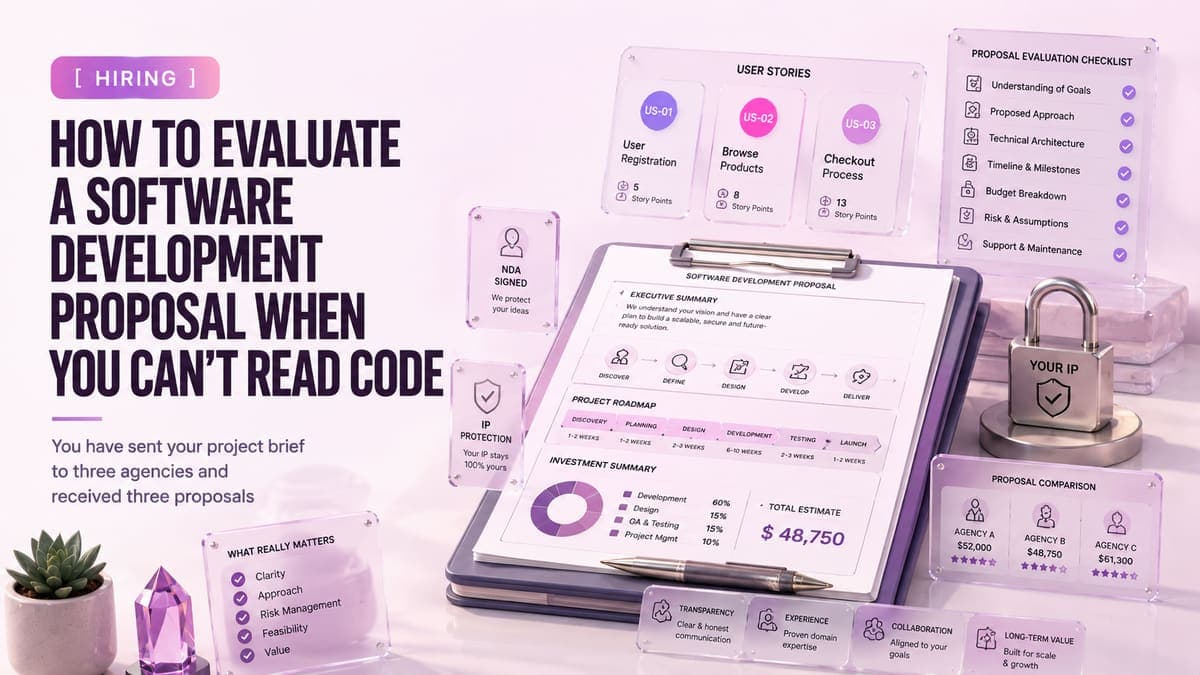
A good proposal breaks down the cost by phase and by deliverable, not just by hour or by total project. If you receive a proposal that says '$45,000 for a mobile app' with no further detail, ask for a phase-by-phase breakdown showing what is included in each phase and what the acceptance criteria are.
Be cautious of the cheapest quote. Agencies that significantly underbid competitors are often planning to make up the difference through change requests, or they have not thought carefully about the scope. Ask any agency that comes in significantly below others what they would not include that the others might.
The quality of communication during the proposal process is a preview of working with the agency. How fast do they respond? Do their questions show they read your brief carefully? Are they asking about your users and goals, or just your feature list? The way an agency handles the sales process is almost always how they handle the project.