“Software projects rarely fail catastrophically. They fail slowly, one missed milestone and one vague update at a time.”
How projects actually go wrongThe founder who is $100,000 into a failed software project almost never saw it coming. The project felt like it was progressing until, suddenly, it was not. But the warning signs were there — they just did not know what to look for.
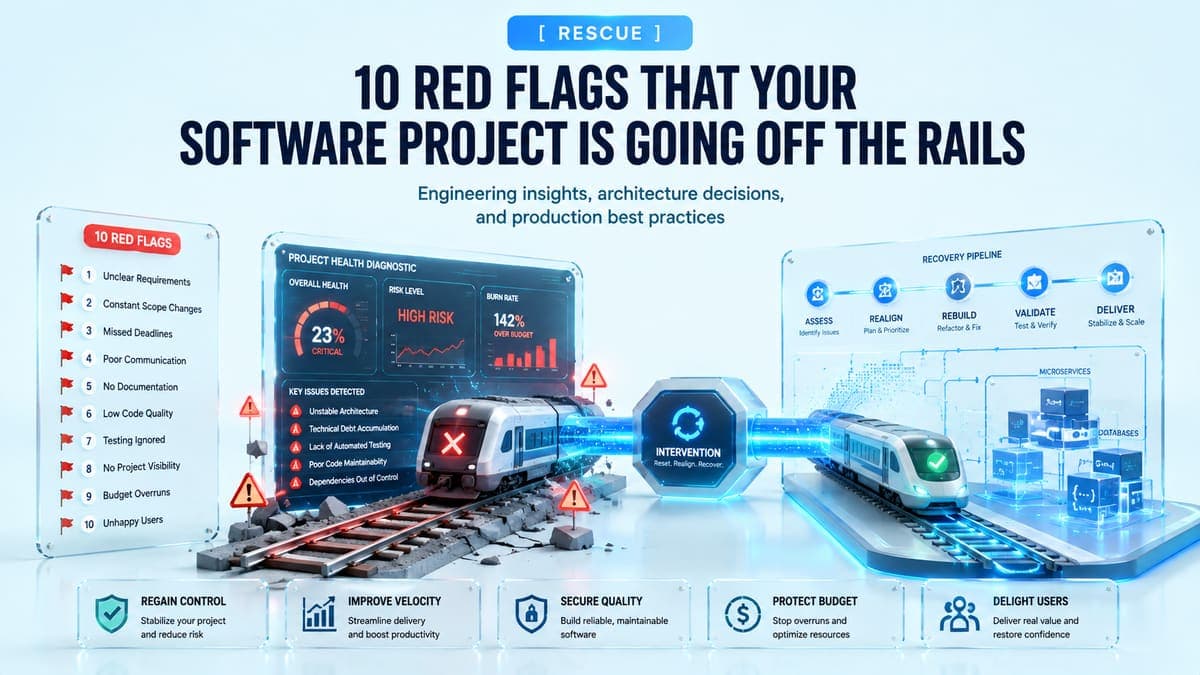
These are the 10 most reliable indicators that a software project is headed for trouble. If you recognise two or more in your current engagement, start asking harder questions now rather than later.
Red Flag 1: Status Updates Are Narrative, Not Factual
'We're making great progress on the backend' is not a status update. It is a sentence. A real status update tells you what was committed for the sprint, what was completed, what carried over, and why. If your developer or agency is consistently delivering narrative updates without specific completions, they are either behind and managing your expectations, or they do not have a process that produces specific outputs.
Red Flag 2: You Have Not Seen Working Software in More Than Two Weeks
Modern development practices produce working software in two-week increments. If you cannot see a functioning, deployed version of features that were supposedly completed in the last sprint, ask why. 'It's not quite ready to show yet' after two weeks of development is not an acceptable answer for features that should have been delivered in that sprint.
Red Flag 3: Scope Is Constantly Expanding
Some scope evolution is healthy and expected. Constant scope expansion without corresponding timeline and budget adjustments is a sign that either the original scope was poorly defined, the agency is saying yes to everything without managing the impact, or there is no change management process protecting you from unlimited expansion.
Red Flag 4: The Team That Is Building Is Not the Team That Pitched
The 'bait and switch' is one of the most documented patterns in outsourced development. Senior developers and the agency founder are present during the sales process. Junior developers — often significantly less experienced — do the actual build. Ask who specifically is working on your project. Meet them. Check their credentials. If the composition has changed since signing, ask why.
Red Flag 5: You Do Not Have Repository Access
If you do not have access to the code repository — or if the repository exists in the agency's account rather than yours — you do not control what happens to your project if the relationship ends. This is not just a risk signal: it means that everything built so far may be inaccessible to you without the agency's cooperation.
Red Flag 6: Bugs Are Being Fixed But Keep Reappearing
Bugs that are fixed and then reappear in the same or adjacent features are a signal of insufficient testing and poor code quality. In a healthy codebase, fixes are stable. In a codebase accumulating technical debt, every fix introduces new problems because the foundations are not solid. This pattern accelerates over time — it does not self-correct.
Red Flag 7: The Agency Agrees to Everything
Good agencies push back. They tell you when a feature will add complexity without proportionate value, when a deadline is unrealistic, or when a technical decision you want to make will create problems later. An agency that agrees to every request and every timeline without asking hard questions is either not engaging with your project seriously or does not have the experience to recognise the problems.
Red Flag 8: Costs Are Escalating Beyond the Original Estimate
On a fixed-price contract, costs should not escalate unless the scope has genuinely changed. On a time and materials contract, costs can escalate if the work is taking longer than estimated. The red flag is when escalation is not accompanied by a clear explanation of what changed and why — and when the explanation does not match what you know about the project.
Red Flag 9: The Agency Is Unreachable for Days at a Time
Development work involves blockers. Questions that need answering before progress can continue. A team that is genuinely working on your project has frequent communication, not because everything is going well, but because they need input to keep moving. Multi-day silences are either a sign of a crisis being managed internally without your knowledge, or a team that is deprioritising your project.
Red Flag 10: The Timeline Has Slipped More Than Twice
One timeline slip is normal. Two slips on the same feature or phase is a pattern. When timelines slip repeatedly, the root cause is either an original estimate that was never realistic, a team that is underperforming, or a scope that is significantly larger than what was agreed. Any of these requires an honest conversation — and if the honest conversation is not possible, that itself is a red flag.