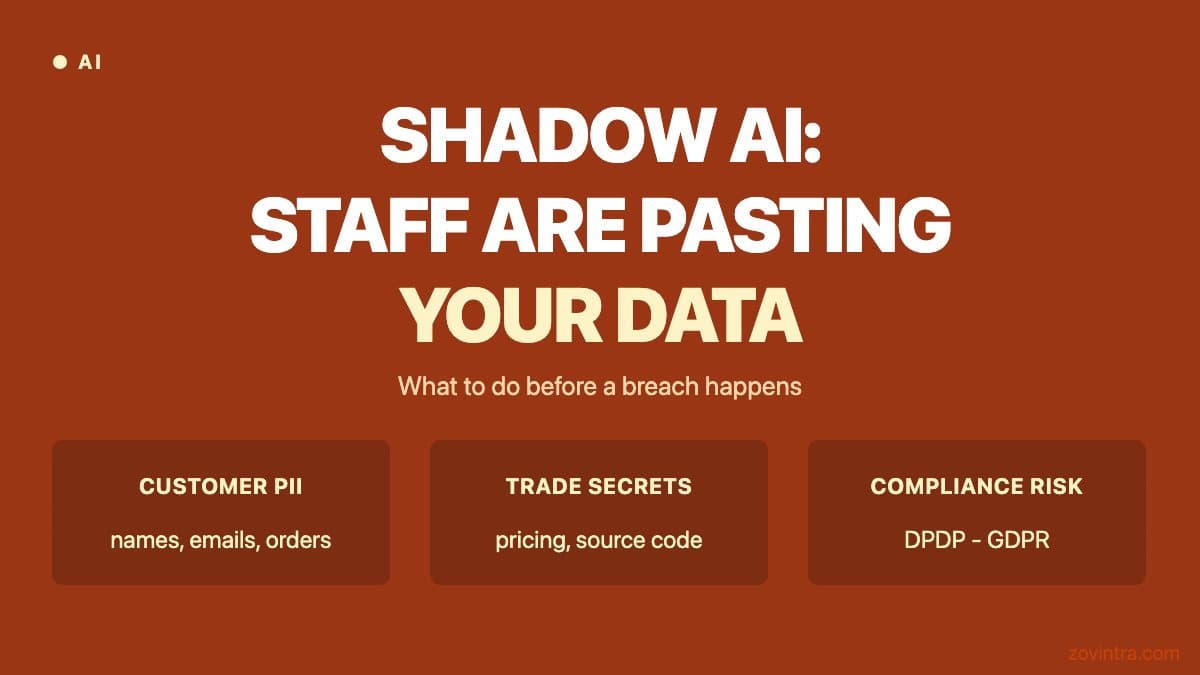
Shadow AI is the use of AI tools that an organisation has not approved, evaluated or set up data-sharing policies for. It is likely happening in many small and mid-sized businesses. Staff paste customer orders, supplier contracts, internal pricing sheets and support tickets into publicly accessible chatbots to get help with tasks. The data leaves your systems. Where it goes, how long it is retained and whether it trains future models depends on the tool's terms of service, not on your business's policies. This article explains the risk clearly and provides a one-page policy outline your team can implement without legal staff. This is not legal advice.
How Widespread Is This?
No survey I could verify measures shadow AI in Indian small businesses directly, so treat the scale as unknown and the exposure as plausible. The nearest primary data is the Stack Overflow Developer Survey 2026, which says coding assistants and agents have become the dominant AI use case (66% of respondents), and that only 6.6% of respondents (949 people) trust AI for many tasks, including important work decisions. Heavy use with low trust is the condition in which people paste data into tools and then check the output, rather than checking where the data went.
Developers are a subset of staff, and the survey says nothing about non-technical employees. Customer support, sales, operations and finance roles handle more personally identifiable information, so the exposure there is plausibly higher. A customer support agent who pastes a transcript of a complaint into a chatbot to draft a response has just shared a customer's name, contact details and the substance of their complaint with a third-party AI service.
What Actually Leaves Your Business
Shadow AI incidents tend to cluster around three categories of data. Understanding which of these your staff handle helps prioritise where a policy needs the most teeth.
- Customer personally identifiable information. Names, email addresses, phone numbers, order histories and support conversation content. In India, this falls under the Digital Personal Data Protection Act (DPDP). In the EU, it falls under GDPR. Sharing it with a third-party AI service without the right agreements in place can be a compliance risk whether or not a breach occurs; ask counsel which apply to you.
- Trade secrets and commercially sensitive data. Supplier pricing, internal cost structures, contract terms, unreleased product details and financial projections. This data does not have a regulatory label, but exposing it to a service whose terms allow model training on user inputs is a business risk with no easy remedy.
- Source code and infrastructure details. Developers pasting code snippets, API keys or configuration files into a coding assistant are sending that information outside the organisation. Keys and secrets pasted into an AI tool leave your control, and what happens next depends on the tool's terms.
Why the Terms of Service Matter More Than You Think
Consumer-tier AI tools can have terms that allow the provider to use conversation content for model improvement, often depending on a setting. For example, Anthropic's privacy page says consumer Claude chats can be used for training if you allow model improvement in your privacy settings. Staff using a tool informally rarely know about such settings or have changed them. Business and enterprise tiers of AI tools often come with different data terms, so check each provider's current commercial terms. That gap between consumer and business terms is a likely place for shadow AI data exposure.
Terms of service also change. A tool that had permissive data-sharing terms a year ago may have updated them, or vice versa. If your business relationship with any AI provider is based on terms you read once at signup, it is worth reviewing them. A contract-level data processing agreement is a stronger protection than a settings toggle in a free account.
For businesses operating under the DPDP Act and AI tool data flows, this is not a theoretical concern. The DPDP Act sets obligations for businesses that process personal data, and the DPDP Rules were published on 13 November 2025, with most duties (Rules 3 and 5 to 16) starting eighteen months after the gazette date, around 13 May 2027. Pasting customer data into an unapproved consumer AI tool is the kind of data flow you will want to be able to explain under those rules. This is not legal advice - consult qualified legal counsel for your specific situation.
A One-Page AI Usage Policy Outline
Most small businesses do not need a 40-page AI governance framework. They need one clear page that staff can read in five minutes and that covers the practical scenarios they encounter daily. The following outline is a starting point, not a legal document.
- Approved tools. List the specific AI tools staff are permitted to use for work tasks. If a tool is not on the list, staff must ask before using it. Starting with a short approved list and expanding it is easier to manage than trying to block everything after the fact.
- Data classification. Define three categories: data that may never be shared with an AI tool (customer PII, financial records, source code, contract terms), data that may be shared with approved enterprise-tier tools only (internal documents, pricing), and data that may be shared freely (publicly available information, anonymised examples).
- Consumer vs enterprise tier. Make explicit that free-tier or personal accounts for any AI tool are not approved for work data, even if the tool itself is on the approved list. Only the enterprise or business account with a data processing agreement in place qualifies.
- Incident reporting. If staff believe they have accidentally shared data outside these rules, they should report it without fear of blame. You cannot respond to an incident you do not know about.
- Review date. Set a date six months out to review the approved tools list. The AI tool landscape changes fast enough that a policy written today needs active maintenance.
The Hidden Cost of Waiting
The case for acting before an incident is not complicated. A data breach involving customer PII carries notification obligations, potential fines and reputational damage. Under the DPDP Rules, once the main duties start (around May 2027), a data fiduciary that becomes aware of a personal data breach must notify affected individuals and the Data Protection Board without delay, with a detailed report to the Board within 72 hours unless the Board allows a longer period. Whether a shadow AI incident counts as a breach depends on what was shared and with whom, but establishing that takes incident response effort you could have avoided.
The cost of a one-page policy and a half-hour team conversation is near zero. The cost of responding to a regulatory enquiry or a customer complaint that a support transcript was used to train a third-party AI model is not.
If you would like help reviewing how your team currently uses AI tools and drafting a basic usage policy, a technical review conversation is a good place to start. We can also help you evaluate whether the tools your team uses have appropriate enterprise data terms in place.
Common questions
What is shadow AI and why is it a risk for my business?
Shadow AI is staff using AI tools your organisation has not approved or set data policies for. Pasted customer data leaves your systems, and whether it is retained or used for training depends on the tool's terms, not your policies.
What should a company AI usage policy include?
A short one-page policy can list approved tools, classify which data may never be shared, require business accounts rather than personal free-tier ones, set up no-blame incident reporting, and set a review date about six months out. This is not legal advice.
When should I get help reviewing how my team uses AI tools?
If you do not know which AI tools your team uses or whether they have enterprise data terms, a technical review conversation is a good start. Zovintra can help review current usage, draft a basic usage policy and evaluate the data terms of the tools in use.
Sources
- 2026 Stack Overflow Developer Survey - AI - Stack Overflow, accessed 19 Oct 2026
- 2026 Stack Overflow Developer Survey - Stack Overflow, accessed 19 Oct 2026
- DPDP Rules, 2025 (Gazette of India) - Ministry of Electronics and IT, 13 Nov 2025
- Is my data used for model training? - Anthropic Privacy Center, accessed 19 Oct 2026