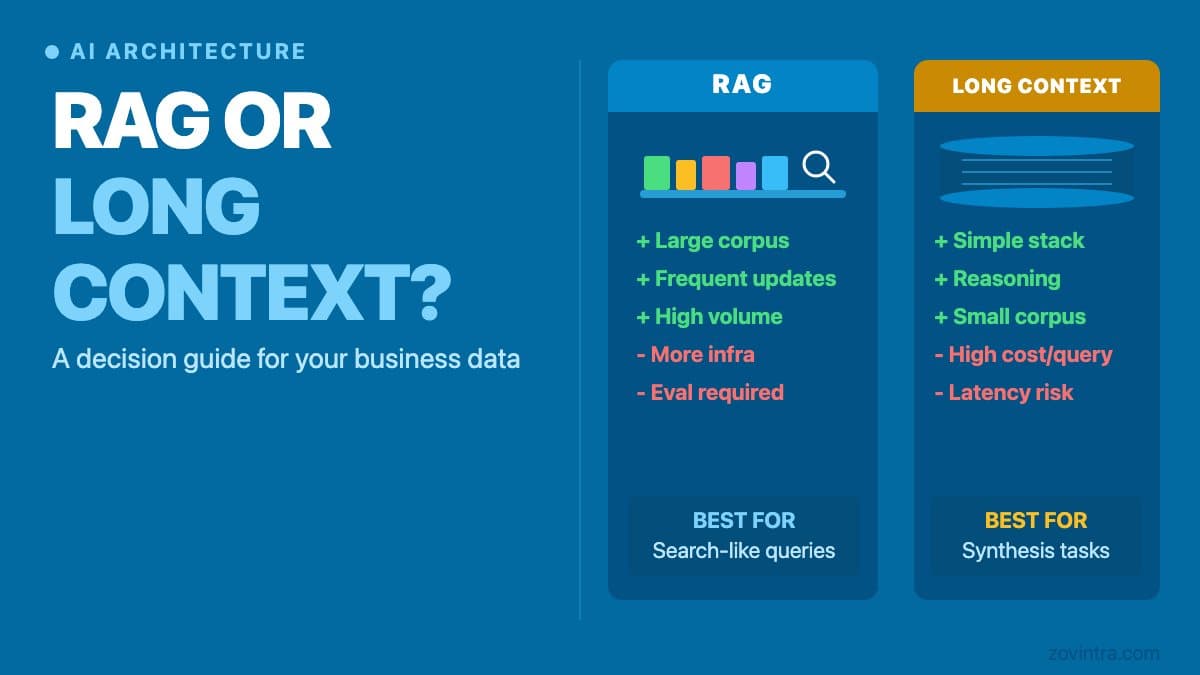
RAG (Retrieval-Augmented Generation) retrieves relevant chunks from a document index and injects them into the prompt at query time. Long-context simply loads your entire corpus into a large model window. Neither is universally better. The right choice depends on how much data you have, how often it changes, what your latency budget is, and what the query pattern looks like. Most teams pick one based on what they have already seen demoed, not on the specifics of their situation.
What RAG Actually Does
In a RAG pipeline you first embed your documents into vectors and store them in a vector database (Pinecone, pgvector, Weaviate, Chroma, and others are common choices). When a user asks a question, the query is embedded the same way, and the nearest chunks are fetched. Those chunks are appended to the prompt, and the model answers using only what was retrieved.
The benefit is that you do not pay to push tens or hundreds of thousands of tokens into the model window on every request. You push a few thousand tokens of retrieved context instead. For a product with many queries per day, that cost difference compounds fast.
The cost is operational complexity. You need to maintain an embedding pipeline, keep vectors in sync as documents change, tune chunking strategy, and monitor retrieval quality separately from generation quality. That last part is what most teams underestimate: a RAG pipeline can fail silently if the retrieved chunks are subtly wrong. The model then gives a confident but incorrect answer based on what was fetched. If you are not testing retrieval quality with something like an eval harness for your AI feature, you will not catch this in dev.
What Long Context Actually Does
Large context windows have grown significantly. As of 19 October 2026, Anthropic lists 1M-token context windows for its current Claude models, OpenAI lists 1.05M tokens for its current flagship GPT models, and Google lists a 1M-token window for its flagship Gemini model. Limits change with each release, so check each provider's model page before you design around a specific number. Anthropic's own conversion is that 200k tokens is roughly 150k words - a long technical manual, a set of company policies, or a moderately sized codebase - and 1M tokens is roughly 555k words on its current tokenizer.
The appeal is simplicity. There is no vector database to manage, no chunking strategy to tune, no retrieval to test. You concatenate your docs into the prompt and the model reasons over the whole thing. For smaller corpora that fit comfortably inside the window, this is often the right call.
The risks are less obvious. First, cost: a 200k-token input processed 1,000 times a day is expensive. Second, latency: first-token latency grows with context length. Third, the "lost in the middle" problem - Liu et al., "Lost in the Middle" (2023, accepted to TACL) found that performance is often highest when relevant information is at the beginning or end of the input and degrades when it sits in the middle, even for models built for long inputs. That paper tested models of its time, so re-test with the model you plan to use rather than assuming either way.
The Decision Factors
Below is a summary of when each approach is the better starting point. These are not hard rules - hybrid approaches exist and are increasingly common - but they cover most of the cases a small or mid-sized product team will encounter.
Where Teams Get It Wrong
The most common mistake is applying RAG to a corpus that is actually small enough for the context window, then spending weeks tuning chunk size, overlap, and retrieval filters. If your knowledge base is 50 documents that collectively fit in 60k tokens and they change monthly, just put them in the prompt. The simplest thing that could possibly work is usually the right first step.
The opposite mistake is using long context for a corpus that is really a search problem. If your product has 100,000 support articles and a user asks a specific question, long context is not a reasonable answer. You need retrieval. The model cannot hold the entire knowledge base in a single call, and even if it could, the cost per query would be prohibitive.
A third pattern worth watching: teams build RAG because it sounds more sophisticated, ship it, and then discover that recall is poor on edge-case queries. The queries where RAG fails are often the ones users care most about (the unusual questions they cannot find answers to elsewhere). Without a test suite, this failure is invisible until a user complains.
Hybrid Approaches
Many production systems combine both. A typical hybrid: use RAG to retrieve the 10 most relevant chunks, then pass those chunks plus a broader context window that includes the conversation history and a system prompt. The model gets retrieval-narrowed context without losing the conversational thread. This gives you cheaper retrieval-focused calls for most queries while keeping reasoning quality high.
A second hybrid pattern is to use long context as a fallback when retrieval confidence is low. This is more expensive to implement and harder to monitor, but it reduces the risk of confident-but-wrong answers when the retrieval step returns weak matches.
What to Check Before Deciding
- Count your tokens: paste your corpus into a tokenizer and find out if it actually fits in the model window you have access to.
- Estimate query volume and cost at that volume for each approach using the provider's published pricing.
- Decide whether you have bandwidth to build and maintain a retrieval eval: if not, long context plus careful prompt engineering may be the safer starting point.
- Check whether your corpus changes weekly or monthly: frequent changes make re-embedding overhead more relevant.
- Ask whether the query pattern is search-like (find a specific fact) or reasoning-like (compare two options across many docs): the answer should weight your decision.
The decision is not permanent. Many teams start with long context to validate product-market fit and move to RAG once the corpus grows or query costs become material. That is a reasonable path as long as you build the eval harness early, because switching retrieval strategies without a way to measure quality is how teams introduce regressions they cannot detect.
If you are evaluating an AI feature addition to your product and want an independent view of which architecture fits your situation, book a scoped AI feature review. We look at corpus size, query patterns, and your team's operational capacity before making a recommendation.
Common questions
When should I use long context instead of RAG?
When your corpus fits comfortably inside the model window and changes rarely. The post's example is 50 documents totalling 60k tokens that change monthly: just put them in the prompt. For a search-like corpus such as 100,000 support articles, you need retrieval.
What goes wrong with long context?
Cost, latency and the lost in the middle problem. A 200k-token input processed 1,000 times a day is expensive, first-token latency grows with context length, and Liu et al. found performance often degrades when relevant information sits in the middle. Re-test with the model you plan to use.
Can someone help me choose between RAG and long context?
Zovintra offers a scoped AI feature review that looks at corpus size, query patterns and your team's operational capacity before recommending an architecture. A useful first step is to count your tokens and estimate query cost for each approach.
Sources
- Models overview - Anthropic Claude Docs, accessed 19 Oct 2026
- Models - OpenAI API Docs, accessed 19 Oct 2026
- Gemini models - Google AI for Developers, accessed 19 Oct 2026
- Lost in the Middle: How Language Models Use Long Contexts - arXiv (Liu et al.), 2023-07-06
- pgvector - GitHub, accessed 19 Oct 2026