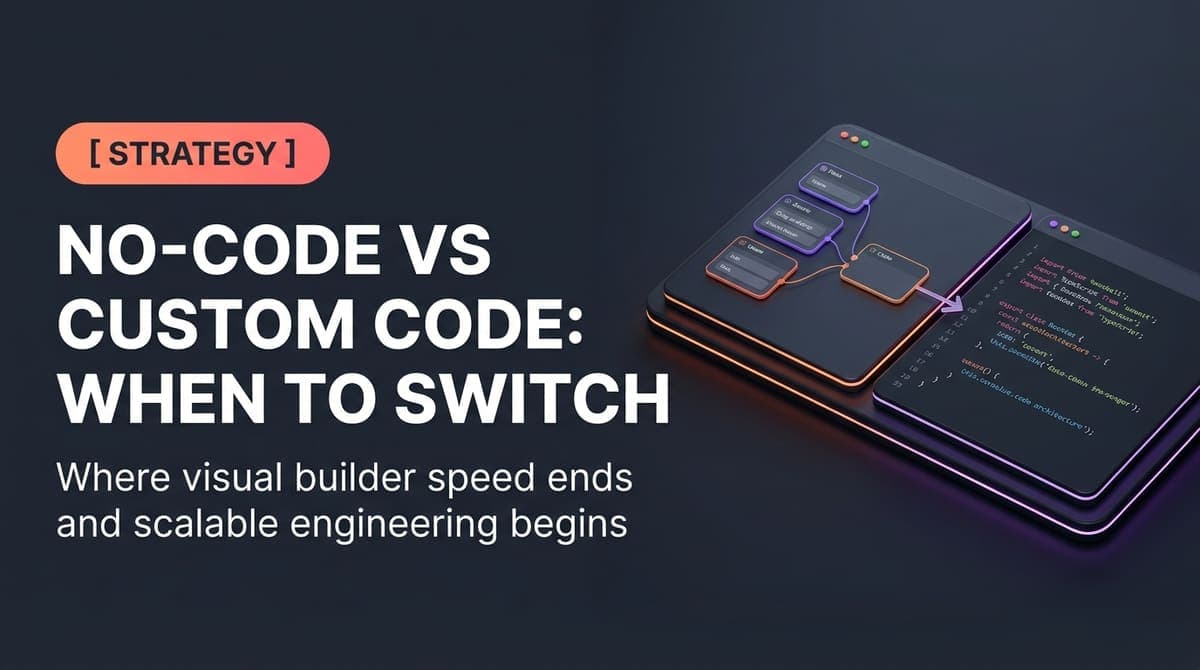
“No-code isn't a stepping stone to real development. It's a legitimate tool with a specific range. Knowing where that range ends is what separates founders who scale from founders who rebuild.”
The question isn't which is better - it's which fits where you areNo-Code Is Not a Compromise
The framing that no-code is "real development with training wheels" is wrong and it leads founders to make bad decisions in both directions. No-code platforms like Bubble, Webflow, and Glide are purpose-built tools that solve specific problems well. For validating a concept, building an internal tool, or launching an MVP before you have technical co-founders or development budget, no-code is often the correct answer - not a fallback.
The mistake is treating no-code as a permanent foundation for a product that will eventually need to compete on performance, flexibility, or compliance. Every no-code platform has a ceiling. The question is whether your product will hit that ceiling before it can afford to climb past it. Most products that start on no-code should eventually migrate. The question is when, not if.
What No-Code Does Well
Speed is the obvious advantage. A founder with moderate Bubble or Webflow skill can build a functional application in 2 to 4 weeks that would take a development team 2 to 3 months to build from scratch. That speed advantage is most valuable at the idea validation stage, where the goal is learning from real users, not optimising for engineering quality.
Cost is the second advantage. A Bubble subscription costs a few hundred dollars a month. Hiring a development team costs that per day. If you're pre-revenue and self-funded, no-code buys you the runway to validate before you spend serious money on development. For internal tools and simple customer-facing workflows, the cost-to-capability ratio of no-code is genuinely hard to beat even at scale.
- Idea validation before committing to a full development budget
- Internal tools and ops workflows where performance isn't customer-facing
- Marketing sites and landing pages where Webflow's CMS is genuinely best-in-class
- Prototypes that you'll use to raise a seed round or get your first 100 customers
- Simple marketplace or directory sites that fit cleanly into a platform's data model
- MVPs where learning speed matters more than technical architecture
Where No-Code Breaks Down
Performance is the first ceiling. Bubble applications slow down as data volumes grow. The platform's database and workflow engine are shared infrastructure, which means you're competing for resources with every other Bubble app. A custom-built application on a dedicated server can handle 100x the concurrent load for the same cost once you're past early-stage usage levels.
The second ceiling is logic complexity. No-code platforms express logic visually, which works well for linear workflows. When your business logic becomes conditional, recursive, or event-driven in complex ways, the visual editor becomes a liability. You end up with workflow diagrams that no one can fully understand, and a single logic change can break five other workflows in ways that take days to diagnose.
The Signals That Tell You It's Time to Switch
You're ready to move when any of the following are consistently true. Your page load times are above 3 seconds under normal usage and platform optimisation hasn't fixed it. You're spending more than 30% of your platform costs on plugins that patch gaps in core functionality. You've lost a sales conversation because a prospect asked about security architecture, data residency, or uptime SLAs and your no-code platform couldn't answer satisfactorily. Your lead developer spends more time working around platform limits than building features.
The most reliable signal is the feature that can't be built. Every no-code platform has a category of features it cannot support - background jobs that run outside a user session, real-time WebSocket connections, custom caching strategies, pixel-perfect mobile performance. When a feature your users clearly want falls in that category, you've hit the hard ceiling.
What the Migration Actually Costs
A realistic migration from a mid-complexity Bubble app to a custom Next.js application costs between 25,000 and 75,000 GBP depending on feature count, data complexity, and the state of your existing data. The range is wide because data migration is often the most expensive and underestimated part. A Bubble database that was built organically without a schema plan takes significant engineering time to clean up and move.
Timeline is typically 3 to 5 months for a team that knows what they're doing. That timeline can be compressed if you're willing to deprioritise non-critical features and accept a temporary feature gap in the new system. It cannot be compressed by throwing more developers at the problem - migration work is inherently sequential in places that don't parallelise well.
No-Code and Custom: The Case for Running Both
The binary framing of no-code versus custom development misses a common and effective third option: running no-code for the parts it handles well while using custom code for the parts it doesn't. A company might run Webflow for their marketing site and customer portal while running a custom backend for their core business logic and data processing. The two systems communicate via API. This isn't a temporary bridge - it's a deliberate architecture that lets each tool do what it does best.
Where teams get stuck is attempting to extend their no-code platform into areas it wasn't designed for, rather than accepting its boundaries and building custom only where it matters. The founders who manage this transition best are the ones who treat no-code as a permanent tool in a broader stack, not as something to graduate from entirely. If you're hitting the ceiling of your current platform and trying to work out what migrating would look like, Zovintra handles this kind of transition regularly - we can give you a specific cost and timeline estimate based on what you've already built.