To hire a developer who will catch problems in AI-generated code, ask about their review process rather than their AI tooling. The questions below reveal whether a candidate treats AI output as code to be verified or as code that is probably fine. That distinction matters more now than any particular tool experience.
Why AI Experience Is Not the Same as AI-Review Experience
Most developers working today have used Cursor, GitHub Copilot, or a similar tool. Knowing how to prompt them is now a basic skill. What is rarer is knowing how to review the output critically. AI tools generate code that looks correct. The formatting is clean, the naming is consistent, and the patterns match what a senior developer would write. The problems are in the logic, the security assumptions, and the things the prompt did not cover.
A 2026 arXiv study by Liu et al. analysed 302,600 verified AI-authored commits from 6,299 GitHub repositories and found that 22.7 percent of the AI-introduced issues it tracked still survived in the latest version of the repository. Most of those issues were code smells rather than security flaws, but the finding shows that AI-introduced problems persist when nobody is looking for them. The issue is not that AI writes bad code. The issue is that standard review habits are not calibrated for the categories of problem AI generates most often.
When a non-technical founder or a team without deep engineering oversight is hiring, this distinction is hard to evaluate. The nine questions below are designed to surface it. They are not trick questions. A developer with genuine AI-review experience will answer them fluently. Someone who has used AI tools but not built review habits around them will struggle to be specific.
Before the Interview: What the Job Description Should Signal
Before you run any interview, the job description should make clear that AI-assisted development means human review, not autonomous shipping. A useful line: "We use AI coding tools as a first-pass assist, with every output reviewed against security, maintainability, and correctness standards before merge." Candidates who find that framing unappealing are signalling something useful.
If you want more background on what good developers look like in general before getting to the AI-specific questions, our guide to assessing technical candidates as a non-technical founder covers the underlying principles.
Nine Interview Questions and What Good Answers Look Like
Ask these in conversation, not as a written test. The quality of the answer matters less than whether the candidate can be specific. Vague answers about "best practices" are a weak signal. Specific process and examples are a strong one.
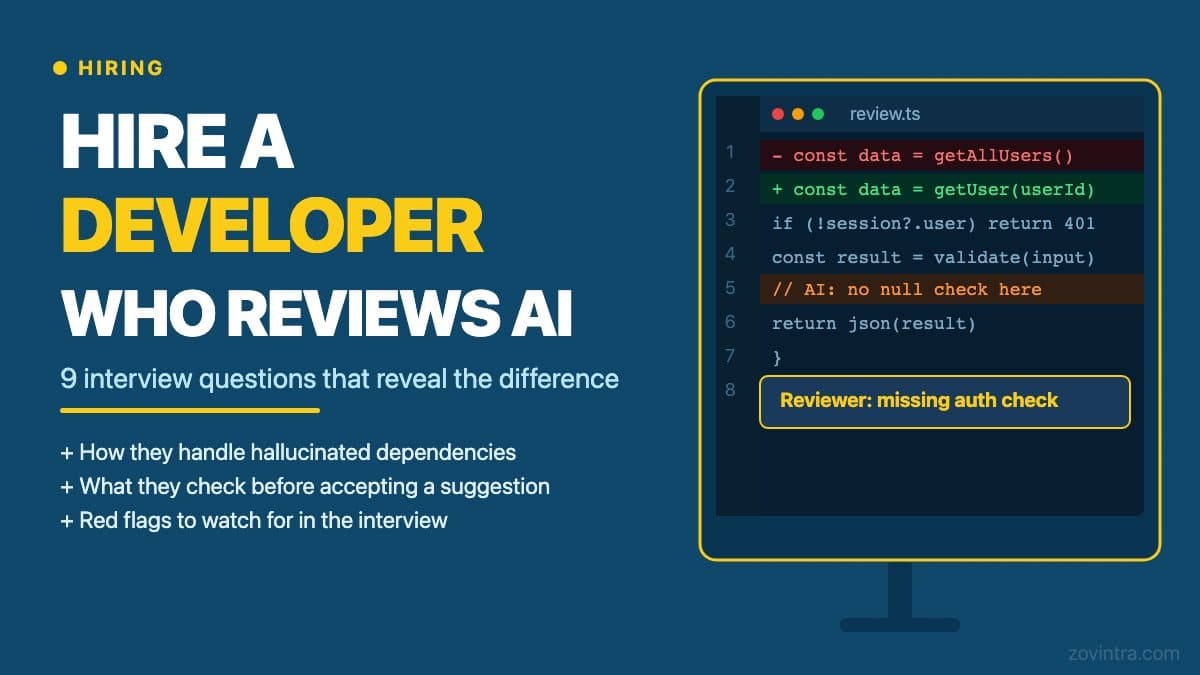
- 1. Walk me through how you review a pull request where Cursor or Copilot wrote most of the diff. Good answer: describes a specific process - checking auth assumptions on new routes, verifying that new dependencies exist on the real registry, reading error handling, checking that tests cover the unhappy path. Bad answer: "I look at it the same as any PR" or "I trust it if the tests pass."
- 2. What categories of problem does AI-generated code miss most often? Good answer: names specific categories - input validation on edge cases, SECURITY DEFINER functions that bypass row-level security, hallucinated package names, error handlers that swallow exceptions or leak stack traces. Bad answer: generic reference to "bugs" or "things that don't make sense."
- 3. Have you ever found a security issue in AI-generated code that tests did not catch? Tell me about it. Good answer: describes a specific example with the mechanism - what the code did, why the test did not catch it, how they found it. Bad answer: no specific example, or pivoting to a general point about AI limitations.
- 4. How do you handle a situation where the AI generates a function that works but you cannot explain exactly why? Good answer: describes rewriting or researching until the logic is understood, or flagging it for a second reviewer. Bad answer: merges if tests pass.
- 5. When you use an AI tool, do you ask it to generate tests, or do you write tests separately? Why? Good answer: explains the difference in coverage - AI-written tests are usually good on the happy path and miss negative cases and authorisation checks. Ideally writes critical test cases manually. Bad answer: "I let the AI write tests, it saves time."
- 6. What do you do when you discover that an AI suggestion introduced a dependency you did not recognise? Good answer: checks the package on its registry (npm, PyPI), verifies it has real maintainers and recent activity, looks for it in OSV or a CVE database. Bad answer: installs it if it resolves and the build works.
- 7. If you inherited a codebase that had been built with AI tools by someone else, what would you check first? Good answer: mentions authentication and authorisation model, environment variable handling, RLS or equivalent data access control, exposed API keys. See also our checklist for taking over a project from another developer. Bad answer: runs the app and looks for visible bugs.
- 8. How do you document decisions in AI-assisted work - specifically, how do you record that a piece of logic was generated and what the intention was? Good answer: inline comments at the important decision points, commit messages that describe intent not just action. Bad answer: does not document AI contributions specifically.
- 9. Have you worked somewhere that had a formal policy on AI code review? What did it cover? Good answer: can describe a policy - even one they disagreed with - with specifics. Bad answer: no experience with policy, and no opinion on what one should cover.
How to Weight the Answers
Questions 1, 2, and 5 are the most revealing. They ask about process directly and require specificity. A candidate who can answer all three with genuine examples is almost certainly someone who reviews AI output rather than ships it. A candidate who gives vague answers to all three is a risk in a codebase where AI tools are used routinely.
Question 3 is a filter for honesty. If a developer has used AI tools regularly and never found a security issue in the output, either they have not been looking or they are not remembering accurately. Veracode's 2025 GenAI Code Security Report tested over 100 large language models and reported that 45 percent of code samples failed its security tests. A developer who has found none is probably not reviewing carefully enough.
Red Flags in Candidate Responses
Beyond the individual answers, watch for these patterns in the conversation:
- Confidence without specificity. Candidates who assert that AI code is generally reliable but cannot say what they specifically check are substituting confidence for process.
- Tests as the only safety net. If every answer to a question about catching problems ends with "the tests would catch it," the candidate has not thought through what AI-generated tests do not cover.
- Treating AI output as the developer's own work. When a candidate describes AI suggestions as "my code," ask a follow-up: what did you review before accepting it? The answer tells you more than the original description.
- No examples of pushing back or rewriting. A developer who accepts every AI suggestion without modification is not reviewing - they are editing prompts.
A Note on Technical Tests
If you run a technical assessment, give the candidate a short piece of AI-generated code and ask them to review it. Seed it with two or three issues: a missing auth check, a dependency that looks real but is slightly wrong, and an error handler that returns a stack trace. Tell the candidate it was generated by an AI tool. Time how long they spend and what they find. This reveals review process more directly than any interview question.
For a full list of what to prepare before bringing a developer on board, our questions-before-hiring checklist covers contracts, IP ownership, and communication expectations alongside technical criteria.
What This Means for Your Hiring Process
The market for developers who can use AI tools is large. The market for developers who can review AI output critically is smaller and worth paying more for. If your product is at a stage where security, maintainability, and correctness matter - which is any stage past early prototype - the questions above help you find the second group inside the first.
If you want an independent technical view before or during a hire - to assess an existing codebase or review a candidate's proposed approach - a technical review from Zovintra can provide that grounding without the overhead of a full engagement.
Common questions
How do I hire a developer who reviews AI-generated code properly?
Ask about their review process rather than their AI tooling. A strong candidate describes specifics, such as checking auth assumptions on new routes, verifying new dependencies exist on the real registry, and testing the unhappy path. A weak one says they review it like any other PR or trust it if tests pass.
What are red flags when a developer talks about AI-generated code?
Watch for confidence without specificity, treating tests as the only safety net, describing AI suggestions as 'my code' without saying what was reviewed, and never rewriting or pushing back on a suggestion. A developer who accepts every suggestion is editing prompts, not reviewing.
Can someone give me an independent technical opinion while I am hiring?
Yes. If you want an independent view to assess an existing codebase or review a candidate's proposed approach, Zovintra offers a technical review that provides that grounding without the overhead of a full engagement.
Sources
- Debt Behind the AI Boom: A Large-Scale Empirical Study of AI-Generated Code in the Wild - arXiv (Liu et al.), 2026-03-30
- 2025 GenAI Code Security Report - Veracode, 2025