“Founders are always surprised by app development costs until you walk them through what is actually being built. Then they're surprised it isn't higher.”
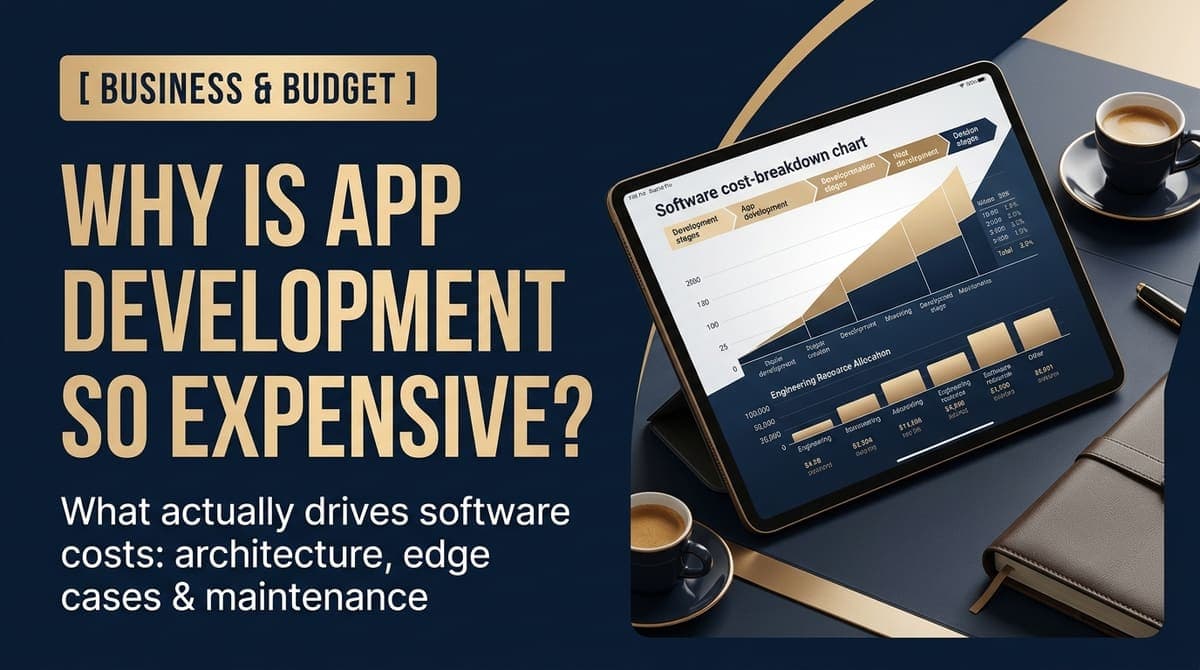
The reality behind every development quoteWhy Is App Development So Expensive?
App development is expensive because software is made of decisions, and every decision takes time. A button that looks simple in a design file represents a UI component, a state change, an API call, error handling, loading behaviour, and edge cases nobody thought about until a real user found them. Multiply that across a hundred features and you start to understand where the budget goes.
Most founders compare app development to buying something physical - a product that gets made once and then exists. Software is not like that. It has to work across dozens of device types, multiple operating system versions, different network conditions, and user behaviour that no one predicted. Every one of those variables is a potential failure point that someone had to anticipate.
The Four Real Cost Drivers
Scope is the biggest driver of cost by far. Every feature you add requires design, development, testing, and ongoing maintenance. A project scoped at 40 features does not cost twice as much as one scoped at 20 features - it often costs three to four times as much because complexity compounds. Features interact with each other in ways that create bugs that wouldn't exist if either feature were absent.
Platform choice is the second driver. A native iOS app and a native Android app are two separate products. Cross-platform frameworks like React Native or Flutter can reduce this cost by sharing a large portion of the codebase, but they add their own complexity and some features still need platform-specific code. Assume 30% to 50% more cost if you want both platforms simultaneously from day one.
Quality and testing is the third driver - and the one most often cut first, which usually generates more cost later. Skipping QA doesn't save money, it defers bugs to production where fixing them costs five to ten times more than catching them before release.
What You're Actually Paying For
When you pay for app development, you are paying for several things that don't show up in a design mockup. You're paying for architecture decisions that determine whether the app can scale to 10,000 users or falls over at 200. You're paying for security that stops someone from accessing another user's data. You're paying for error handling so the app doesn't crash every time the server is slow.
You're also paying for knowledge of what you don't know you need. An experienced developer will ask about rate limiting, session management, third-party API failure handling, and data migration before you have thought about any of those things. That foresight is part of what you pay for, and it saves significantly more than it costs.
Why Quotes Vary So Dramatically
If you've collected quotes for the same project and received ranges from $10,000 to $150,000, you're not seeing the same project priced differently. You're seeing different interpretations of what you asked for. The $10,000 quote is building the happy path: user does exactly what you expect, nothing goes wrong. The $150,000 quote includes the unhappy path, security, testing, deployment infrastructure, and everything that makes the product production-ready.
- Does the quote include design or assume you'll provide finished mockups?
- Does it cover both iOS and Android or just one platform?
- Is backend development included, or just the front-end interface?
- Does it include QA and testing, or is that a separate scope?
- What about deployment setup, hosting configuration, and post-launch support?
- Are third-party integrations (payments, auth, maps, push notifications) included?
Ask every vendor to answer these questions before you compare numbers. You will often find that the cheaper quote is not actually cheaper - it's just scoped to exclude the things you'll pay for anyway, later, at a higher cost because they weren't planned from the start.
Where No-Code and AI Tools Fit In
Tools like Lovable, Bubble, Bolt, and v0 have genuinely reduced the cost of getting to an MVP. If you want a working prototype to test an idea, these tools can get you there in days rather than months. For that purpose, they are excellent.
The cost savings stop when you need production-grade security, custom business logic, performance at scale, or integrations that the tool doesn't support natively. At that point you hit a ceiling and the choice is to rebuild on a proper stack or work around the tool's limitations - which creates technical debt that adds cost back faster than the tool saved it.
How to Scope a Project to Control Costs
The single most effective thing you can do to control app development costs is lock scope before development begins and hold it. Every addition mid-build - even ones that seem minor - breaks existing work, requires re-testing, and adds time. Change requests mid-project typically add 20% to 40% to total cost.
Start with a discovery phase. Spend two to three weeks mapping every flow, every user action, every edge case, and every third-party dependency before anyone writes code. A discovery phase typically costs 5% to 10% of a project budget and regularly prevents surprises that would have cost 30% more to fix later.
The Real Cost of Cutting Corners
The founders who spend the least upfront on development often spend the most overall. A cheap build that breaks at 500 users needs to be rebuilt. A prototype that wasn't secured needs a security audit and fixes. An app built on a no-code tool that hit its limits needs to be migrated to a real stack. Every one of these scenarios costs more than building it right the first time.
If you are looking at quotes and trying to figure out what is reasonable for your product, we are happy to review scope and give you an honest assessment. We build from scratch, and we also rescue projects that have hit their ceiling - whether that's a prototype built with AI tools or a legacy app that needs rearchitecting. Understanding what something should cost before you commit is worth a conversation.