“The fastest way to slow a startup down is to hire the wrong person full-time. The second fastest is to have no developers at all.”
On the staffing dilemma every early-stage founder hitsWhat Staff Augmentation Actually Means
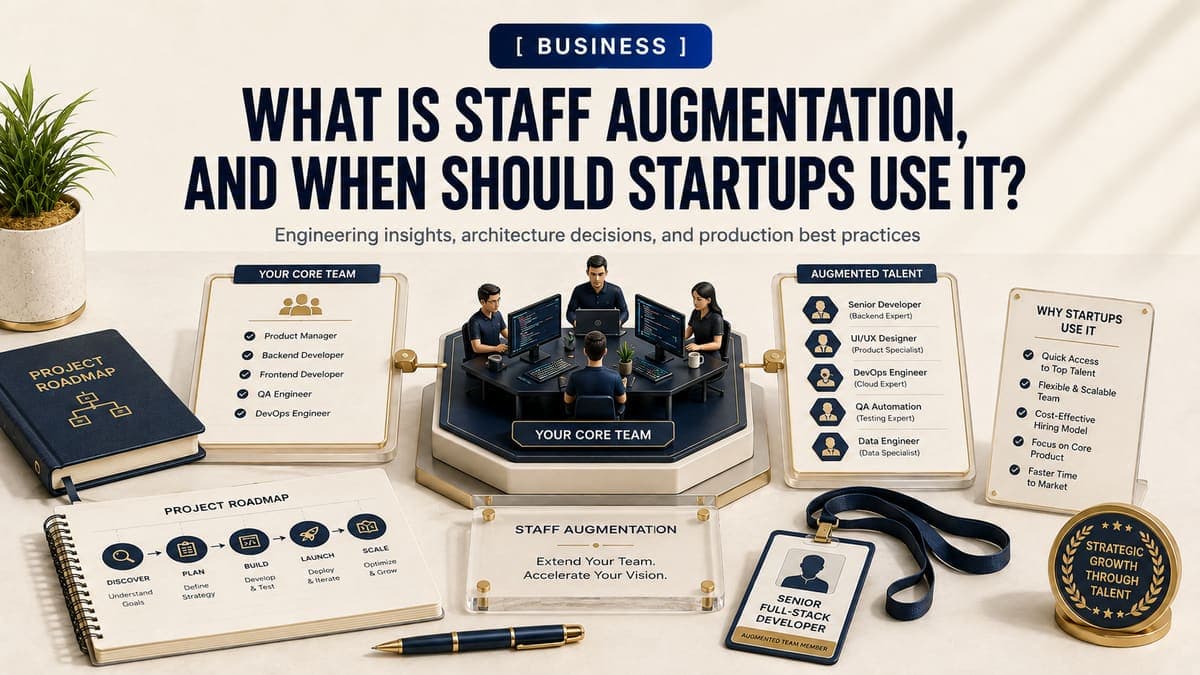
Staff augmentation is a staffing model where you bring in external engineers - or designers, product managers, or QA specialists - who work as part of your team rather than as a separate outsourced unit. They join your Slack, attend your standups, commit to your repos, and ship features alongside your existing team.
The distinction matters. A traditional outsourced agency takes a scope and delivers it. An augmented team member takes a seat at the table. You direct the work, set the priorities, and own the output. The provider handles employment, benefits, and bench management on their side.
Staff augmentation is not new. Enterprises have used it for decades through staffing firms. What has changed is that quality engineering talent is now available this way at every scale - including seed-stage startups that need two solid engineers for six months without making a two-year bet on full-time hires.
When It Makes Sense to Augment
There are a handful of situations where augmentation is the cleanest solution. The clearest is a capacity gap: you have a roadmap, you have direction, but your team cannot execute fast enough. Hiring full-time takes three to four months from posting to productivity. An augmented engineer can be ramped in two weeks.
A second scenario is a skill gap. You need a machine learning engineer for one feature, or a security specialist for a compliance audit, and that skill does not justify a permanent hire. Augmentation lets you bring in precisely the expertise you need without carrying it on payroll indefinitely.
The third scenario - and the one startups underestimate - is bandwidth protection. If your two-person engineering team is 80% occupied on product features, any sudden infrastructure work, a critical bug, or a new client integration will derail the roadmap. Adding one augmented engineer as a buffer is far cheaper than the opportunity cost of constant context switching.
Staff Augmentation vs. Managed Development
Staff Augmentation
- You direct the work - provider supplies the person
- Fits into your existing workflows and tools
- Flexible scope: priorities can change week to week
- Ongoing engagement with ramp-up investment that compounds
What to Look For in an Augmented Engineer
The model only works if the person can operate independently. In a small startup, there is no room for an engineer who needs daily guidance or a thick specifications document before writing a line of code. You need someone who can read existing code, ask the right questions upfront, and deliver with minimal hand-holding.
Beyond technical ability, communication cadence matters more than most teams anticipate. An augmented engineer who goes quiet for two days and then surfaces a half-finished PR creates more friction than value. Explicit expectations around daily async updates, PR turnaround time, and how to escalate blockers should be established at the start of the engagement.
- Can navigate an unfamiliar codebase without a guided tour
- Writes a clear PR description explaining what changed and why
- Flags blockers within hours, not days
- Produces code that passes review without multiple rounds of cleanup
- Communicates progress and estimates honestly - even when the news isn't good
- Asks clarifying questions before building, not after
The Ramp-Up Cost Is Real
Staff augmentation is not zero-friction. Any engineer joining your team needs time to understand your codebase, your conventions, your deployment pipeline, and your product context. For a startup with a two-year-old codebase and limited documentation, that ramp-up can take two to four weeks before the engineer is contributing at full velocity.
This cost is real, but it is also a one-time investment per engagement. If you plan to keep the engineer on for three to six months, the ramp-up amortises quickly. Where it becomes a problem is when companies cycle through short one-month engagements and pay the ramp-up cost every time.
The implication: if you need someone for less than six weeks, a project-scoped engagement from a dev shop is often cleaner than augmentation. Augmentation pays off when you need sustained, integrated execution over a meaningful window of time.
When Augmentation Is the Wrong Answer
If your problem is architectural - a codebase that cannot scale, a data model that was poorly designed, or a deployment process that breaks with every release - adding more engineers to the team will not fix it. More hands on a broken foundation makes the problem worse faster. You need a code audit and a clear refactor plan before you augment.
Augmentation also fails when there is no one internal to provide direction. An augmented engineer can operate autonomously, but someone on your side still needs to own the roadmap, set priorities, and make product decisions. If your CTO role is vacant and your founders are non-technical, you may need a fractional CTO engagement before augmentation makes sense.
How Zovintra Approaches Augmentation
When startups come to us for staff augmentation, we treat the first week as a structured onboarding - not just a code review but a proper assessment of the existing system, the team's working patterns, and where the real bottlenecks sit. That context means our engineers contribute meaningfully by week two instead of spending a month getting up to speed.
We also handle the scenarios where augmentation intersects with our Launch & Rescue work - founders who built their MVP with Lovable, Bolt, or Cursor and now need production-grade engineers to extend and stabilise what was started. In those cases, the augmented engineer's first task is often a structured handoff from the AI-generated codebase to something maintainable.
The companies that get the most out of staff augmentation treat it as a strategic tool, not a hiring shortcut. When the conditions are right - clear direction, a real capacity gap, and a meaningful engagement window - it is one of the fastest ways to accelerate a startup without the overhead of building a permanent team. If you're unsure whether augmentation or a different model fits your situation, that's exactly the conversation we have with engineering leaders before we propose anything.