A small SaaS on Vercel and Supabase can run for free while you are building and testing, but the first bills arrive faster than most founders expect once real users arrive. Understanding where the free tier limits are - and which usage patterns push costs up quickly - prevents surprise invoices at the end of the month. This guide uses the Vercel and Supabase pricing pages as read on 19 October 2026. Both update their pricing periodically; verify the current limits before making financial decisions.
The Free Tier Limits (as of October 2026)
Vercel's Hobby plan (free) is designed for personal projects and prototypes. It includes 100GB of Fast Data Transfer per month, 1 million function invocations, and one developer seat, with no pay-as-you-go extra usage. Crucially, Vercel states it is for personal, non-commercial use. If you are charging customers, you need the Pro plan.
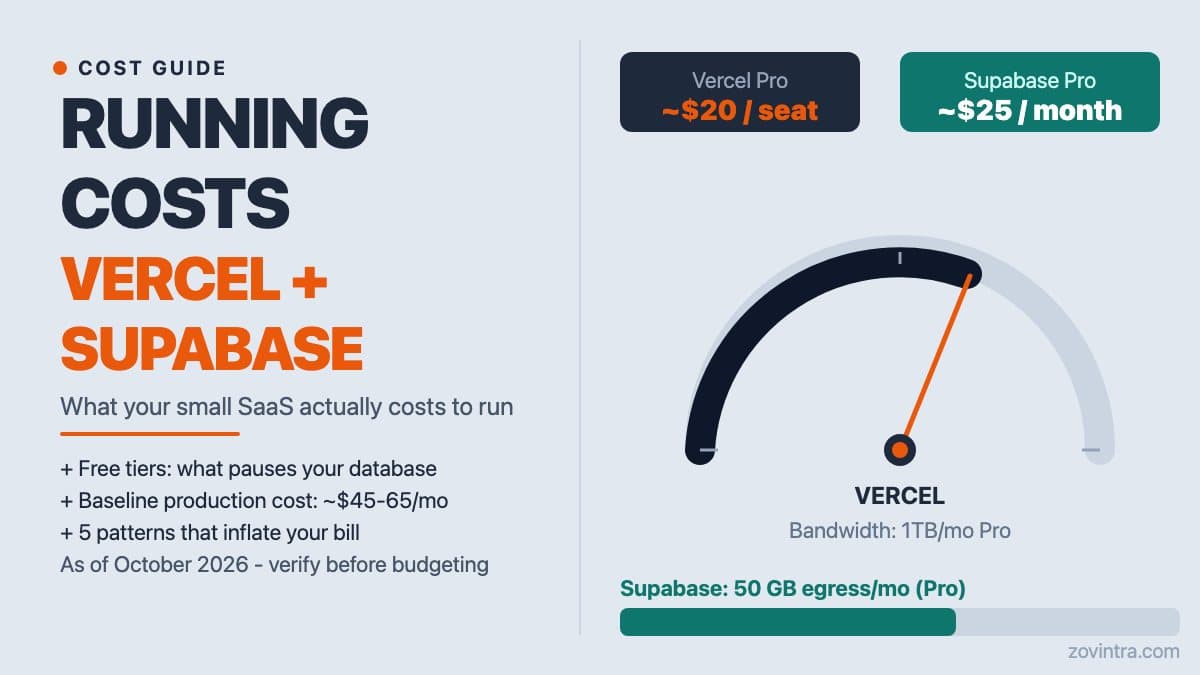
Vercel Pro is $20 per month per developer seat, with a $20 included usage credit. It raises included Fast Data Transfer to 1TB per month, then charges from $0.15 per GB, and removes the non-commercial restriction. Most small SaaS teams need Pro from the day they start charging customers.
Supabase's free plan allows up to two active projects, 500MB of database size per project, 1GB of file storage, 5GB of egress (plus 5GB of cached egress) and 50,000 monthly active users. There is an important constraint that catches many founders: free projects are paused after one week of inactivity. The first real user hitting a paused project sees an error until you unpause it from the dashboard. For a production SaaS, this makes the free tier a poor fit.
Supabase Pro removes the pause behaviour and starts at $25 per month for the organization. It includes 8GB of database disk per project (then $0.125 per GB), 250GB of egress (then $0.09 per GB), 100GB of file storage and 100,000 monthly active users. For a single-project SaaS, Pro is the minimum viable production tier.
Your Baseline Monthly Cost
For a solo founder, the minimum production setup is about $45 per month: Vercel Pro at $20 for one seat plus Supabase Pro from $25. A two-person team on Vercel is about $65. That covers a product with modest usage - a few hundred active users, typical web application traffic, and no large file storage requirements. These are list prices before any overage or tax.
This is not a large number. The risk is not the baseline - it is the overage charges that appear when specific limits are hit without warning.
Where Vercel Costs Increase
- Bandwidth overage. Pro includes 1TB of Fast Data Transfer per month, then from $0.15 per GB. Most small SaaS products stay well under this. The exception is apps that serve large files, unoptimised images, or video directly from Vercel.
- Serverless function usage. Vercel meters Active CPU time (from $0.128 per hour), provisioned memory and invocations (from $0.60 per million) beyond the included credit. Apps with slow database queries, heavy data processing, or long-running operations burn through this faster.
- Middleware and invocation volume. Running middleware or an API call on every request multiplies invocations. At small scale it is negligible; at larger scale it is worth checking in the usage dashboard.
- Team seat count. Every developer seat on the Vercel team costs $20 per month. A team of five costs $100 per month in seat fees alone, before any usage charges.
- Build minutes. Builds are billed per minute (from $0.007 per minute on basic machines). If your CI pipeline deploys on every commit to every branch, build minutes add up on active codebases.
Where Supabase Costs Increase
- Database storage. Pro includes 8GB of disk per project, then $0.125 per GB. A SaaS with user-generated content, audit logs, or frequent inserts can exceed this faster than expected, and unoptimised logging or unindexed tables can grow faster than they should.
- Egress bandwidth. Pro includes 250GB of egress, then $0.09 per GB. An app that returns large JSON payloads, returns unfiltered table results, or serves images from Supabase Storage without caching can reach this with enough users. Every row you return that the client does not display is egress you pay for.
- Realtime connections. Pro includes 500 concurrent peak connections and 5 million messages per month, then metered. A chat feature or a live dashboard that keeps connections open across many users can reach the limit.
- Auth monthly active users (MAUs). Pro includes 100,000 MAUs, then $0.00325 per MAU. Most small SaaS products stay under this for a long time, but a consumer product with high registration and low return rate can accumulate MAUs quickly.
- Storage egress. Files served from Supabase Storage count against egress. If your app serves large user-uploaded images or documents, caching or a CDN in front of Storage can reduce egress costs.
A Worked Example
A small B2B SaaS with 200 paying customers, typical API traffic, and no large file serving might look like this per month: Vercel Pro with two seats at $40, Supabase Pro from $25, no significant overage on either. Total: about $65 per month at list prices.
The same product with a file upload feature that serves documents directly from Supabase Storage might push egress to 400GB in a month. At the listed $0.09 per GB beyond the 250GB included, that is about $13.50 of overage, roughly $160 a year. Caching or a CDN in front of the files can cut that. The point is that one architectural choice, not the plan price, moves the bill.
Five Things That Drive Bills Higher Than Expected
- Unoptimised queries that return full table rows when the UI needs three fields. Every extra field returned is bandwidth you pay for.
- No image optimisation. Serving raw uploaded images through Supabase Storage without resizing burns egress. Resizing on upload usually pays for itself on a product with real users.
- Realtime subscriptions left open. Mobile or web clients that subscribe to realtime events and never unsubscribe hold connections open even when the user is idle. This counts against connection limits.
- Development environments pointing at production. Developers testing against the production Supabase project generate real egress and real function calls. Separate development projects are free-plan eligible and keep costs predictable.
- Logging too much. Application logs stored in the database - error tables, audit tables, analytics events - grow continuously. Without a retention policy, a logging table can become the largest table in the database within months.
When to Upgrade vs Optimise
The general principle is: optimise before you upgrade. Most small SaaS cost spikes are caused by a specific architectural choice - unoptimised queries, missing CDN, unnecessary realtime connections - not by the product genuinely needing more infrastructure. Identifying the cause before upgrading prevents paying for headroom you do not need.
The exception is when optimisation would require significant engineering time and the cost of the overage is small. If Supabase egress is costing an extra $20 per month and fixing the root cause would take a week of a developer's time, pay the overage until there is a quieter moment for the optimisation.
For a broader view of the costs that founders miss when building a SaaS, our guide to the hidden costs of software development covers infrastructure, support, and operational costs that are rarely in the initial budget.
If you want help auditing your current Vercel and Supabase usage to understand what is driving costs - or to plan an architecture that stays within sensible limits at scale - our support and hosting service is a practical place to start.
Common questions
Can I run a paid SaaS on Vercel's free plan?
No. Vercel states the Hobby plan is for personal, non-commercial use, so if you charge customers you need Pro, listed at $20 per month per developer seat when read on 19 October 2026. Check the current pricing page before deciding.
How much does a small SaaS on Vercel and Supabase cost per month?
At list prices read on 19 October 2026, a solo founder's minimum production setup is about $45 per month: Vercel Pro at $20 plus Supabase Pro from $25. A two-person team on Vercel is about $65. Both vendors update pricing, so verify first.
Who can audit what is driving my Vercel and Supabase bill?
Most cost spikes come from specific architectural choices, such as unoptimised queries, a missing CDN or open realtime connections, rather than needing more infrastructure. Zovintra's support and hosting service can audit your usage and plan an architecture that stays within sensible limits.
Sources
- Vercel Pricing - Vercel, accessed 19 Oct 2026
- Supabase Pricing - Supabase, accessed 19 Oct 2026