“The most common cause of software project overruns is not technical failure. It is a scope that was never fully defined before the contract was signed.”
Why the first quote is rarely the final costIf you have tried to get a cost estimate for a software project, you have probably received quotes ranging from $8,000 to $250,000 for what sounds like the same thing. Both numbers can be correct. The variation is not dishonesty — it is a reflection of how differently agencies understand your project, and how differently they scope, staff, and run work.
This guide breaks down what software development actually costs in 2026, what drives the variation, and how to get a meaningful estimate before you commit to anything.
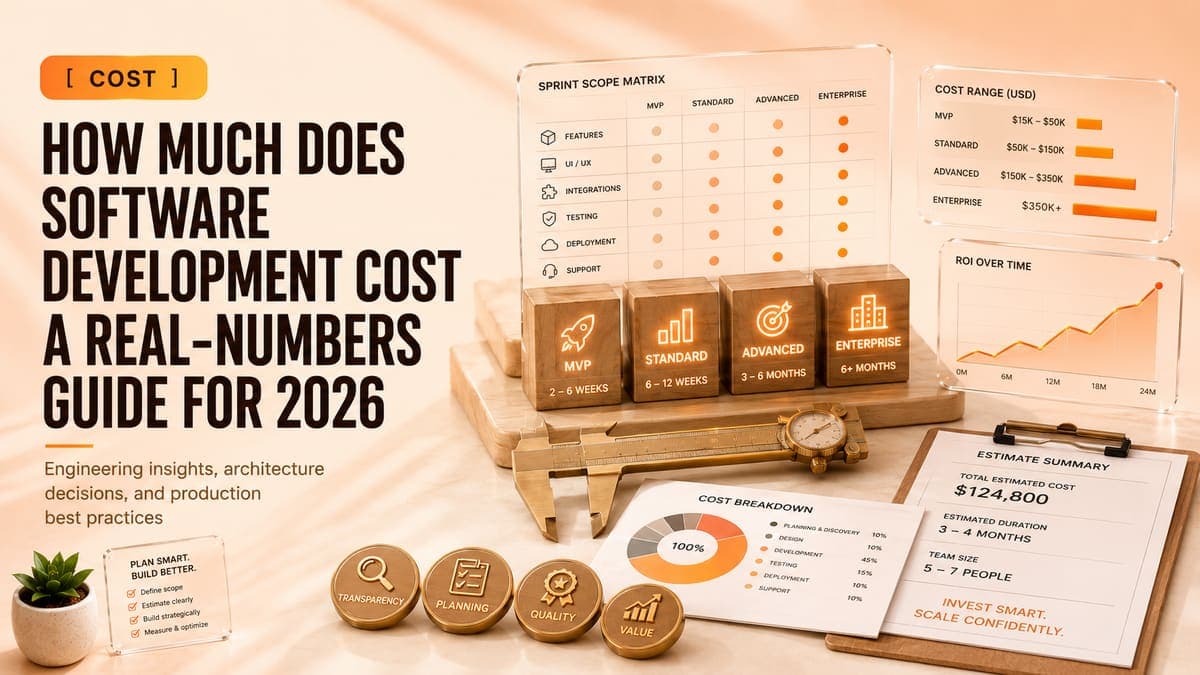
The Short Answer: Real Cost Ranges by Project Type
These are total project ranges for a finished, production-ready product — not hourly rates. Annual maintenance typically adds another 15 to 25% of the build cost per year. Cross-platform mobile development (Flutter or React Native) typically costs 30 to 40% less than building separate native iOS and Android apps.
What Actually Drives the Cost
Software cost comes from three things: the number of decisions that need to be made, the complexity of implementing those decisions, and the time required to test that they work correctly. Every feature on your product roadmap multiplies all three.
- Scope: number of screens, user roles, and unique user flows — this is the biggest driver
- Integrations: every third-party API (payments, maps, messaging, CRM) adds 2 to 6 days
- Compliance: HIPAA, GDPR, PCI-DSS each add significant architecture, audit, and documentation cost
- Performance requirements: an app that needs to handle 10,000 concurrent users is fundamentally different from one handling 100
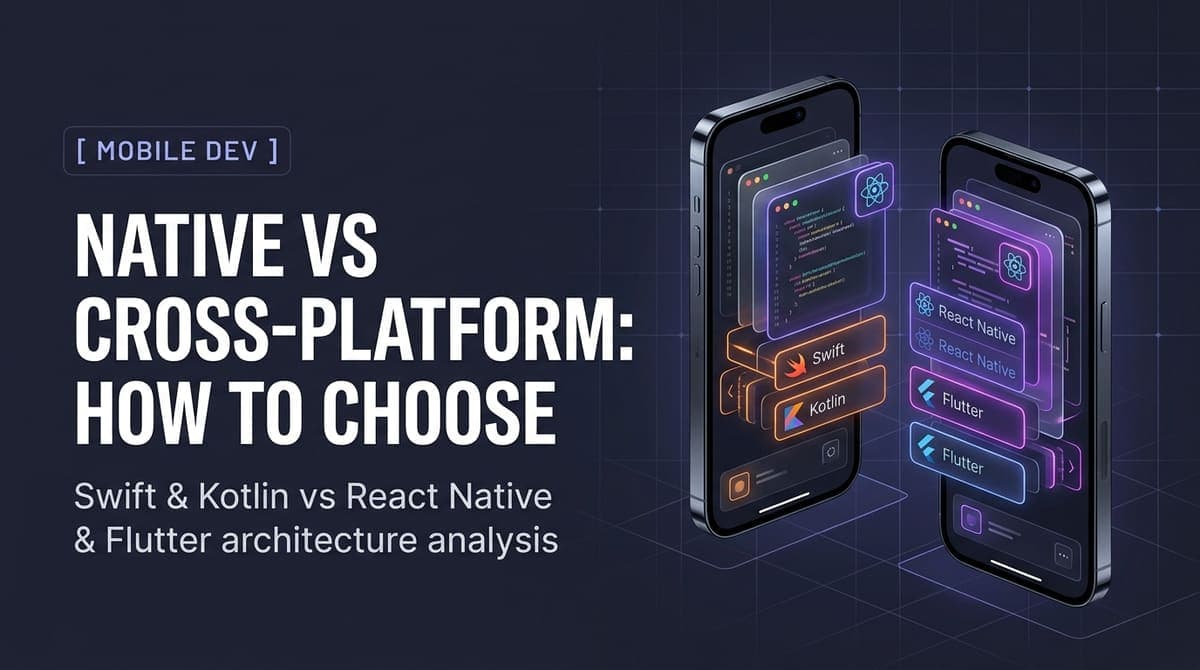
- Mobile platform choice: iOS only costs 40–60% of iOS plus Android; cross-platform costs 60–70% of native dual
- Design quality: a fully custom design system costs more than a component library-based UI
- Testing: a proper QA pass adds 15 to 25% to development cost but dramatically reduces post-launch fixes
What Is Usually Not Included
Project quotes frequently exclude items that are real costs for your business. Before finalising any budget, ask explicitly about these:
- Infrastructure and hosting: AWS, Google Cloud, or Vercel monthly costs — typically $50 to $2,000/month depending on scale
- Third-party service costs: Stripe fees, Twilio messaging, Sendgrid email, Google Maps API — all monthly costs
- App store fees: $99/year for Apple Developer account, $25 one-time for Google Play
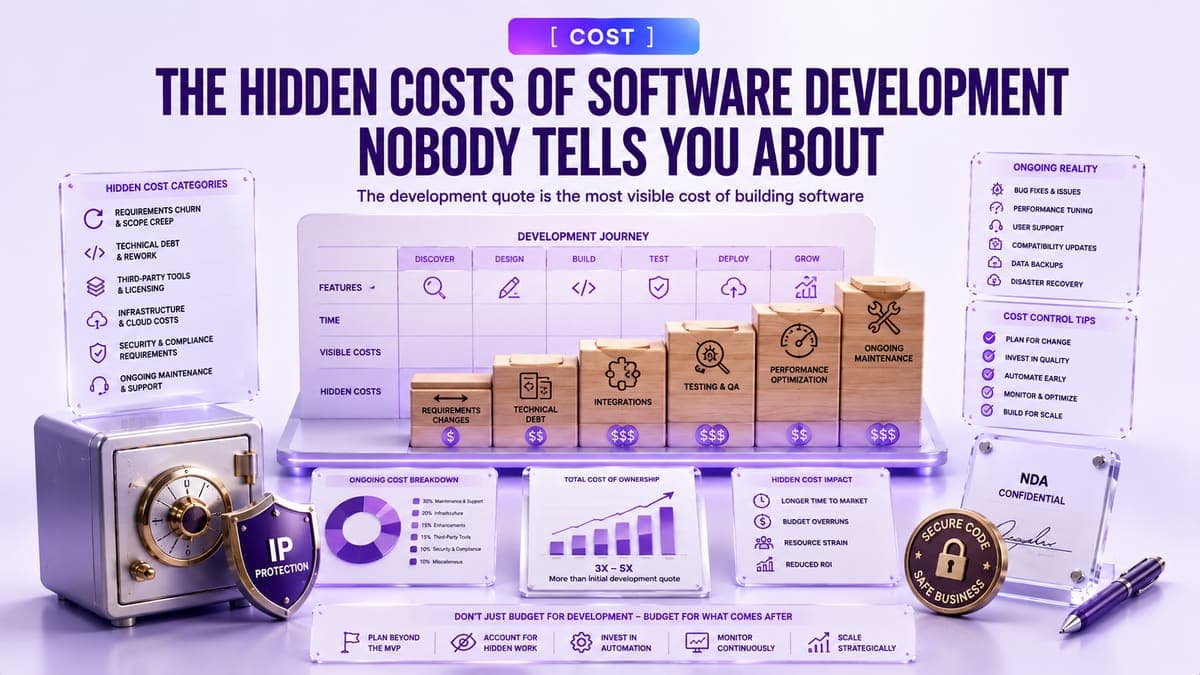
- Ongoing maintenance: bug fixes, security patches, dependency updates — typically 15 to 25% of build cost per year
- Future feature development: your MVP is not the finished product — budget for iteration
- Design assets: icon libraries, stock photography, illustration packs — $200 to $2,000+ depending on scope
How to Get a Meaningful Estimate
The quality of an estimate you receive is directly proportional to the quality of the brief you provide. Agencies that give you a price after a 30-minute call are guessing. The price will change once the project starts and reality sets in.
Before approaching any agency, write a one to two page project brief covering: what problem the software solves, who uses it, what the MVP includes (and explicitly what it does not include), what success looks like 90 days after launch, and what your timeline and budget range are. Agencies that respond to a clear brief with specific questions and detailed breakdowns are worth taking further. Agencies that respond with a quote are not.
Fixed Price vs. Time and Materials: Which Protects You?
Time and Materials
- You pay for actual time spent, billed monthly or weekly
- More flexible as requirements evolve
- Requires active management to avoid bill shock
- Agency does not carry overrun risk
- Better for complex or exploratory projects
Why the Cheapest Quote Is Often the Most Expensive
The cheapest development quote usually reflects one of three things: a smaller, less experienced team that will take longer; a scope that the agency has understood differently from you; or a deliberate strategy of winning the work cheaply and then charging for scope changes. In all three cases, the total cost of the project ends up higher than the initial quote suggested.
We have taken on rescue projects where founders spent $20,000 on a cheap build and then another $40,000 to fix or rebuild it. The money they saved on the initial quote was spent twice over to correct the problems it created. The lesson is not that expensive agencies are always better — it is that value matters more than price, and that a lower quote deserves more scrutiny, not less.