“Signing an NDA takes five minutes. Wishing you had one after a dispute can take years.”
A lesson most founders learn too lateThe Question Behind the Question
When founders ask "do I need an NDA with a developer," what they're really asking is: how much can I trust this person with my idea? The NDA question is a proxy for a deeper anxiety about sharing something you've spent months thinking about with someone you've known for a week.
The short answer: yes, you should get an NDA signed before sharing detailed product specs, business logic, or proprietary data with any developer or agency. But the longer answer matters more - because an NDA is only one piece of a protection framework, and over-relying on it gives a false sense of security.
This post covers when an NDA is essential, what a good one contains, what it cannot protect, and what else you need alongside it.
When an NDA Is Essential
You should absolutely get an NDA in place before sharing your full product spec, any proprietary data sets, integrations with third-party services under your accounts, or internal business processes that give you a competitive edge. These are things with real commercial value that a developer has no legitimate reason to share with others.
You also want an NDA before a detailed discovery call with an agency, particularly if you're sharing user research, business model assumptions, or customer data to help them scope the project. Everything you share in that call should be covered.
You probably don't need an NDA before a first introductory call where you describe the general category of product you want to build. Saying "I want to build a project management tool for construction teams" is not trade-secret territory. The detail is what matters.
What a Developer NDA Should Cover
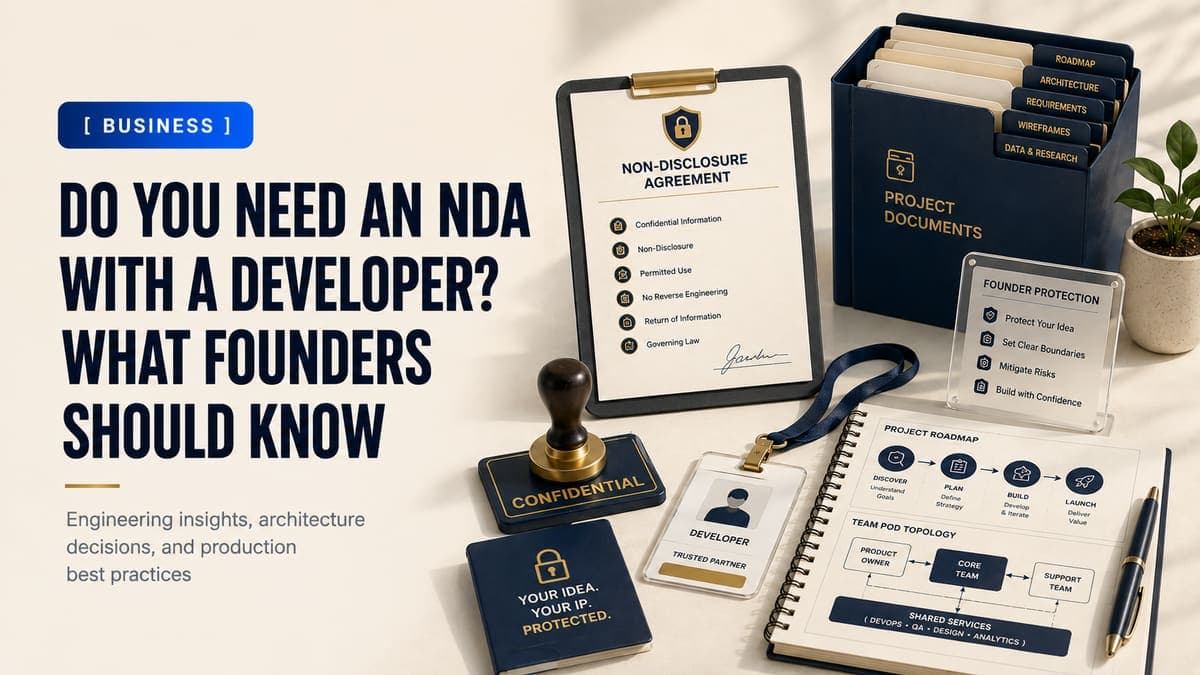
A solid NDA for a software development engagement should cover confidentiality of the concept and feature documentation, any proprietary algorithms or business logic, customer and user data you share for testing or scoping, pricing and commercial terms, and any third-party integrations or API keys you disclose.
It should specify a duration - typically 2 to 5 years - and state what the developer can and cannot do with the information. "Cannot disclose to third parties" is the minimum. Better NDAs also include a clause that the developer will not use the information to develop a competing product within the term.
Mutual NDAs are common and fair. A mutual NDA means you also agree not to share the developer's proprietary processes or tools. Reputable agencies often prefer this form.
What an NDA Cannot Protect
This is where founders often misunderstand the tool. An NDA does not prevent a developer from being inspired by your idea and building something similar. If they take nothing confidential but simply remember the concept and execute it differently, an NDA is very hard to enforce.
NDAs also don't protect code ownership. A developer can sign an NDA and still legally own the code they write for you if your contract doesn't include an IP assignment clause. These are separate legal instruments solving separate problems.
Enforcement is also a real-world consideration. Taking legal action on an NDA breach requires proving the breach occurred, identifying what specific information was used, and demonstrating harm. This is expensive and uncertain. An NDA deters bad behavior far more effectively than it remedies it after the fact.
How to Ask a Developer to Sign an NDA
Most professional developers expect this request and treat it as normal. A simple message works: "Before I share the full product brief, I'd like to have an NDA in place. Do you have a standard template, or would you like me to send one?" A developer who reacts with suspicion or refuses entirely is telling you something important about how they operate.
You can use free NDA templates from sources like Clerky, Docracy, or an AI tool like ChatGPT with a clear prompt - but for anything where significant money or proprietary technology is involved, have a lawyer review it. A $300 legal review is cheap insurance on a $50,000 development budget.
If a developer says "we never sign NDAs," ask why. Some agencies have valid reasons - for example, they work in a niche where they serve multiple competing clients and a blanket NDA creates conflicts. In that case, ask for a more narrowly scoped confidentiality clause in the development contract instead.
What Good Agencies Do Without Being Asked
The agencies worth working with treat confidentiality as standard practice. They'll proactively mention their NDA process in the first conversation. Their contracts will already contain IP assignment language and confidentiality terms. They won't wait for you to ask.
At Zovintra, every client engagement starts with a mutual NDA before any detailed scoping begins. Our standard contract includes a full IP assignment clause - meaning every line of code and every design asset you commission belongs to you, not us, the moment your final payment clears.
If you're currently evaluating developers and want a plain-language checklist of what to look for in a contract before you sign, that's a conversation we're happy to have. Most of the risk in early-stage development engagements comes not from malicious developers but from unclear paperwork - and that's entirely preventable.