“The messiest codebases are rarely the result of bad developers. They're the result of good developers working under bad conditions for too long.”
A CTO reviewing a three-year-old startup productWhat "Messy" Actually Means in a Codebase
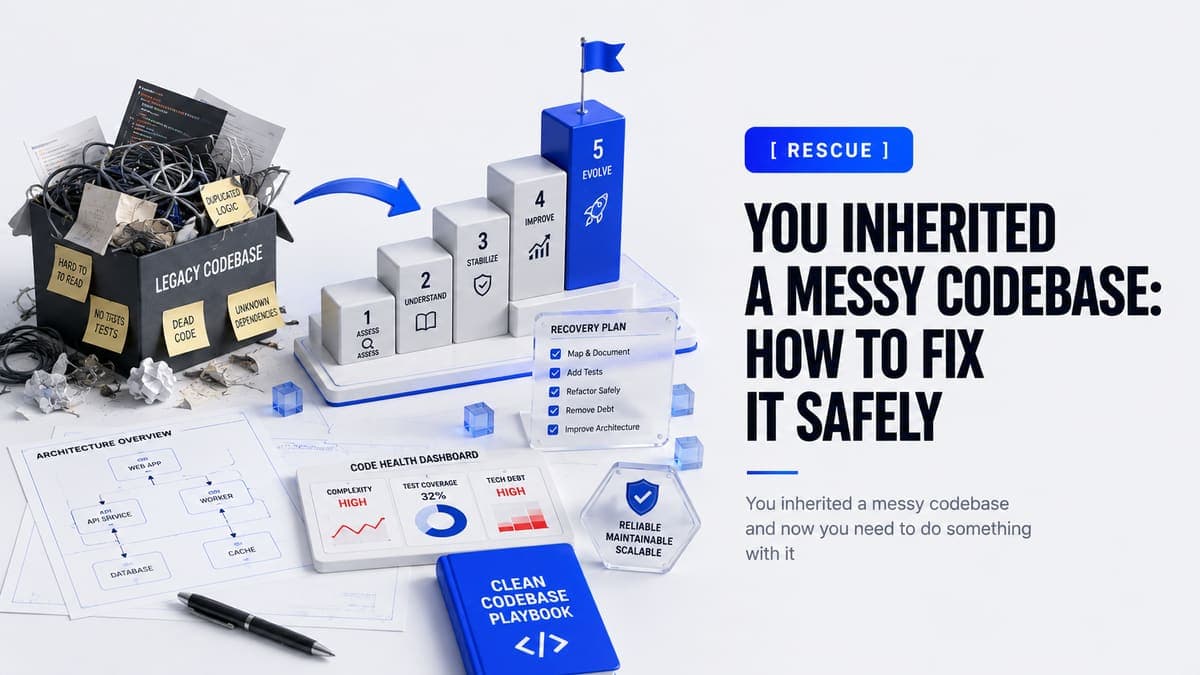
You inherited a messy codebase and now you need to do something with it. Maybe you've just joined a company and this is your first task. Maybe a developer left and the project landed on your desk. Maybe you're a founder who finally got access to your own product and opened it up to find something you didn't expect.
"Messy" covers a wide range. It might mean missing tests, inconsistent naming, or components that do five things each. It might mean hardcoded values everywhere, a deployment process that only one person ever understood, or dependencies that haven't been updated in two years. In serious cases, it means all of the above plus security vulnerabilities that have been running in production without anyone noticing.
The temptation in every case is to rewrite it. That temptation is almost always wrong. But the other extreme - shipping on top of a broken foundation without addressing anything - is how small problems become production incidents.
Why Rewriting From Scratch Is Usually the Wrong Move
The rewrite is appealing because starting fresh feels faster than untangling what's already there. It almost never is. Every rewrite begins with a honeymoon phase where everything is clean and moving quickly. Then reality arrives: edge cases from the original app that weren't documented anywhere, integration behaviour that only worked because of a specific quirk in the old code, user data migrations that no one planned for.
Joel Spolsky called this one of the single worst strategic mistakes a software company can make. The old code, messy as it is, encodes years of hard-won knowledge about how the system actually needs to work. Throwing that away means rediscovering all of it the hard way, while your users are waiting and your competitors aren't standing still.
The goal isn't a perfect codebase. The goal is a codebase that is stable enough to build on, safe enough to trust, and clear enough for your team to work in without daily frustration. You get there incrementally, not by torching it and starting over.
How to Assess a Messy Codebase Without Getting Overwhelmed
A structured audit is the only way to turn a vague sense of "this is bad" into a prioritised action list. Spend two to three days reviewing the project before you do anything else. You're not trying to understand every line - you're trying to understand the risk profile.
- Identify the parts of the codebase that touch money, authentication, or user data - these are highest priority for review
- Run a dependency audit to find outdated packages with known security vulnerabilities
- Look for any hardcoded credentials, API keys, or environment-specific values in the source code
- Check whether there is a working test suite and what percentage of critical paths it covers
- Map the deployment process - can you deploy without the previous developer's machine or knowledge?
- Note which parts of the code are touched most frequently - high-churn areas with no tests are your biggest risk
The Right Order for Fixing Things
Not all mess is created equal. Fixing things in the wrong order wastes effort and can create new problems. A useful priority framework is: security first, stability second, clarity third, performance last.
Security issues - exposed credentials, missing authentication checks, unvalidated inputs - need to be fixed before anything else, regardless of how much other work is on the list. Stability issues - things that cause crashes or data loss - come next. Clarity improvements (refactoring confusing code, writing documentation, improving naming) come after the system is safe and stable. Performance is last because a well-structured codebase is usually fast enough, and premature performance optimisation in a messy codebase is a trap.
Writing Tests Before You Refactor Anything
Before you change a single line of existing code, write tests for the behaviour you're about to touch. This is the rule that separates safe refactoring from dangerous refactoring. If you don't have a test confirming that a feature works before you change it, you have no way to know whether your change broke it - only that it seemed to work when you checked.
Start with the highest-risk areas: authentication flows, payment processing, any operation that writes to the database. Even rough integration tests that hit the key endpoints are better than nothing. Once those are in place, you can refactor with confidence because any regression shows up immediately.
Managing the Process Without Disrupting Live Users
If the messy codebase is running a live product, the cleanup process has to happen without breaking things for your users. This means making changes in small, reversible steps rather than large refactors. Feature flags can help: roll a change out to a small percentage of users before releasing it fully. Separate staging environments let you test thoroughly before anything touches production.
Set a rule for yourself and your team: no refactoring and new feature development in the same pull request. These two types of changes need separate review and separate deployment so that when something breaks, you know which type of change caused it.
When the Mess Is Too Deep to Handle Incrementally
Some inherited codebases are in a state where normal incremental improvement isn't enough. Security vulnerabilities in the authentication system, data integrity problems in the database, or a deployment setup so fragile that no one dares touch it - these situations require specialist assessment before you can even estimate what normal development will look like.
The sign that you need outside help isn't that the codebase is messy - all old codebases are messy. The sign is that your team is spending more time managing the mess than building the product, or that you've had two or more production incidents in the last quarter that traced back to structural problems rather than normal bugs.
Zovintra's rescue work frequently starts with exactly this kind of audit: an inherited codebase that someone needs to understand, stabilise, and then build on confidently. If you're sitting on a messy codebase and not sure whether to fix it incrementally or take a more structured approach, a discovery conversation is the fastest way to get clarity on what you're actually dealing with.