“The wrong hire at the start of a build doesn't just slow you down. It hands you a codebase you'll spend six months cleaning up before you can move fast again.”
A pattern we see in at least half of our rescue engagementsThe Decision That Shapes Everything Downstream
Before you write a single line of code, you have to answer one question: who's building this? Founders who choose quickly and confidently tend to do better than founders who agonise - not because speed beats deliberation, but because the wrong choice made quickly is easier to course-correct than a slow decision that delays the build by three months. That said, it's worth understanding the real tradeoffs before you commit.
Agency vs freelancer vs in-house isn't a philosophical debate. It's a resourcing decision with specific financial and delivery consequences. Each option has a genuine use case. The problems start when founders choose a model that doesn't fit their situation - usually because they optimise for the wrong variable, most often cost.
What Each Option Actually Delivers
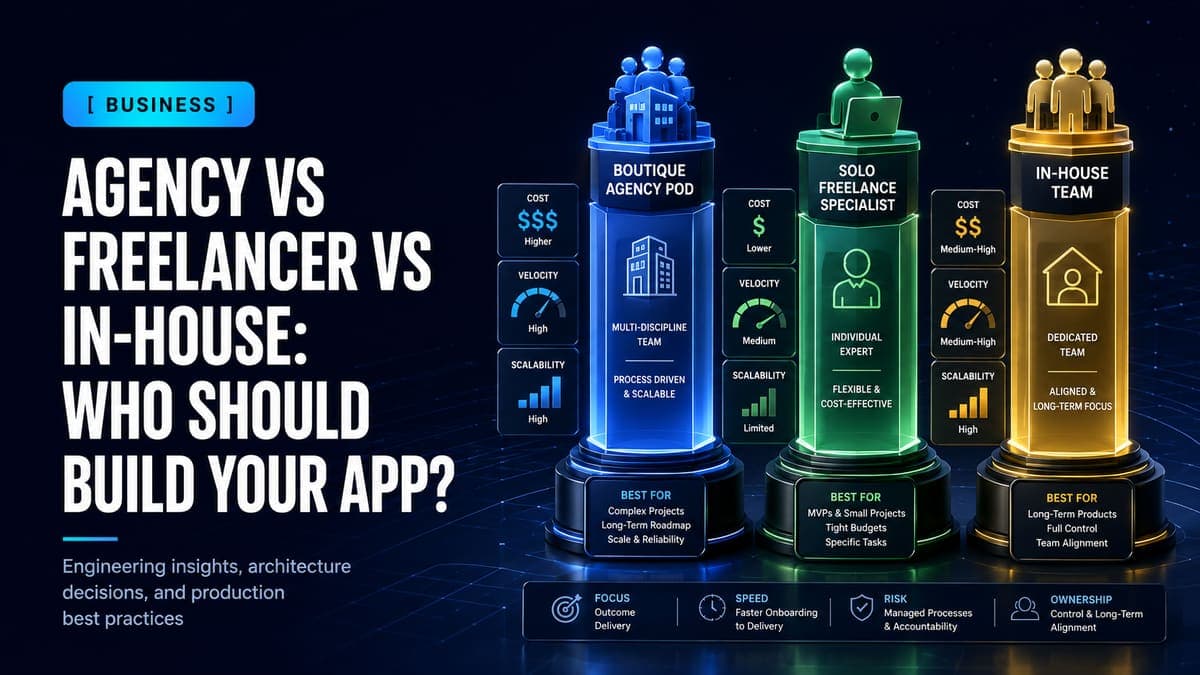
A freelancer is a single person. You get their skills, their availability, and their personal quality ceiling - all of which vary enormously. A strong senior freelancer can deliver excellent work on contained, well-scoped projects. The risk is dependencies: if they get sick, take another contract, or lose interest, your build stalls. Freelancers also rarely cover the full stack. Your React developer probably isn't your DevOps engineer or your UX designer.
An agency brings a team, a process, and coverage across disciplines. You get a project manager who keeps things moving, designers who hand off to developers, QA that runs before delivery. You pay more per hour, but you're buying coordination and reduced single-point-of-failure risk. The tradeoff is less flexibility - agencies work to a scope, and changing direction mid-engagement costs money and time.
In-house hires are the long-game option. You're building institutional knowledge, full alignment on your product vision, and the ability to iterate at speed once the team is ramped. The cost is front-loaded and the time to productivity is real. A new hire takes 4 to 8 weeks to be effective and 3 to 6 months to be genuinely fast. That timeline only makes sense if you have a sustained, ongoing build ahead of you.
When a Freelancer Is the Right Answer
Freelancers work well for bounded, well-specified tasks. A landing page redesign. A specific API integration. A mobile app with a clearly defined feature set. If you can write a two-page spec and hand it to someone with confidence that the scope won't shift, a good freelancer is often the fastest and most cost-effective option.
The failure mode is using a freelancer for open-ended product development - a build where requirements will evolve as you learn from users. Freelancers price on scope. When scope changes, you renegotiate, they get frustrated, or they disappear. If you can't write a complete spec before the build starts, a freelancer is probably the wrong choice regardless of how strong their portfolio looks.
- Freelancers are well-suited to clearly scoped, time-bounded deliverables
- A single senior freelancer can cover one discipline well, rarely more than two
- Vetting matters enormously - a weak freelancer is worse than no hire
- Availability risk is real: illness, other clients, or disengagement can stall a project
- Intellectual property and code ownership terms must be explicit in the contract
- Expect to spend 2 to 4 weeks finding the right person through referrals or platforms like Toptal
When an Agency Is the Right Answer
Agencies are the right call when you need cross-functional execution and don't want to coordinate it yourself. A product that needs design, frontend, backend, and DevOps work done in parallel is difficult for a freelancer to handle and expensive to staff in-house before you have revenue. Agencies absorb that coordination cost in exchange for a higher day rate.
They're also the right call when timeline certainty matters. If you have a launch date, an investor demo, or a market window that closes, an agency can commit to a delivery date in a way that a freelancer can't - because they have multiple people who can absorb delays. You're paying for that guarantee, but for certain builds it's worth it.
Agency
- Higher day rate but cross-functional team included - design, dev, QA, PM
- Multiple people means delivery continuity even when one is unavailable
- Structured process handles scope changes better - change orders are standard
- Milestone-based delivery with defined acceptance criteria reduces delivery risk
When In-House Makes Sense
The in-house argument gets stronger as your product matures and your iteration speed becomes a competitive advantage. If you're shipping features every week and responding to user feedback in real time, the overhead of briefing an external team slows you down. An in-house team that knows your codebase, your users, and your priorities can move faster than any agency once they're ramped.
The math works when you have enough sustained build work to justify a full-time salary for at least 12 months. A mid-level full-stack developer in the UK costs around 60,000 to 75,000 GBP per year all-in. If you're spending more than that on agency retainers annually and you have stable, ongoing work, it's worth building in-house. If your work is project-based with gaps between builds, the economics rarely support full-time headcount.
A Framework for Making the Call
Ask yourself three questions. First: can you write a complete spec today? If yes, consider a freelancer. If no, you need a team that can help you discover the right scope - which points to an agency. Second: do you have at least 12 months of continuous build work ahead? If yes, in-house is worth exploring. If no, don't hire. Third: is delivery timeline certainty important to you? If yes, an agency is safer than a freelancer.
The hybrid approach that works well for early-stage companies is agency for the initial build, then transition to in-house once the product is stable and the codebase is clean. This avoids the trap of hiring full-time developers before you know what you're building, while giving you a clean handoff point when in-house starts to make economic sense.
If you started with a freelancer and it went wrong - the freelancer delivered something that works partially, left without documentation, and you're stuck with a codebase you can't extend - the fix is a proper audit before anything else. Understand what was built before you hire someone new to extend it. Rushing to hire a second freelancer without the audit usually compounds the problem rather than solving it.
What This Means for Your Build
Most early-stage founders should not hire in-house for their first build. Most should not default to the cheapest freelancer they can find on Upwork either. The middle path - a focused agency engagement to get to a working v1, followed by a deliberate decision about what comes next - avoids the two most common mistakes. Where teams get stuck is when they optimise for cost in the short term and end up paying twice: once for the cheap build and once to fix it. If you're at the point of making this decision and want a clear-eyed view of what your build would cost and how long it would take, Zovintra offers a no-commitment scoping call that takes 30 minutes.