
“Technical leadership is not just about making architecture decisions. It is about making sure the business and the engineering team are pointed at the same problem.”
On what a fractional CTO actually doesWhat a Fractional CTO Is
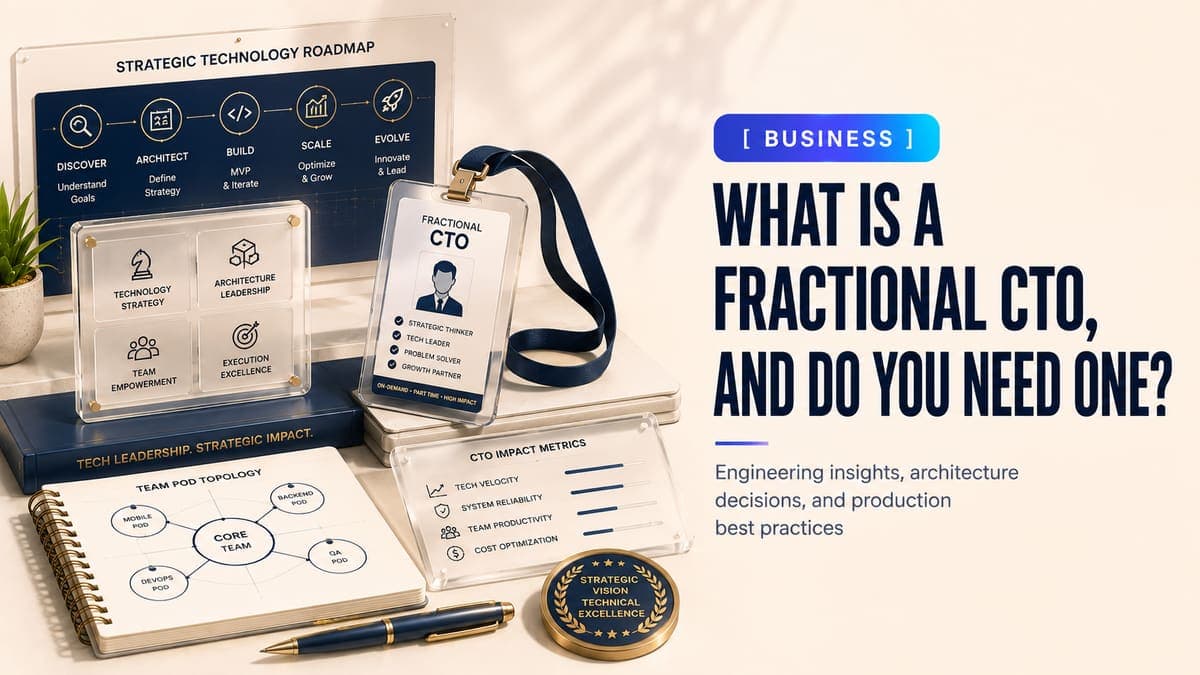
A fractional CTO is a senior technical leader who works with your company on a part-time or retainer basis - typically one to three days per week - providing the strategic and architectural leadership you need without the cost or commitment of a full-time executive hire. They own the technical direction, work with your engineering team, and sit at the leadership table alongside your founders or CEO.
The word 'fractional' simply means their time is divided across a small number of engagements rather than committed to one company. For the CTO, this works because early-stage companies rarely need 40 hours per week of executive technical thinking - they need high-quality judgment applied consistently, not constant availability.
This is different from a technical advisor, who provides occasional input and introductions. A fractional CTO is accountable for outcomes: the architecture decisions, the hiring calls, the vendor selections, the engineering team's velocity, and the technical credibility of the company in front of investors and customers.
Who Typically Needs One
The most common profile is a non-technical founder who has been running engineering through a combination of outsourced developers, a junior in-house engineer, and their own judgment - and has hit the ceiling of what that approach can deliver. The codebase is accumulating debt, the outsourced team is building things that aren't quite right, and there is no one with the seniority to call it out and fix it.
A second profile is a technical founder who is good at building but has moved into CEO mode. They are now spending their time on fundraising, customers, and hiring - and they no longer have the bandwidth to run the engineering team. The team needs a technical lead, but the company is not ready to compete on salary with FAANG for a full-time CTO.
A third scenario is the pre-fundraise period. Investors - particularly at Series A and above - want to talk to the person responsible for technical decisions. If that person is an outsourced contractor or a junior engineer, it undermines confidence. A fractional CTO provides that credibility during the raise and through the due diligence process.
What a Fractional CTO Does Day to Day
- Sets and maintains the technical roadmap in alignment with the product and business strategy
- Reviews and approves architectural decisions before they are built into the codebase
- Conducts 1:1s with senior engineers and owns their performance and growth
- Participates in fundraise conversations and investor technical due diligence
- Evaluates and selects vendors, platforms, and infrastructure choices
- Identifies technical risks before they become crises - including in AI-generated or inherited codebases
- Establishes engineering standards: code review practices, testing requirements, deployment processes
Fractional CTO vs. Full-Time CTO
Fractional CTO
- Covers pre-seed through Series A for most startups
- One to three days per week delivers 80% of the strategic value at 30% of the cost
- Ideal when you need credibility and direction without a full executive budget
- Lets you access CTO-level experience that would otherwise be out of reach on a startup salary
What to Expect in the First 90 Days
A fractional CTO engagement that starts well begins with a structured assessment - not building, but understanding. The first two to three weeks should involve a thorough review of the existing codebase, infrastructure, team capabilities, current vendor relationships, and the gap between what engineering is delivering and what the business actually needs.
By the end of month one, you should have a clear technical roadmap, a prioritised list of risks to address, and a view on whether the current team structure can execute the plan or whether you need to hire, re-scope, or restructure. By month three, the fractional CTO should have materially improved engineering velocity, reduced risk, and created a process that continues to work even when they are not on-site.
If an engagement is still in 'assessment mode' at month three, something is wrong. The value of a fractional CTO is in delivering strategic clarity and measurable execution improvement quickly - not in generating long strategy documents.
The AI-Tool Startup Edge Case
There is a growing category of startups where the fractional CTO's first job is triage rather than strategy. These are companies that built their product with AI coding tools - Lovable, Bolt, Cursor, Replit - and have a working product but no real technical foundation. The founder knows the product works today but has no idea whether it will survive real user load, a security review, or an investor's technical due diligence.
In these cases, the fractional CTO typically starts with a code audit, stabilises the highest-risk areas, and then builds a migration plan from 'AI-generated prototype' to 'production-grade product.' It is a specific and increasingly common engagement pattern - and it requires someone who understands both the constraints of AI-generated code and the architecture decisions needed to move past them.
How to Evaluate a Fractional CTO
Most startups that need a fractional CTO know they need one before they admit it. The signs are consistent: engineering direction drifting, the same architectural debates happening without resolution, investor conversations stalling on technical questions, and a general sense that no one is holding the technical strategy together. If any of those resonate, a fractional engagement is almost always worth exploring before committing to a full-time hire - and it's a model we've used as the foundation for longer-term technical partnerships with many of the startups we work with.