“Your idea is not your biggest asset. Your execution is. But that doesn't mean you hand it over without any paperwork.”
The founder's protection dilemmaWhy Founders Worry About Idea Theft
If you're about to hire a developer or agency and your stomach tightens at the thought of sharing your concept, you're not being paranoid - you're being careful. The fear is real: what if they take my idea and build it themselves, or share it with someone else?
The honest answer is that most developers are too busy building other people's products to steal yours. But "most" is not "all," and hope is not a strategy. There are concrete, practical steps you can take to protect your app idea when hiring a developer - and they cost almost nothing to put in place.
The good news is that protection is mostly about documentation, not secrecy. The founder who has a signed NDA, a clear IP clause in their contract, and a paper trail of their idea's development is almost always protected. The one who relies on trust and a handshake is not.
What You're Actually Protecting
Before you can protect something, you need to know what it is. Your app idea breaks down into a few distinct things: the concept itself, the specific features and flows you've designed, any proprietary data or content, and the code that gets written.
The concept - the high-level "Uber for dog walkers" type of idea - is nearly impossible to protect legally. Ideas are not patentable in most jurisdictions without a specific technical implementation. What you can protect is the specific execution: your wireframes, your documented feature list, your brand identity, and especially the code.
This is why "you own the code" should be a non-negotiable clause in any development contract. If a developer writes code for you and there's no IP assignment clause, copyright law in many countries defaults to the creator - meaning the developer, not you, owns what they built.
The NDA: A Starting Point, Not a Finish Line
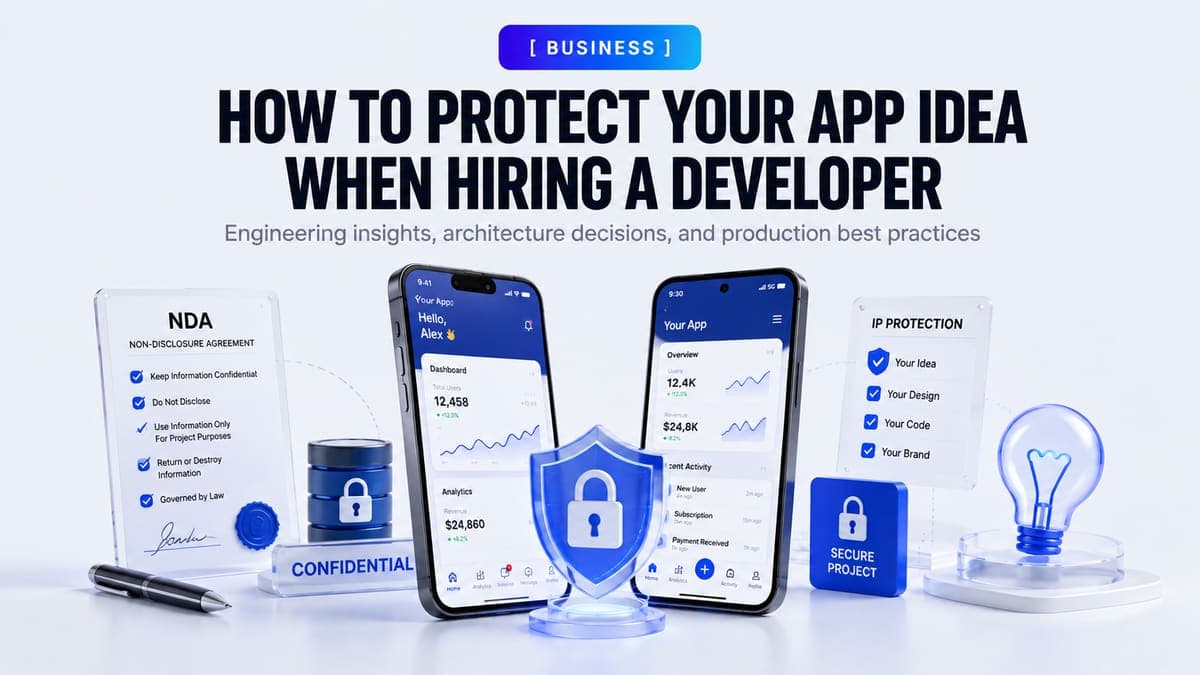
A Non-Disclosure Agreement (NDA) is the first tool most founders reach for, and it's a reasonable one. An NDA legally binds a developer or agency to keep your information confidential. Any reputable studio will sign one before a discovery call or proposal conversation.
But an NDA has real limits. It prevents sharing, not using. If a developer signs your NDA and then builds something inspired by your idea for a different client, proving they used your confidential information is very difficult in practice. NDAs are most valuable for protecting technical trade secrets, proprietary data, and documented business logic - not general app concepts.
Sign one, absolutely. But treat it as the floor of your protection, not the ceiling.
The Clause That Matters Most
The single most important thing in any development contract is the IP assignment clause. This should state clearly that all work product - every line of code, every design, every asset - created under the contract is assigned to you, the client, upon final payment.
Without this clause, you may pay $40,000 for a custom app and still not legally own it. Some developers use this as leverage - delaying source code delivery or licensing the codebase to you rather than transferring ownership outright. If your contract says "license" anywhere near the deliverables section, ask questions before signing.
A clean contract says something close to: "Developer assigns all intellectual property rights in the deliverables to Client upon receipt of full payment." If the agency you're speaking to pushes back on this language, treat that as a serious red flag.
Practical Steps Before You Share Anything
- Document your idea in writing before first contact - a dated email to yourself, a Notion doc, anything with a timestamp establishes prior art
- Prepare a summary version of your idea for initial conversations - enough for a developer to scope the work, not a full product spec
- Ask any potential developer to sign an NDA before the first detailed call
- Read the IP and ownership section of every proposal before discussing price
- Use a shared Git repository that you control, so you always have access to the codebase
- Never give a developer credentials to infrastructure they control exclusively - keep AWS, hosting, or database access under your account
Red Flags That Should Make You Walk Away
Most developers are honest professionals. But there are patterns that signal a higher risk of a bad outcome. A developer who resists signing an NDA for a discovery call has no good reason for that refusal. A contract that delivers a "license to use" the software rather than ownership of it is structured to keep you dependent.
Agencies that host your code in their own repositories under their own accounts - rather than a repository you control - make it very easy for them to hold your product hostage if a payment dispute arises. This happens more often than founders expect, especially with offshore freelancers.
Finally, be cautious about developers who want to build your MVP on a no-code tool like Bubble under their own account. If the account is theirs, the product is effectively theirs to control until you move it.
Protected Approach
- NDA signed before any detailed conversation
- Contract assigns all IP to you on final payment
- Code committed to a repository you own and control
- Hosting, domain, and database accounts are yours
- Dated documentation of concept and feature decisions before engagement
What Legitimate Studios Do by Default
A trustworthy development studio treats IP protection as a standard part of onboarding, not something you have to fight for. They'll offer an NDA before you ask, their contract will have a clear IP assignment clause, and they'll push code to a repository you control from day one.
Zovintra's standard contract assigns full IP ownership to the client upon project completion. Your code, your designs, your data - all of it transfers to you. We also encourage clients to set up their own hosting accounts before we begin, so infrastructure is never held in our name.
If you're evaluating studios right now and you're not sure what to ask, the three questions that matter most are: Will you sign an NDA today? Does your contract assign IP to the client? Will the code live in a repository I control? A professional team answers yes to all three without hesitation.