“Hiring your first developer feels like building the company. Hiring the right agency feels like buying time. Both are right depending on where you are.”
The decision most early-stage founders get wrongWhy This Decision Matters More Than It Seems
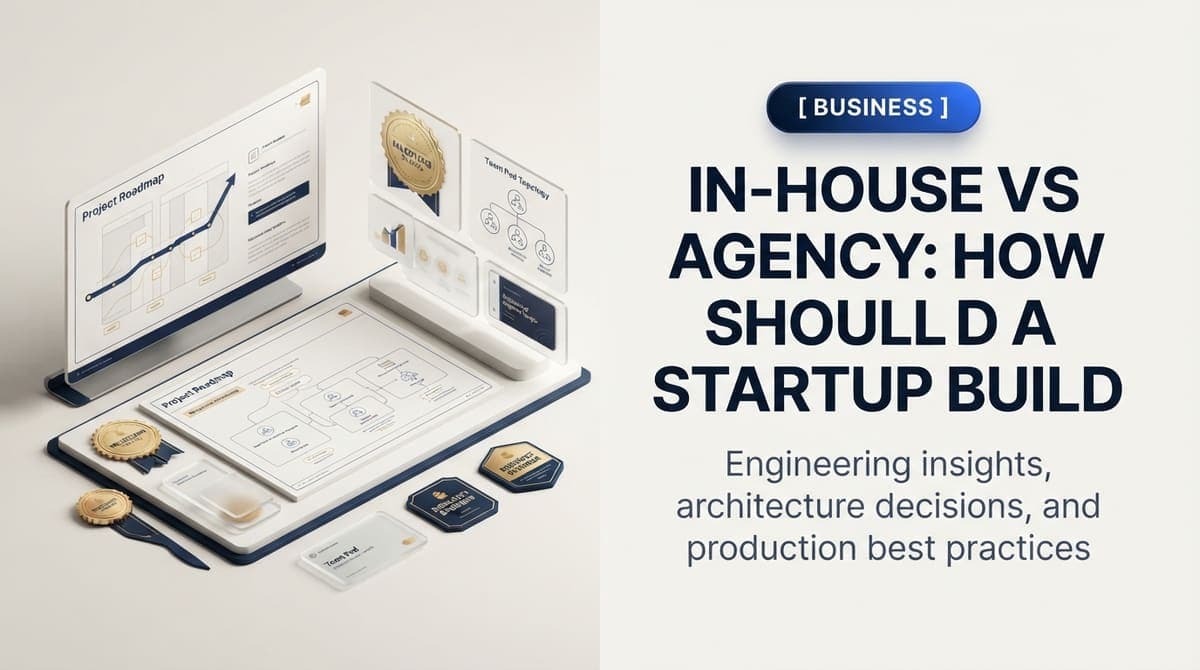
The build decision - in-house team versus development agency - is one of the most consequential choices a startup makes in its first two years. Get it right and you move fast, control costs, and ship a product that fits your market. Get it wrong and you burn eighteen months and a significant chunk of your runway on the wrong approach.
The frustrating reality is that both options work. In-house teams built Stripe, Notion, and Figma. Agencies helped launch products that later raised Series A rounds and hired their own engineering teams. The question is not which option is universally better - it is which one is right for your specific stage, budget, and product complexity.
This post gives you a framework for making that call. No ideology, no agenda - just the tradeoffs stated plainly so you can make a decision that fits your situation.
The Case for Building In-House
An in-house engineering team gives you full context alignment. Your developers attend your customer calls, absorb your strategic pivots in real time, and build institutional knowledge about your codebase that no external team can match. For products that require constant iteration based on user feedback - where requirements change every two weeks - this depth of context is genuinely hard to replicate with an external team.
In-house also makes sense when your product is your primary competitive moat. If the way you process data, the algorithm you have built, or the workflow you have invented is what makes your company defensible, you want the people who built it sitting next to you. Proprietary technology is harder to protect when it lives inside an agency's codebase.
The cost math also favors in-house at scale. A senior full-stack developer at $120,000 to $160,000 per year costs less per hour than a mid-tier agency over a twelve-month engagement. Once you are past product-market fit and your product roadmap is stable, an in-house team will almost always be more cost-efficient than continuing to pay agency rates.
The Case for Starting With an Agency
Before product-market fit, speed is more valuable than cost efficiency. An experienced agency brings a full team - designer, frontend developer, backend developer, QA - that would take you four to six months to hire individually. You are paying for assembled capability and immediate start, not just code output.
Agencies also carry risk that early-stage startups cannot afford to carry alone. If a key in-house developer leaves mid-project, you are scrambling to hire and onboard a replacement while the build stalls. A good agency absorbs that risk internally - if someone leaves their team, it is their problem to solve, not yours.
For founders who are not technical, an agency provides a layer of translation between business requirements and engineering decisions. A good agency will tell you when you are over-engineering something, when a third-party tool can replace six weeks of custom development, and when your timeline expectations are unrealistic. That expertise has real dollar value - it often saves more than it costs.
Side-by-Side: The Real Tradeoffs
Development Agency
- Immediate start - full team available within weeks
- Variable cost tied directly to project scope
- Experienced across multiple tech stacks and industries
- Managed delivery - you define outcomes, not tasks
- Scales up or down based on what the project needs
The Hybrid Model That Most Startups End Up Using
In practice, the most successful early-stage startups use a blend: they work with an agency to get to their first working product, then hire one or two in-house engineers to own the codebase while continuing to use the agency for specific projects - a new feature, a platform migration, a performance overhaul. The in-house team provides continuity; the agency provides surge capacity.
This model works because it solves the agency's biggest weakness (lack of long-term context) and the in-house team's biggest weakness (limited bandwidth). The in-house engineers become the institutional knowledge holders; the agency becomes a specialist resource that can be engaged for clearly scoped work.
The transition from agency-first to hybrid typically happens when you close your seed round or Series A, hire a technical lead or CTO, and begin building a team around them. Getting the agency to document the architecture, hand over the codebase cleanly, and brief the incoming team is a step that many startups skip and regret later.
Stage-Specific Recommendations
Pre-seed with an idea and no code: use an agency or a hybrid AI-tool-plus-agency approach. Your goal is a working demo or MVP as fast as possible. You are not building the final product - you are building something to learn from and show to investors and early customers.
Post-seed with early traction: if your product is working and your roadmap is clear, start hiring. Begin with a senior engineer or technical lead who can own the codebase and make hiring decisions as the team grows. Keep the agency on retainer for specialized work while your team ramps up.
- If you have runway for less than 12 months, an agency is almost always cheaper than hiring
- If your product requires machine learning or advanced infrastructure, agencies with that specialization beat generalist in-house hires
- If you are in a regulated industry, an agency with compliance experience is worth a significant premium
- If your co-founder is technical and has bandwidth, a lean in-house approach can work even pre-product-market fit
- If you have already hired in-house and the build has stalled, bringing in an agency to supplement is faster than hiring again
What to Watch Out For With Agencies
Not all agencies are equal, and the risks are real. The most common failure mode is an agency that takes your project on without the right expertise, outsources to cheaper developers without telling you, and delivers code you cannot maintain. Protect yourself with a discovery phase before any build begins, weekly demos of working software, and a handoff plan that is agreed before the contract is signed.
Ownership of your IP, your code, and your infrastructure credentials is another area where startups get burned. Ensure your contract states that all code, designs, and credentials are your property from day one - not delivered at project completion. If an agency pushes back on this, walk away.
At Zovintra, we work with early-stage founders who are figuring out exactly this decision. Whether you need a full product build, a rescue of something already started, or a technical partner to work alongside your growing in-house team, the engagement model adapts to where you actually are - not a one-size-fits-all retainer that assumes you know what you need twelve months from now.