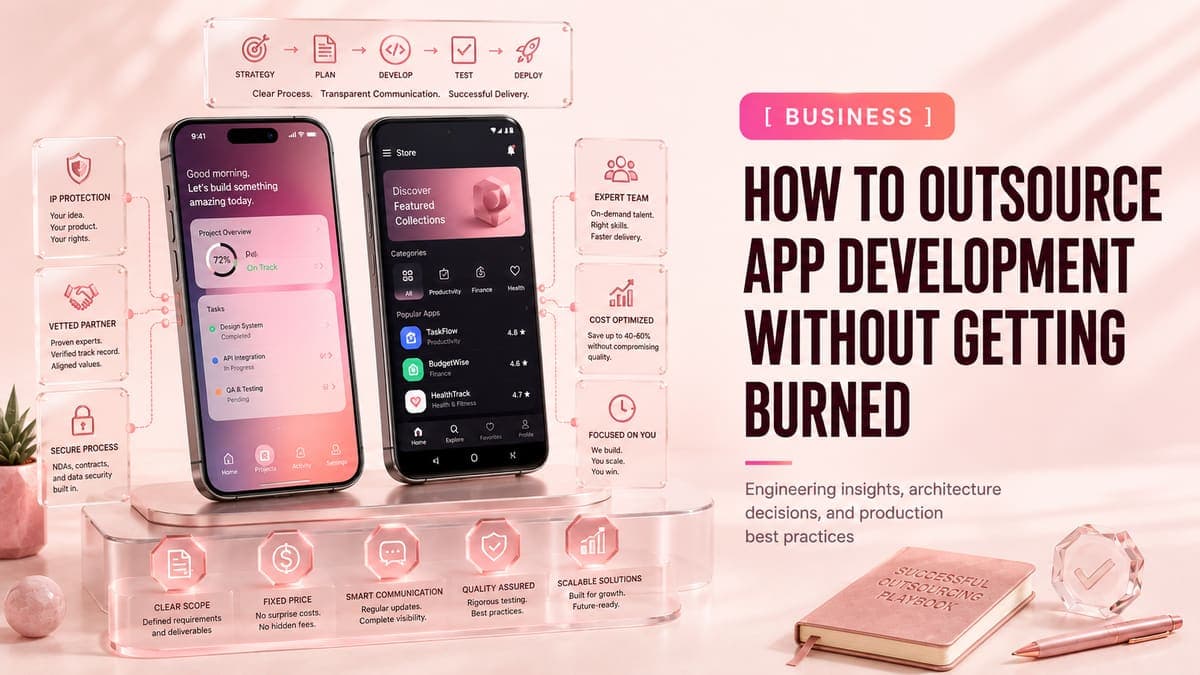
Outsourcing app development has a bad reputation in some circles - and a well-earned one. The horror stories are real: six-figure projects that delivered nothing usable, offshore teams that disappeared mid-build, apps launched with no documentation that cost a fortune to maintain. But the problem is almost never outsourcing itself. It is outsourcing badly, with the wrong partner, on a poorly scoped project.
“The most expensive outsourcing mistake is not picking the wrong vendor. It is failing to define what done looks like before you sign anything.”
Why scope documents matter more than hourly ratesThe Pre-Engagement Work Most Companies Skip
Before you talk to a single development agency, you need to be able to answer four questions clearly: What problem does this app solve and for whom? What does the MVP include - and what deliberately does not? What does success look like at 30, 90, and 180 days post-launch? Who owns the product internally after delivery?
These sound basic. Most companies cannot answer them in specific terms before starting an RFP. When the scope is vague, every vendor interprets it differently, every quote is incomparable, and the project drifts from day one. The company that does this pre-work before engaging vendors consistently gets better outcomes - because they are evaluating against a standard rather than hoping a vendor figures it out.
How to Evaluate and Choose a Development Partner
The RFP process for development work is often optimised for the wrong things. Teams over-index on hourly rate and under-index on process quality, communication style, and how the vendor handles ambiguity. An agency that charges $120 per hour and misunderstands requirements will cost far more than one charging $180 per hour that asks the right questions early.
Ask any agency you are seriously evaluating to walk you through a recent project that went wrong and how they handled it. Agencies that have delivered at scale have these stories and can tell them clearly - including what they changed as a result. Agencies that claim everything always goes smoothly either have not done enough complex work or are not being honest with you.
- Review actual code from a recent project (with client permission) - not just a demo or a portfolio screenshot
- Ask how they handle scope changes mid-project and request a sample change request form
- Verify the team that worked on the case studies is the team that will work on your project
- Check references specifically on communication quality and how they handle difficult conversations
- Understand the handoff process - what you own at the end, how documentation is delivered, what support looks like post-launch
- Confirm IP ownership terms in writing before starting - some contracts assign IP to the agency by default
Contracts That Protect You
A contract for outsourced development should include a detailed Statement of Work (SOW) with specific deliverables, not general descriptions. "A mobile app with user authentication" is not a deliverable. "An iOS and Android application built in React Native, with email and social sign-in via Supabase Auth, passing all acceptance criteria listed in Appendix A" is a deliverable.
Payment milestones should be tied to delivery milestones, not calendar dates. Never pay 50% upfront for a project with a 6-month timeline. A structure of 25% on contract signing, 50% across defined delivery milestones, and 25% on final acceptance protects both sides - you are not carrying the full financial risk and the agency has enough upfront to resource the work properly.
Discovery and Scoping (Weeks 1 to 2)
Vendor documents requirements in detail. Both sides sign off on the scope, acceptance criteria, and milestone definitions before development starts.
Design and Architecture (Weeks 3 to 4)
Wireframes or high-fidelity designs approved before any code is written. Technical architecture documented. Stack choices agreed.
Development Sprints (Weeks 5 to 14)
Two-week sprints with a working demo at the end of each. Stakeholder review and feedback built into the cycle - not saved for the end.
QA and Staging (Weeks 15 to 16)
Full QA pass on staging environment. Acceptance testing against criteria defined in the SOW. Issues logged and resolved before production.
Launch and Handoff (Week 17)
Production deployment, documentation delivered, codebase transferred to client repository, 30-day warranty period begins.
Communication Structures That Prevent Disasters
The single biggest predictor of outsourced project success is communication frequency and quality - not the vendor's technical skill. Teams that hold weekly syncs, maintain a shared project board, and escalate blockers within 24 hours consistently deliver on time. Teams that check in monthly and treat the vendor as a black box reliably get surprises at the end.
Define the communication structure before the project starts: who is the single point of contact on each side, how often are formal check-ins, what channel are day-to-day updates in, and what constitutes a blocker requiring immediate escalation. Document this in writing. When something goes sideways six weeks into a project, the communication structure is what keeps it recoverable.
What to Do When a Project Is Already in Trouble
The Decision That Matters Most
Outsourcing works when the scope is specific, the contract protects you, the communication structure is defined, and the vendor has a track record on comparable projects. It fails when any one of those is missing. Choosing the cheapest quote on a vague scope is not saving money - it is delaying an expensive rework conversation by 6 months.
If you are evaluating development partners for an app project and want to understand what a well-scoped engagement should look like before you sign anything, that is worth a conversation. The 30 minutes spent on that call consistently saves months of the wrong kind of work.