“Off-the-shelf software fits the way the vendor imagined your business. Custom software fits the way your business actually works.”
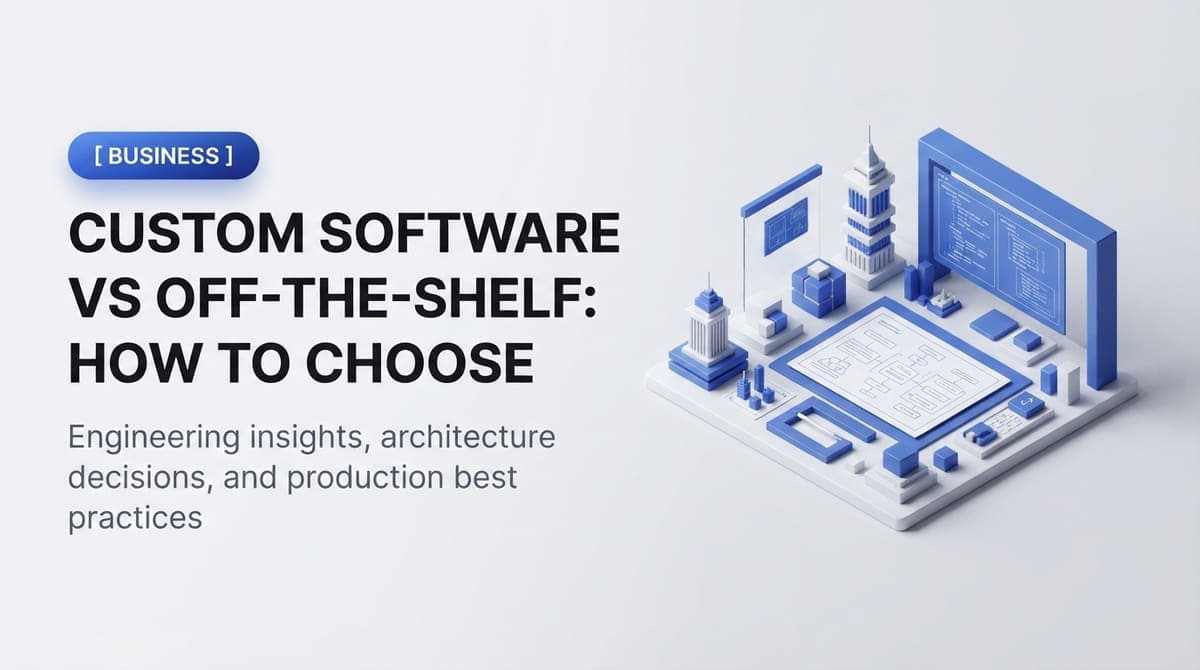
The question founders ask us every weekCustom Software vs Off-the-Shelf: The Core Tradeoff
When businesses ask "should I buy software or build it?", they're really asking two questions at once: how fast do I need a solution, and how much does the fit matter? Off-the-shelf tools - SaaS platforms, packaged software, marketplace apps - exist because most business problems follow predictable patterns. CRM, accounting, project management, email marketing: these categories are mature enough that a third-party product will handle 80 to 90 percent of your needs out of the box.
Custom software is the answer when that remaining 10 to 20 percent is the part that actually matters to your business. If your competitive advantage lives in how you process data, how you serve customers, or how your internal operations run - and a generic tool flattens that into a standard workflow - you're trading away differentiation for convenience.
This guide walks through the factors that actually determine the right choice, with specific examples and numbers so you can make the decision for your situation rather than guessing.
When Off-the-Shelf Wins
Off-the-shelf software wins when your needs are standard, your team is small, and speed matters more than precision fit. A 10-person company using HubSpot for CRM, Xero for accounting, and Notion for documentation is making a smart decision. These tools exist because thousands of companies share the same requirements. Building custom equivalents would cost 100x more and deliver maybe 20% more relevance to your specific context.
The economics are straightforward: a SaaS tool at $200 per month costs $2,400 per year. A custom-built equivalent starts at $30,000 to $60,000 to develop and then requires ongoing maintenance. Unless the custom version generates measurable value that the SaaS tool doesn't - in revenue, cost savings, or competitive advantage - the math doesn't work.
Off-the-shelf also wins when your problem is still being defined. If you're not sure exactly what your workflow needs to look like, buying a flexible tool and adapting your process to it is faster and cheaper than commissioning software around a process you haven't validated yet.
When Custom Software Wins
Custom software wins when your process is genuinely unique and cannot be expressed cleanly inside the constraints of a generic tool. Logistics companies with non-standard routing rules. Manufacturers with proprietary quality control workflows. Marketplaces with unusual matching logic. If your team spends hours each week exporting data from one tool, manipulating it in a spreadsheet, and importing it into another - that gap is a custom software opportunity.
It also wins when the off-the-shelf alternatives have pricing models that punish your growth. Some SaaS tools charge per user or per transaction in ways that make them increasingly expensive as you scale. A business processing 50,000 orders per month on a platform that charges per-order can hit monthly software costs that would fund significant custom development within a year.
- Your core workflow cannot be configured into any existing tool without major workarounds
- You're paying for three or more tools that partially overlap and require manual data sync between them
- Vendor lock-in is a real risk - your data, your integrations, and your business logic are controlled by a third party
- Compliance requirements (HIPAA, SOC 2, data residency) that SaaS platforms cannot meet
- Your competitive advantage comes from doing something operationally that generic software doesn't support
The Hidden Costs Both Options Carry
Off-the-shelf software has costs that don't show up in the pricing page. Implementation time. Staff training. Workflow adaptation - the process changes you have to make to fit the tool. Integration work when your chosen tools don't talk to each other natively. And subscription fees that accumulate for years, often for features you don't use.
Custom software has its own hidden costs. Development takes longer than most timelines predict. Requirements that were clear on paper turn out to be ambiguous when a developer tries to implement them. Maintenance is ongoing - security patches, dependency updates, bug fixes. And if your internal requirements change significantly, you need developer time to change the software.
The honest comparison isn't "$500/month SaaS vs. $50,000 custom build." It's the full 3-year total cost of each path, including the cost of the fit gap - the productivity lost to workarounds, manual steps, and limitations in the off-the-shelf option.
Custom Software
- Built exactly around your process and data model
- One-time build cost, lower ongoing cost at scale
- You control the roadmap and can change anything
- Proprietary workflows stay proprietary
- Integration with any system you need
The Hybrid Approach Most Businesses Miss
Most businesses don't face a binary choice between "buy everything" and "build everything." The most efficient approach is usually a combination: buy commodity tools for standard functions (email, HR, accounting) and build custom software for the workflows that are genuinely specific to your business.
A common pattern we see: a company uses Salesforce or HubSpot for customer-facing CRM but builds a custom internal operations tool that automates their specific service delivery process and integrates with the CRM via API. The commodity tool handles the standard part. The custom tool handles the part that's actually differentiated.
This approach also gives you a migration path. You're not betting everything on a single custom codebase. The custom software you build is focused, has a clear scope, and solves a well-defined problem - which makes it faster to build and easier to maintain.
How to Make the Decision
Start with the fit gap question: list every place where the best off-the-shelf option forces you to change how you work. Assign a rough cost to each gap - the time spent on workarounds, the revenue delayed by limitations, the manual steps that could be automated. If the annual cost of the fit gap is higher than the annual cost of custom development plus maintenance, build.
Then ask about the maturity of your requirements. If you've been operating this process for a year or more and it's stable and well-understood, custom software is safer to commission. If the process is still evolving, buy something flexible and revisit in 12 months.
The Decision Most Businesses Get Wrong
The most common mistake is buying off-the-shelf to save time, then spending years accumulating workarounds until the cost of those workarounds exceeds the cost of building what was actually needed. The second most common mistake is commissioning custom software before requirements are stable enough to build against - which leads to expensive rework.
Get the sequencing right: validate your requirements with off-the-shelf first if the problem is new, then build custom once you know exactly what needs to be built. If the problem is well-understood and the fit gap is measurable, go straight to custom.
When businesses come to us at this decision point, we help them quantify the fit gap and model the total cost of each path before writing a line of code. If it turns out off-the-shelf is the right answer for now, we'll tell you. If the numbers point to custom, we can scope and build it - focused on exactly the workflows that matter, without building a platform for problems you don't have yet.